
Olympic National Park’s wild coast, rainforest and peaks
Published on 08/20/2026 at 13:02 | Editorial responsibility: Rafael Müller, Editor-in-Chief AD HOC NEWS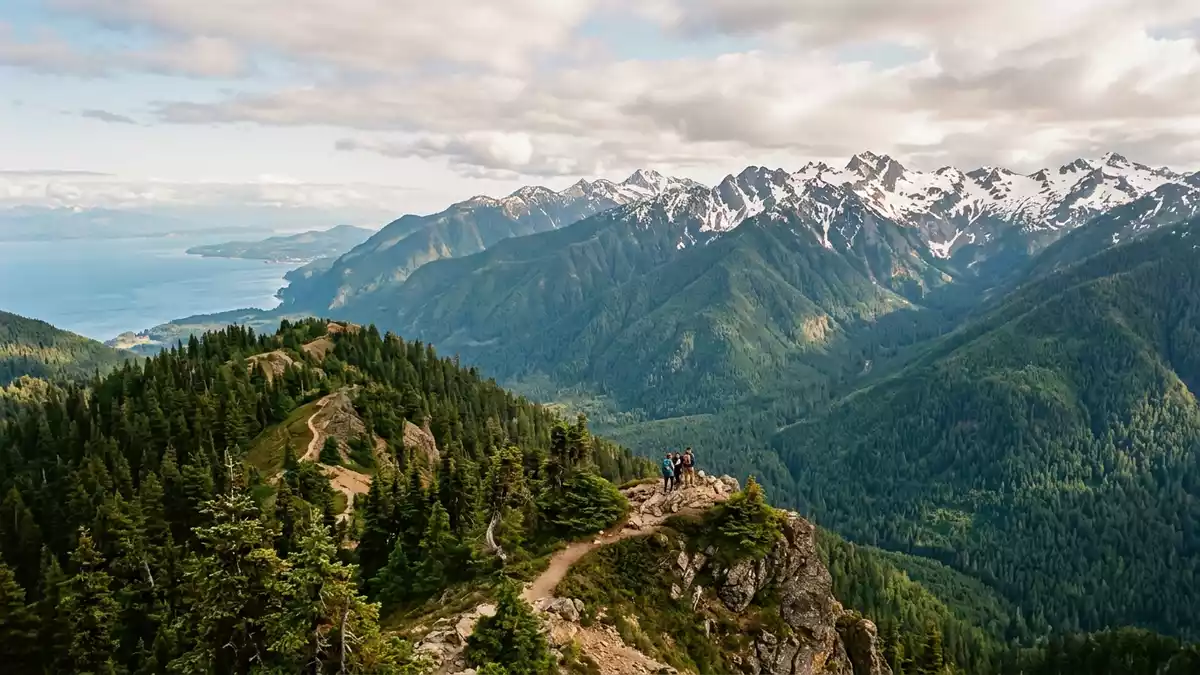
Olympic National Park on Washington’s Olympic Peninsula is one of the rare places where Pacific surf, deep temperate rainforest and glacier?capped mountains all lie within a single protected landscape. Recognised both as a United States national park and through international designations from the 1970s and 1980s, it offers a concentrated view of the natural variety that defines the north?west corner of the country.
From Port Angeles to a protected mountain core
Olympic National Park lies in Jefferson, Clallam, Mason and Grays Harbor counties and is reached most directly from Port Angeles on the Strait of Juan de Fuca. Port Angeles serves as the main gateway town, with the Olympic National Park Visitor Center on Mount Angeles Road at the park’s northern boundary just outside the town centre.Jefferson, Clallam, Mason, and Grays Harbor counties The paved road from this visitor centre climbs from low elevations through forested foothills towards the high country at Hurricane Ridge, where meadows and views of glaciated summits announce the park’s mountainous core.road climbs from Port Angeles
The park was formally established as a national park on 29 June 1938, consolidating earlier forms of protection for the Olympic Mountains and surrounding forests.Date the Park was Established: June 29, 1938 It now covers more than 920,000 acres (over 3,730 km2), a size that allows large tracts of terrain to function as continuous habitat from sea level to the crest of the range.Area: 922,650 acres Within that area almost all of the mountainous interior is managed as wilderness, leaving high ridges and valleys largely free of roads and permanent structures.
World Heritage rainforest, mountains and coast
Olympic National Park is recognised beyond the United States for the variety and condition of its ecosystems. In 1976 it was nominated as an International Biosphere Reserve under UNESCO’s Man and the Biosphere Programme, and in 1981 it was inscribed on the World Heritage List under natural criteria relating to outstanding beauty and ecological processes.Olympic Biosphere Reserve and National ParkInscribed on the World Heritage List These designations highlight three broad ecosystems within the park: glacier?capped mountains, temperate rainforest and a wild Pacific coast.
The mountain zone centres on the Olympic Mountains, whose peaks rise above alpine parklands and remnant glaciers. Mount Olympus is the highest summit, and its icefields feed rivers that descend towards both the Pacific Ocean and the Strait of Juan de Fuca.glacier-capped mountains On the west side of the peninsula, abundant precipitation supports temperate rainforest where Sitka spruce, western hemlock and other conifers reach exceptional sizes and ages, with trunks and branches coated in mosses and ferns.temperate rainforest ecosystem Farther west, a long coastal strip within the park protects headlands, offshore stacks, beaches of sand and shingle, and intertidal zones where sea stars, anemones and other shore life inhabit pools among the rocks.wild Washington coast
Hoh Rain Forest and river valleys
Among the park’s rainforest valleys, the Hoh Rain Forest south of Forks is widely known as a particularly accessible example of temperate rainforest. Mild winters, cool summers and high annual rainfall in this valley support giant conifers whose canopies form dense layers of foliage above a forest floor thick with ferns and fallen logs.Forest of Rain Trails in the Hoh area pass groves where trunks are draped in moss, cross small streams and offer views of the Hoh River flowing through gravel bars and wood?strewn channels.
The Hoh River itself rises high on the glacier?capped slopes of Mount Olympus and descends more than 2,000 m (about 7,000 ft) to the Pacific.Hoh River is born high on glacier-capped Mount Olympus As it travels, it reshapes its course, eroding banks and depositing sediment, and carries fallen logs downstream where they form logjams and pools. Other rainforest valleys in the park, such as the Quinault, Queets and Bogachiel, share similar characteristics of tall conifers, abundant epiphytes and river?cut floodplains, though with different access routes and levels of remoteness.Bogachiel, Quinault, and Queets areas
Visiting Olympic National Park: what travellers from Western Europe should know
- Olympic National Park occupies most of the Olympic Peninsula in the north?west of Washington State, west of Seattle and near the town of Port Angeles. U.S. Highway 101 encircles much of the park and links coastal and inland access points.
- The approach from Port Angeles to Hurricane Ridge follows a paved mountain road with sustained gradients and curves, gaining significant elevation and ending in high?altitude terrain where weather can change quickly.
- Many areas of the park, including rainforest valleys and coastal sections, involve walking on natural surfaces such as earth, roots, stones and driftwood rather than paved paths.
- The official language is English and the currency is the United States dollar.
- Entry requirements depend on your nationality; UK travellers can check the FCDO travel advice at gov.uk/foreign-travel-advice, Irish travellers the Department of Foreign Affairs at ireland.ie.
Searching for Olympic National Park on social platforms
These links open searches for Olympic National Park on each platform.
Frequently asked questions about Olympic National Park
Where is Olympic National Park located?
Olympic National Park is on Washington State’s Olympic Peninsula in the north?western United States, with Port Angeles as its nearest city.
What can visitors expect during a visit?
Visitors encounter mountain vistas, temperate rainforest valleys and Pacific Ocean coastline, with trails and viewpoints giving access to each landscape in turn.
What makes Olympic National Park distinctive?
The park’s combination of glacier?capped mountains, extensive temperate rainforest and protected ocean shore within a single large area gives it a character unusual even among national parks.


