
Olympic National Park’s three worlds of wilderness
Published on 09/15/2026 at 22:42 | Editorial responsibility: Rafael Müller, Editor-in-Chief AD HOC NEWS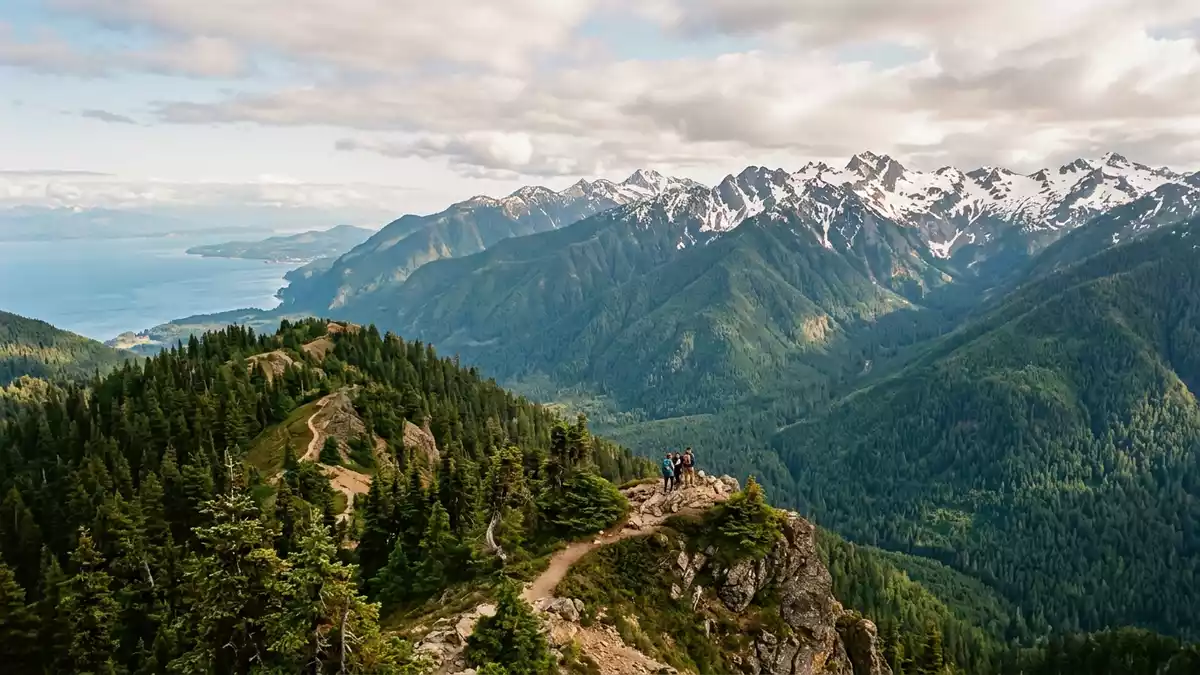
Olympic National Park in Washington brings together glacier?capped mountains, deep temperate rainforests and a wild Pacific shoreline in a single protected landscape west of Port Angeles. Established as a national park on 29 June 1938 under President Franklin D. Roosevelt, it grew from earlier conservation efforts and now covers close to one million acres on the Olympic Peninsula. Much of that area is designated wilderness, giving the park a rare continuity of undeveloped terrain for travellers willing to range beyond the road ends.
From monument to vast mountain park
The federal protection story around Olympic National Park reaches back to the early twentieth century, when the area was first set aside as Mount Olympus National Monument in 1909 under President Theodore Roosevelt.Originally established as a national monument in 1909 Nearly three decades later, legislation signed by Franklin D. Roosevelt on 29 June 1938 redesignated the landscape as Olympic National Park and greatly expanded its boundaries, formally recognising the scale of the mountains, forests and rivers gathered inside.An Act to establish the Olympic National Park
The park now occupies much of the Olympic Peninsula in north?western Washington and lies across several counties, with Port Angeles serving as the nearest city and main service hub on the north side.Port Angeles as nearest city Conservation status extends beyond national designation: the area is recognised as an International Biosphere Reserve within UNESCO’s Man and the Biosphere Programme and also forms part of the UNESCO World Heritage list, reflecting its combination of rugged mountains, extensive forests and relatively intact coastline.Olympic Biosphere Reserve and National Park These overlapping layers of protection frame the park as a long?term reserve of biodiversity and wild scenery within the United States.
Glaciated peaks and subalpine meadows
At the centre of Olympic National Park rise the Olympic Mountains, a compact range of sharp summits and ridges that push up from lowland forests almost directly towards snow and ice. Elevations reach well above 2,000 m (6,562 ft), with Mount Olympus as the central massif carrying several glaciers on its flanks.glacier-capped mountails The high country carries subalpine forests and wildflower meadows in summer, where tree line gives way to open slopes and weathered rock, and a network of rivers radiates outwards from the range in different directions.
The mountains anchor one of the park’s three broad ecosystems: glaciated peaks and subalpine terrain, temperate rainforest and rugged Pacific coastline. This triad of environments inside one boundary is one of the defining features of Olympic National Park.three distinct ecosystems—glaciated mountains, rugged Pacific coastline, and lush temperate forests Eleven major rivers rise in the mountains and flow towards the surrounding lowlands, carving valleys that carry both forest and trail routes, and several are recognised under the United States Wild and Scenic Rivers Act. For travellers from Western Europe, the short horizontal distances between sea level and alpine viewpoints stand out: a journey from tidepools and surf to snow?patched slopes can be traced within one region.
Rainforests, coastline and rare species
Encircling the mountains on the west and south, the park’s temperate rainforests form dense corridors of conifer and broadleaf trees draped with moss and ferns. Valleys such as the Hoh, Queets and Quinault carry these forests in deep bands from the oceanwards flank of the range into the interior, with annual rainfall among the highest recorded in the continental United States.one of the world's most pristine temperate rainforests To the north and west, the park meets the Pacific with headlands, sandy stretches and offshore stacks along more than 70 miles (over 110 km) of largely undeveloped coastline.73 mile Pacific coastline
This combination of forest and shore supports a wide range of plant and animal life. Surveys within the park count dozens of mammal, bird, fish, reptile and amphibian species, alongside a long list of native plant taxa.over 1,200 native plant taxa Several species are endemic to the Olympic Peninsula, including the Olympic marmot and the Olympic torrent salamander, which are naturally restricted to this region.endemic species like the Olympic marmot For visitors, the ecological richness is visible in contrasts along relatively short drives: elk sign on river flats, moss?coated trunks in shaded valleys and seabirds over coastal rocks all sit within the same protected area.
Visiting Olympic National Park: what travellers from Western Europe should know
- Olympic National Park lies on the Olympic Peninsula in north?western Washington, with Port Angeles on the Strait of Juan de Fuca acting as the principal gateway town on the north side.
- Roads reach separate valleys and coastal sections around the edge of the park rather than crossing its interior, so moving between mountains, rainforest and shoreline involves returning to the highway network and driving around the range.
- Terrain on foot varies from short, level paths through lowland forest to steep mountain trails in the high country, and some coastal approaches involve walking along beaches that can be exposed to tide and surf.
- English is the official language in Washington State and the currency across Olympic National Park is the United States dollar.
- Entry requirements depend on your nationality; UK travellers can check the FCDO travel advice at gov.uk/foreign-travel-advice, Irish travellers the Department of Foreign Affairs at ireland.ie.
Searching for Olympic National Park on social platforms
These links open searches for Olympic National Park on each platform.
Frequently asked questions about Olympic National Park
Where is Olympic National Park located?
Olympic National Park occupies much of the Olympic Peninsula in north?western Washington State in the United States, with Port Angeles as the nearest city on its northern edge.
What can visitors expect on a first visit?
Visitors encounter a protected landscape that combines glacier?capped mountains, temperate rainforests and a long stretch of Pacific coastline, connected by approach roads to different valleys and shore sections around the park’s perimeter.
What makes Olympic National Park distinctive among national parks?
The park is distinctive for gathering three major ecosystems within one boundary and for its dual recognition as both a UNESCO World Heritage site and an International Biosphere Reserve, reflecting its ecological diversity and scale.


