
Olympic National Park’s three wild worlds from Port Angeles
Published on 09/05/2026 at 10:53 | Editorial responsibility: Rafael Müller, Editor-in-Chief AD HOC NEWS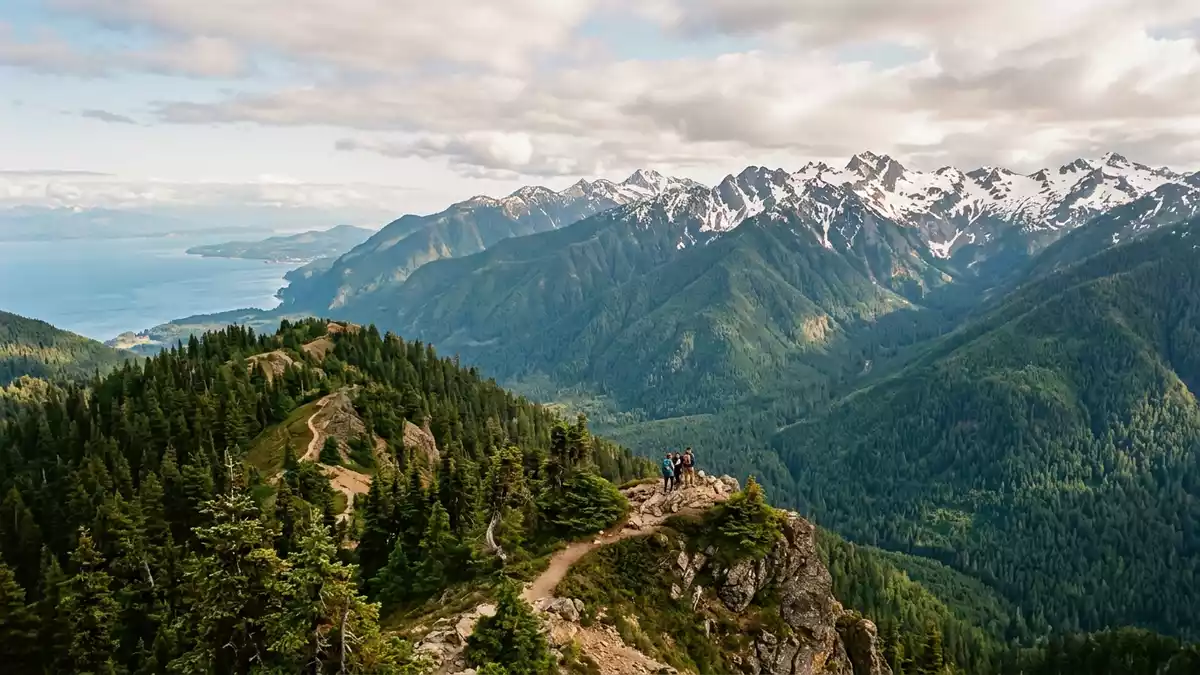
Olympic National Park on Washington’s Olympic Peninsula is a rare place where rugged glacier peaks, temperate rainforest and wild Pacific shore belong to one protected landscape. Its headquarters stand at Port Angeles on the north coast of the peninsula, anchoring a park that was redesignated as a national park in 1938 and later recognised internationally for its ecological diversity.
A protected landscape of mountains, forest and coast
Olympic National Park occupies much of the Olympic Peninsula in north-western Washington State, with its main expanse inland and a separate strip along the Pacific shore.Ecologically diverse area is not a slogan here but a literal description of three distinct ecosystems that share one park boundary. High in the interior, glacier-capped summits rise above alpine meadows and subalpine forests, forming the Olympic Mountains that give the peninsula its shape.
Westward, the park’s Pacific coastal segment gathers beaches, offshore islands, intertidal zones and rocky tide pools along more than 60 miles (around 95 km) of shoreline.Pacific coastal strip and offshore islands form a separate unit, yet they belong to the same protection regime as the mountain core. Between mountains and sea lie valleys where temperate rainforest flourishes, with old-growth stands that have become one of the park’s defining features.
From national monument to World Heritage site
The protected history of Olympic National Park reaches back to 1909, when the area was first set aside as a national monument in the United States.Originally established as a national monument in 1909 The change to national park status came in 1938 under federal legislation, expanding the scope of protection for its forests, wildlife and mountain landscapes.Date the park was established: 29 June 1938 Over decades, the park’s conservation value brought further recognition. In 1976 it was designated an International Biosphere Reserve in UNESCO’s Man and the Biosphere Programme, acknowledging the area as a significant example of ecosystem diversity within a major biogeographical province.
International status deepened with inscription on the World Heritage List in 1981 under natural criteria that highlight both scenic qualities and ongoing ecological processes.Inscribed on the World Heritage List in 1981 Virtually the entire park area was later designated wilderness, reinforcing a management approach that favours natural dynamics over direct intervention.Declared a wilderness area in 1988 For visitors, these layers of formal protection translate into a landscape where old-growth forest, alpine habitats and undeveloped coast are conserved as part of a single, large-scale system.
Rainforest valleys and alpine meadows
One of Olympic National Park’s most striking features lies on the western slopes of its mountain massif, where heavy precipitation supports temperate rainforest centred on rivers such as the Hoh.Old-growth temperate rainforest on the Hoh River In these valleys, conifers including Sitka spruce and western hemlock reach considerable size, with trunks and branches draped in mosses and lichens. The forest floor carries dense carpets of ferns and ground vegetation, while epiphytes cluster on older trees, adding further layers to the canopy structure.
Towards the eastern side of the mountains, precipitation decreases and the vegetation pattern changes. Forests become less dense, giving way to lakes and meadows where fir species are characteristic trees.Eastern slopes with firs and lakes In summer, subalpine meadows carry displays of wildflowers, including endemic species such as Piper’s bellflower and Flett’s violet. Higher still, alpine parklands and glacier surfaces form a stark contrast with the lush rainforest of the western valleys, giving Olympic National Park a vertical sequence of habitats within a compact region.
Visiting Olympic National Park: what travellers from Western Europe should know
- Olympic National Park sits on the Olympic Peninsula in north-western Washington State in the United States, with park headquarters at Port Angeles on the peninsula’s north coast.
- Most road access for private vehicles follows U.S. Highway 101 around the Olympic Peninsula, with side roads leading into valleys, coastal areas and viewpoints on the mountain slopes.
- Public transport reaches several communities and access points around the Olympic Peninsula, including Port Angeles and other towns that act as gateways to different parts of the park.
- Terrain within the park ranges from sea-level beaches and tide pools to high-altitude mountain areas, where trails can involve sustained gradients and extended walking distances.
- The official language is English and the currency is the United States dollar. Entry requirements depend on your nationality; UK travellers can check the FCDO travel advice at gov.uk/foreign-travel-advice, Irish travellers the Department of Foreign Affairs at ireland.ie.
Searching for Olympic National Park on social platforms
These links open searches for Olympic National Park on each platform.
Frequently asked questions about Olympic National Park
Where is Olympic National Park in relation to Port Angeles?
Olympic National Park occupies much of the Olympic Peninsula in north-western Washington, with its main headquarters and visitor centre based at Port Angeles on the peninsula’s northern coast.
What can visitors expect on a first visit to Olympic National Park?
Visitors encounter glacier-capped mountains, temperate rainforest valleys and a separate strip of protected Pacific coastline, with access routes leading from communities such as Port Angeles into these distinct landscapes.
What makes Olympic National Park distinctive among United States national parks?
Its combination of old-growth temperate rainforest, alpine environments and undeveloped ocean shore within one protected area, together with UNESCO Biosphere Reserve and World Heritage designations, gives Olympic National Park a particular standing.


