
Olympic National Park’s three landscapes in one park
Published on 09/16/2026 at 07:17 | Editorial responsibility: Rafael Müller, Editor-in-Chief AD HOC NEWS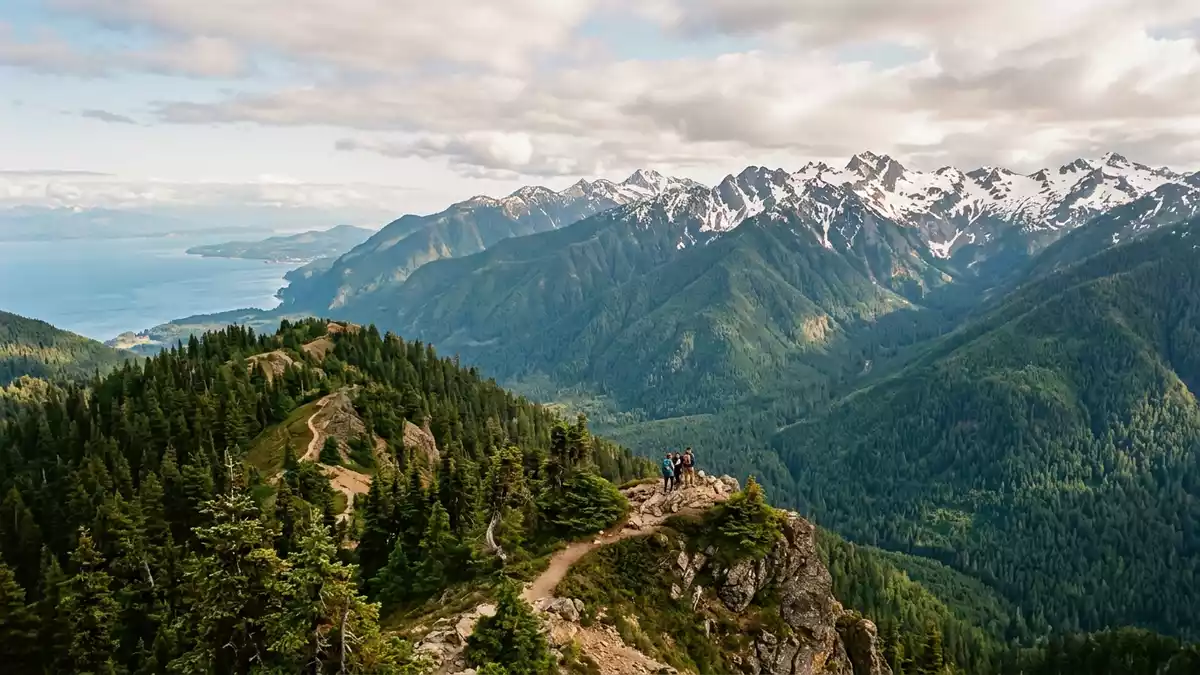
Olympic National Park near Port Angeles brings together a rocky coast, temperate rainforest and glacier-capped mountains in one protected landscape. It was established as a national park in 1938 and later recognised by UNESCO.
Coast, forest and mountain in one sweep
The park occupies much of the Olympic Peninsula in north-western Washington, and Port Angeles sits on its northern edge. Its official boundaries include coast, inland forest and high mountain country, with the Olympic Mountains rising behind the shoreline.
The UNESCO listing describes spectacular coastline, scenic lakes, mountains, glaciers and temperate rainforest. Those elements give the park a rare variety of forms within a single landscape, from sea level to alpine ground and ice.
Olympic National Park and its formal recognitions
The park was first set aside as a national monument in 1909 under Theodore Roosevelt, then redesignated a national park in 1938. It was added to the World Heritage List in 1981, and UNESCO also lists it within the Man and the Biosphere Programme from 1976.
Those designations sit alongside the park’s position on the Olympic Peninsula, where the north-western corner of the American mainland meets the Pacific. The park’s protected area includes old-growth forest, alpine meadows and the coast, with a landscape that changes sharply from one zone to another.
Olympic National Park’s place in the Pacific North-west
For English-speaking visitors based in Western Europe, the park may read as a single destination, but it is better understood as several landscapes joined under one name. The coast, the rain forest and the high mountains each give a different face to the same park, and the transition between them is immediate rather than gradual.
The UNESCO record also notes the park’s geological variety, including rocky islets, canyons, valleys, peaks and cirques shaped by glaciation and erosion. That mix of forms gives the park a strong visual identity even before the forests and shoreline enter the picture.
Visiting Olympic National Park: what travellers from Western Europe should know
- Olympic National Park lies on the Olympic Peninsula in Washington, with Port Angeles on the north side of the park. The park headquarters are in Port Angeles.
- The terrain ranges from shoreline to alpine country. That means sea-level beaches, forest roads, mountain tracks and high ground with snow and ice in the upper elevations.
- Long stretches of coast and forest are part of the park’s character. The Hoh Rain Forest, Lake Crescent and the Pacific shore are among the named areas associated with the park.
- The park is a protected natural area, not a compact city park. Its different zones sit far enough apart to give each part a distinct character.
Searching for Olympic National Park on social platforms
These links open searches for Olympic National Park on each platform.
Frequently asked questions about Olympic National Park
Where is Olympic National Park?
It is in Washington state in the north-western United States, on the Olympic Peninsula. Port Angeles lies on the park’s northern edge.
What does a visit to Olympic National Park involve?
The park combines coastline, rainforest and mountain terrain, so the main experience is variety of landscape rather than a single viewpoint. Trails, shoreline and mountain areas all belong to the same protected whole.
What makes Olympic National Park distinctive?
Its strongest feature is the combination of Pacific coast, old-growth forest and glacier-capped mountains. UNESCO also recognises it as both a World Heritage site and a biosphere reserve.


