
Olympic National Park links Pacific coast and glacier peaks
Published on 09/24/2026 at 12:04 | Editorial responsibility: Rafael Müller, Editor-in-Chief AD HOC NEWS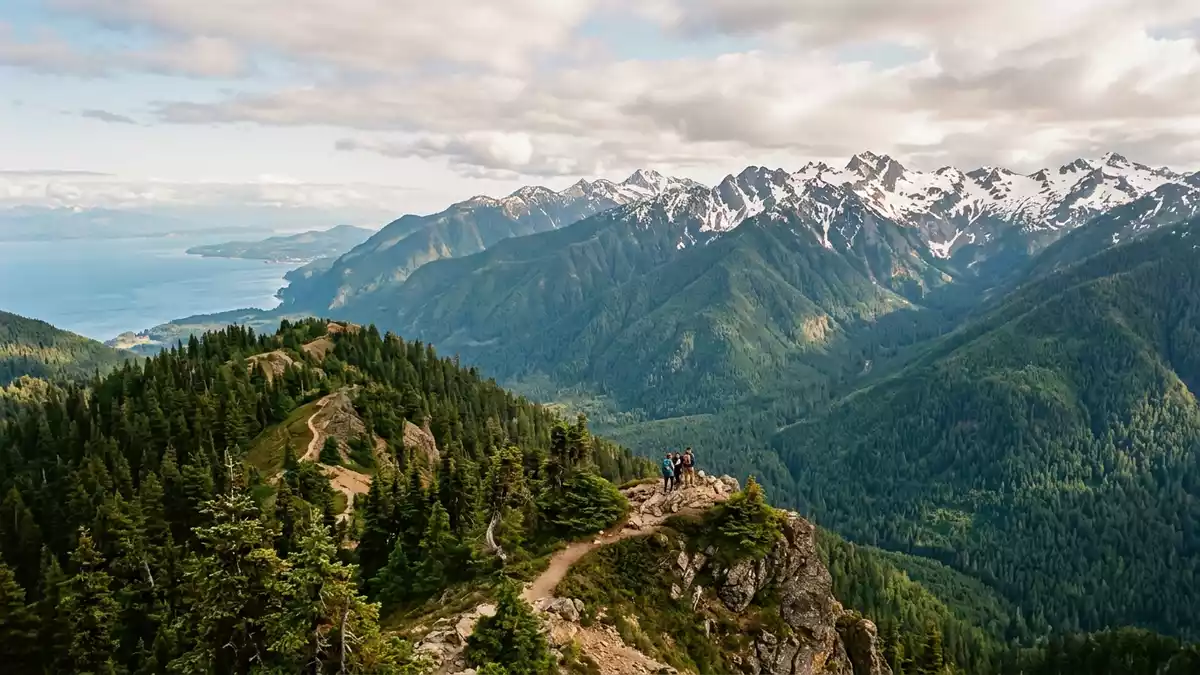
Olympic National Park gathers Pacific beaches, temperate rainforest and glacier-capped mountains within one protected landscape on Washington’s Olympic Peninsula. Established as a national park on 29 June 1938, it extends west and south from Port Angeles across forests, valleys, lakes and alpine terrain.
From Pacific beaches to glacier-capped summits
The park’s defining feature is its range of landscapes. A coastal strip follows the Pacific, with sandy beaches, rocky headlands, offshore sea stacks and intertidal habitat. Inland valleys carry rivers through old-growth forest, while the Olympic Mountains rise towards Mount Olympus, the highest peak in the range at 2,432 m (7,980 ft).
These environments occupy a single protected area of about 373,000 hectares. The park includes more than 100 km of wilderness coastline, deep valleys, alpine meadows and glaciers. The park’s natural ecosystems form a sequence from ocean edge to high mountain.
Rainforest valleys and old-growth trees
The western valleys contain temperate rainforest shaped by heavy Pacific rainfall. The Hoh Rain Forest is the best-known example, with Sitka spruce, western hemlock and western red cedar rising above mosses, ferns and fallen trunks. The forest floor is layered with decaying wood, green vegetation and shallow streams.
Rainforest conditions do not cover every part of Olympic National Park. Forests on the peninsula also include drier stands, while elevation changes the vegetation from lowland trees to subalpine meadows. Rivers drain the Olympic Mountains towards the Strait of Juan de Fuca, inland lakes and the Pacific coast.
Lake Crescent occupies a long glacial valley near the northern edge of the park. Its deep blue water lies among wooded slopes, with the Olympic Mountains visible beyond the lake basin. Lake Crescent’s glacial history belongs to the wider geological story of ice, landslides and erosion across the peninsula.
A protected landscape with a human history
Olympic National Park was first protected as Mount Olympus National Monument on 2 March 1909, during Theodore Roosevelt’s presidency. Congress and President Franklin D. Roosevelt established the national park on 29 June 1938.
The landscape also carries longstanding Indigenous connections. The Makah, Quileute, Hoh, Quinault, Skokomish, Port Gamble S’Klallam, Jamestown S’Klallam and Lower Elwha Klallam maintain cultural relationships with lands and waters within and around the park. Their histories include coastal settlement, river travel, fishing, hunting and the use of mountain and forest resources.
International designations mark the park’s ecological range. UNESCO recognised Olympic National Park as an International Biosphere Reserve in 1976 and inscribed it as a World Heritage Site in 1981. Olympic National Park’s World Heritage status reflects the combination of coastline, rainforest, alpine meadows and glaciated peaks.
The protected area is divided visually into contrasting zones, but the transition between them is part of its identity. A walk beside the Pacific can belong to the same park as a forest trail, a mountain lake or a route beneath glaciers. Olympic National Park is therefore read as a landscape of connected extremes: salt water, enormous trees, clear lakes and high snow-covered rock.
Visiting Olympic National Park: what travellers from Western Europe should know
- Olympic National Park occupies much of the Olympic Peninsula in north-western Washington. Port Angeles lies on the northern side, with U.S. Route 101 linking major approaches around the peninsula.
- Hurricane Ridge Road climbs south from Port Angeles into the Olympic Mountains. Hurricane Ridge reaches 1,598 m (5,242 ft), where alpine meadows and glacier-capped peaks replace lowland forest.
- The park’s landscapes are spread across a large peninsula. The Hoh Rain Forest, Lake Crescent, the Pacific coast and Hurricane Ridge belong to different areas rather than one compact site.
- The official language is English and the currency is the US dollar.
- Entry requirements depend on your nationality; UK travellers can check the FCDO travel advice at gov.uk/foreign-travel-advice, Irish travellers the Department of Foreign Affairs at ireland.ie.
- Conditions on the mountain change with the seasons; the local cable-car operators and alpine clubs provide information.
Searching for Olympic National Park on social platforms
These links open searches for Olympic National Park on each platform.
Frequently asked questions about Olympic National Park
Where is Olympic National Park?
Olympic National Park lies on Washington State’s Olympic Peninsula, west of Seattle and around the mountains, forests and coast near Port Angeles.
What can visitors expect in the park?
Visitors encounter rainforest valleys, old-growth trees, mountain lakes, alpine meadows, glaciers and a Pacific coastline with beaches and rocky headlands.
What makes Olympic National Park distinctive?
Its protected landscape connects ocean shore, temperate rainforest and glacier-capped mountains within one large national park. The park also holds UNESCO Biosphere Reserve and World Heritage designations.


