
Olympic National Park and its four landscapes
Published on 09/23/2026 at 00:04 | Editorial responsibility: Rafael Müller, Editor-in-Chief AD HOC NEWS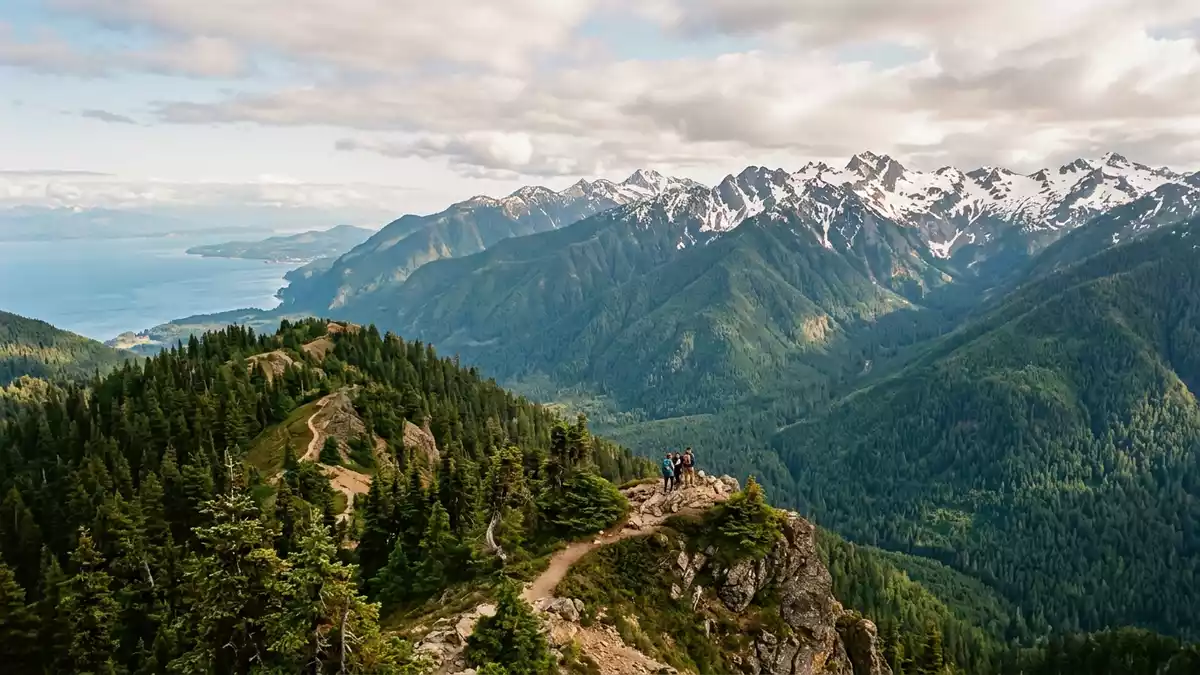
Olympic National Park gathers glacier-capped mountains, temperate rainforest, old-growth forest and Pacific shoreline on Washington’s Olympic Peninsula. From its headquarters in Port Angeles, the park extends across landscapes that change from ocean beaches to alpine meadows and high peaks.
From Pacific beaches to glaciated peaks
Olympic National Park occupies much of the Olympic Peninsula in north-western Washington State. Its protected land includes a Pacific coastal strip, forested valleys, mountain slopes, lakes, rivers and alpine country. The park covers about 373,383 hectares (922,650 acres), with more than 113 km (70 mi) of Pacific coastal beach. the park’s coastal extent is part of the same protected landscape as its inland mountains.
The Olympic Mountains form the central high country. Mount Olympus rises among glaciated ridges, deep valleys and subalpine meadows, while rivers descend towards forests and the coast. The park’s elevation runs from sea level to 2,432 m (7,980 ft), creating marked changes in vegetation across a compact peninsula.
Rainforest, old-growth trees and living rivers
The western valleys contain the Hoh and Quinault rainforests, where heavy precipitation supports moss-covered trunks, dense fern growth and towering conifers. Sitka spruce and western hemlock dominate many lowland areas, while other forests occupy montane and subalpine zones. the park’s forest ecosystems include old-growth stands and temperate rainforest.
Water links the park’s landscapes. Snow and ice feed rivers that cross valleys and forests before reaching the Pacific, while lakes occupy lower basins. Along the coast, rocky headlands, sandy beaches, driftwood and offshore sea stacks create habitats for intertidal wildlife. The shoreline also includes tide pools and stretches of wilderness coast.
A protected landscape with deep cultural connections
Theodore Roosevelt established Mount Olympus National Monument on 2 March 1909. Congress and President Franklin D. Roosevelt established Olympic National Park on 29 June 1938, giving the protected area its present national-park designation. the park’s 1938 designation remains a central date in its history.
Eight tribes maintain traditional associations with lands and waters within Olympic National Park: the Makah, Quileute, Hoh, Quinault, Skokomish, Port Gamble S’Klallam, Jamestown S’Klallam and Lower Elwha Klallam. Archaeological sites record more than 13,500 years of human occupation. The park became an International Biosphere Reserve in 1976 and a UNESCO World Heritage Site in 1981. the peninsula’s tribal connections remain part of the place’s cultural identity.
Visiting Olympic National Park: what travellers from Western Europe should know
- Olympic National Park lies on the Olympic Peninsula west of Seattle. Port Angeles is the park headquarters, and U.S. Highway 101 follows routes around the peninsula.
- The terrain ranges from Pacific beaches to alpine country. Mountain routes include steep ground, rocky surfaces, forest approaches and high-elevation conditions.
- The park’s main landscapes are widely separated across the peninsula. Reaching the coast, rainforest and mountains involves travelling between different access roads.
- The official language is English and the currency is the US dollar.
- Entry requirements depend on your nationality; UK travellers can check the FCDO travel advice at gov.uk/foreign-travel-advice, Irish travellers the Department of Foreign Affairs at ireland.ie.
Searching for Olympic National Park on social platforms
These links open searches for Olympic National Park on each platform.
Frequently asked questions about Olympic National Park
Where is Olympic National Park?
Olympic National Park is on Washington State’s Olympic Peninsula, west of Seattle. Port Angeles lies on the northern side of the peninsula and hosts the park headquarters.
What landscapes can visitors expect?
The park contains Pacific coast, temperate rainforest, old-growth forest, rivers, alpine meadows and glacier-capped mountains. These environments are spread across the peninsula rather than gathered around one compact site.
What makes Olympic National Park distinctive?
Its protected landscape connects ocean shoreline, rainforest and glaciated mountains within one national park. The area also carries a long human history and continuing relationships with eight Olympic Peninsula tribes.


