
Old Trafford, the Theatre of Dreams in Manchester
Published on 09/16/2026 at 21:37 | Editorial responsibility: Rafael Müller, Editor-in-Chief AD HOC NEWS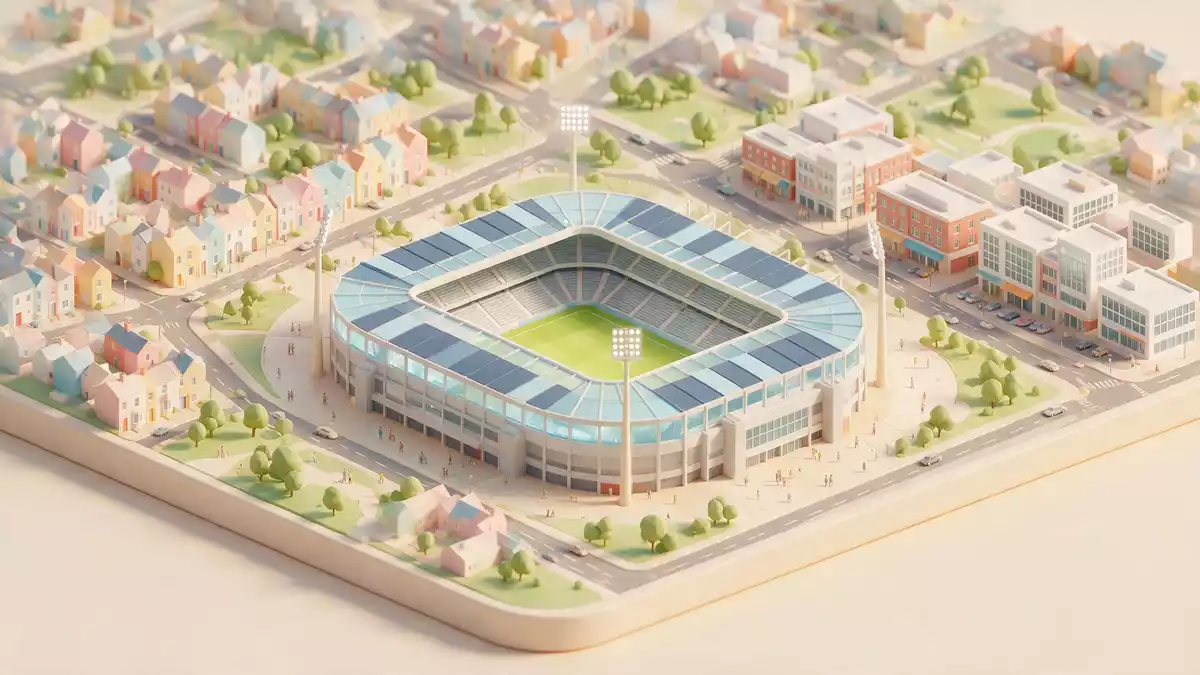
Old Trafford in Manchester brings together a century of football history in a single stadium, its towering stands rising above the streets of Trafford and the nearby canals. Built in the early twentieth century and opened in 1910, it has been the home ground of Manchester United ever since, anchoring the club to a specific place in Greater Manchester rather than an abstract brand. The ground’s scale and its close relationship with the surrounding neighbourhood form the thread that runs through any visit.
The stadium in the fabric of Trafford
Old Trafford stands in the Old Trafford area of the Metropolitan Borough of Trafford, just south-west of central Manchester, where the city’s dense grid begins to loosen into industrial units, housing and waterways. Its address on Sir Matt Busby Way places it among ordinary streets that carry supporters towards a structure whose floodlight masts and cantilevered roofs mark the stadium from far beyond its immediate surroundings.football stadium in the Old Trafford area The name itself comes from this wider district of Trafford, a zone that also includes Old Trafford Cricket Ground, so the stadium’s identity is inseparable from the locality that gave it its title.Old Trafford is an area of Trafford
The site lies roughly two miles (3.2 km) south-west of Manchester city centre, in the historic county of Lancashire, and is threaded into a landscape of rail lines, the Bridgewater Canal and arterial roads that carry traffic towards Salford and beyond.two miles south-west of Manchester city centre Approaching from central Manchester, visitors move through ordinary neighbourhoods before the stadium comes into view, with the main stands and external stair towers stepping up from the street. This transition from everyday urban fabric to vast arena is one of the most striking aspects of Old Trafford’s setting.
Architecture, scale and the Theatre of Dreams
When Old Trafford was constructed between 1909 and 1910, it reflected the ambitions of an era that was beginning to build substantial football grounds rather than simple wooden terraces.construction 1909–1910 The original design is associated with the Scottish architect Archibald Leitch, whose work on stadiums across Britain introduced distinct lattice-steel structures and organised terraces to the game’s architecture. The ground has been reworked and expanded repeatedly since, yet the idea of a continuous bowl of stands enclosing the pitch has remained, giving the interior a coherent, arena-like character.
Old Trafford’s seating capacity is in the mid-70,000s, making it one of the largest dedicated club football stadiums in the United Kingdom and a venue that rivals many national grounds for scale.capacity and opening year Inside, seats rise in tiers from pitchside up to the upper decks, with the corners largely filled in so that the bowl feels continuous rather than fragmented. The stands themselves are named rather than numbered, reflecting the club’s history: the Stretford End behind one goal, the Sir Alex Ferguson Stand along one side, and the Sir Bobby Charlton Stand facing it, among others, each linked with particular eras and personalities in Manchester United’s story.
History on the pitch and in the stands
Manchester United played their first match at Old Trafford in February 1910, an opening fixture against Liverpool that established the stadium as the club’s base.inauguration in February 1910 Over the decades that followed, the ground saw league titles, European nights and domestic cup ties, and it became associated with teams managed by figures such as Sir Matt Busby and Sir Alex Ferguson. The nickname “Theatre of Dreams”, popularised by Bobby Charlton, ties the stadium’s physical presence to the idea of football as spectacle, suggesting that the sweeping stands and enclosed pitch form a stage on which ambitions and narratives unfold.
The record attendance at Old Trafford dates from the late 1930s, when a crowd of over 76,000 watched Wolverhampton Wanderers play Grimsby Town in an FA Cup tie, illustrating how packed the terraces once were before all-seater regulations changed stadium design.record attendance in 1939 Over the twentieth century the ground has been upgraded, with seating replacing standing areas and the roofs and hospitality spaces updated, yet the basic orientation of the pitch and the idea of four principal stands enclosing it have remained constant. A visit therefore connects the present day with more than a century of football history anchored to the same patch of turf.
Visiting Old Trafford: what travellers from Western Europe should know
- Old Trafford stands in the Old Trafford district of Trafford, south-west of central Manchester, with its main approaches converging on Sir Matt Busby Way and nearby arterial roads.
- The stadium interior is arranged as a multi-level bowl, with staircases, ramps and concourses linking the different tiers, so movement between levels involves substantial flights of steps.
- Rail lines and the Metrolink light-rail system run close to the stadium, with stations in walking distance that connect Old Trafford to Manchester Piccadilly and other hubs.
- Old Trafford sits near Old Trafford Cricket Ground and the Bridgewater Canal, so the wider area combines major sports venues with canal-side paths and mixed commercial development.
Searching for Old Trafford on social platforms
These links open searches for Old Trafford on each platform.Frequently asked questions about Old Trafford
Where is Old Trafford?
Old Trafford is a football stadium on Sir Matt Busby Way in the Old Trafford district of Trafford, south-west of Manchester city centre in north-west England.
What can visitors expect on a visit to Old Trafford?
Visitors encounter a large enclosed bowl of stands wrapped around the pitch, with named stands, memorials and concourses that reflect more than a century of Manchester United history.
What makes Old Trafford distinctive among football stadiums?
Its combination of early twentieth-century origins, association with Manchester United and large club-ground capacity gives Old Trafford a particular status as the “Theatre of Dreams”.


