
Old Trafford, Manchester’s red-brick football cathedral
Published on 09/10/2026 at 15:13 | Editorial responsibility: Rafael Müller, Editor-in-Chief AD HOC NEWS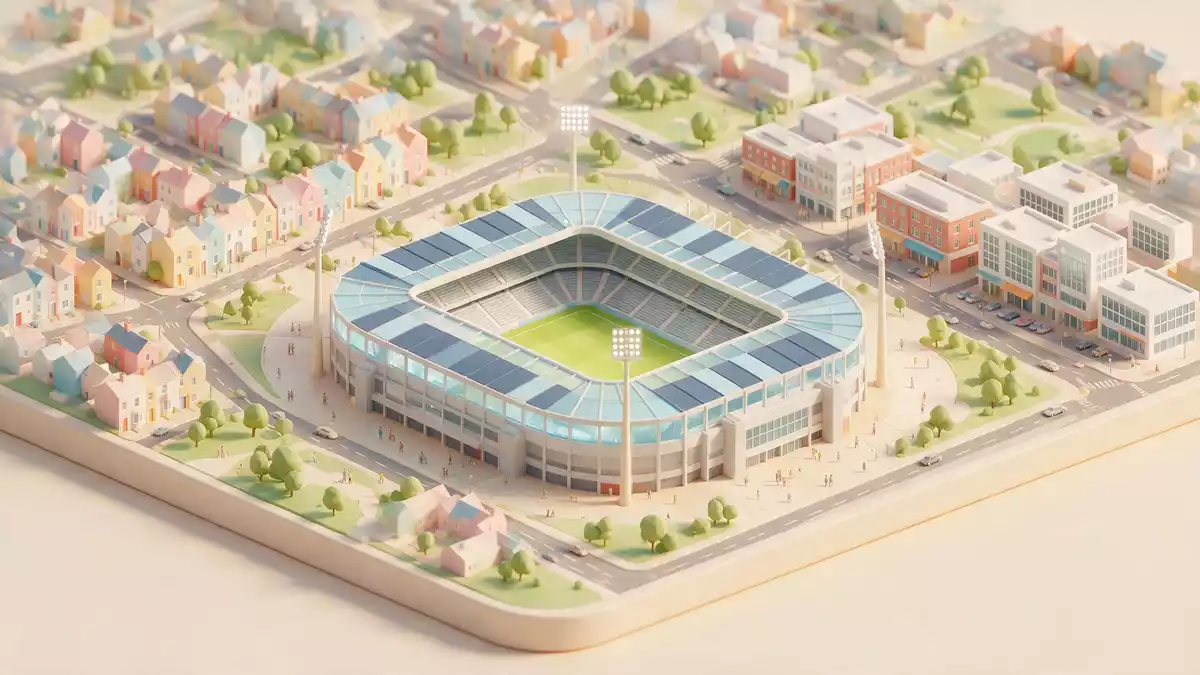
Old Trafford is the historic home stadium of Manchester United in Trafford, just outside central Manchester, a red-brick football ground first opened on 19 February 1910 and designed by Scottish architect Archibald Leitch.first opened on 19 February 1910 From Leitch’s early rectangular bowl with curved corners, Old Trafford has grown into a large all?seater stadium with cantilevered roofs over its stands and a capacity that rose again in the early twenty-first century.
From Leitch’s Edwardian bowl to a post-war ground
When Old Trafford opened in 1910, it replaced Manchester United’s earlier ground at Bank Street and offered a capacity of roughly 80,000, with one covered seated stand and open terraces on the other three sides.capacity of approximately 80,000 The layout followed Archibald Leitch’s characteristic approach to early football grounds, combining a multi-span main stand with terraces wrapped around a near-rectangular pitch.multi-span stand
Old Trafford suffered severe bomb damage during the Second World War, when German air raids hit the stadium in March 1941 and left it unusable for several years.bomb damage in March 1941 Manchester United played home matches at Maine Road during this period, returning to a rebuilt Old Trafford in August 1949 with a reconstructed main stand and roofs added as materials became available in the early 1950s.returned home in August 1949
The cantilevered era and expansion into a modern arena
In preparation for matches at the 1966 World Cup, Old Trafford gained a striking two-tier cantilevered stand along the United Road side, bringing seating for around 10,000 spectators plus standing room for a similar number.two-tiered cantilevered stand This development began a wider plan to transform the ground with cantilevered roofs that removed supporting columns from sightlines and gradually extended around the stadium during the 1970s and 1980s.
The conversion of Old Trafford to an all-seater stadium in the early 1990s initially reduced capacity to about 44,000, followed by a sequence of major expansions that lifted it again.reduced capacity to approximately 44,000 A three-tier North Stand completed in 1996, extra tiers on the East and West stands around 2000, and new seating in the northern quadrants in 2006 brought capacity to more than 70,000 and gave Old Trafford its present enveloping form.three-tier North Stand completed in 1996 The North Stand was renamed the Sir Alex Ferguson Stand in 2011, marking the long tenure of the club’s manager whose era coincided with much of this expansion.North Stand renamed Sir Alex Ferguson Stand in 2011
Theatre of Dreams: layout, pitch and surroundings
Old Trafford stands in the borough of Trafford, south-west of central Manchester, close to the industrial and commercial area of Trafford Park and linked to the city by road and public transport routes.stadiums/eng/old_trafford The pitch follows standard modern dimensions at around 105 m (344 ft) by 68 m (223 ft), set within a bowl of four main stands: the Sir Alex Ferguson Stand to the north, the West Stand including the Stretford End behind one goal, the East Stand opposite, and the South Stand along the touchline.pitch dimensions at Old Trafford
The stadium’s nickname “The Theatre of Dreams”, widely associated with Bobby Charlton, reflects both its long footballing history and the size of its all-seater arena, which reached more than 75,000 seats after the 2006 corner expansions.“The Theatre of Dreams” Inside, tiers of red seating rise above the grass pitch, framed by cantilevered roofs and large scoreboards, while outside the ground’s mixture of brick, concrete and steel sits among urban streets and rail lines that connect it with wider Greater Manchester.
Visiting Old Trafford: what travellers from Western Europe should know
- Old Trafford stands in Trafford to the south-west of central Manchester and is reached by urban rail, tram and road links from the city and from Manchester Airport.
- The stadium interior is arranged over several tiers of seating, with staircases and concourses connecting the levels and an approach on foot from surrounding streets.
- Old Trafford lies close to Trafford Park’s industrial and commercial area and the Bridgewater Canal, so the wider setting mixes stadium structures with water, warehouses and office buildings.
- The official language is English and the currency is the pound sterling.
Searching for Old Trafford on social platforms
These links open searches for Old Trafford on each platform.Frequently asked questions about Old Trafford
Where is Old Trafford located?
Old Trafford is in the borough of Trafford, south-west of central Manchester in England, close to Trafford Park and linked by road and public transport.
What should visitors expect on a visit to Old Trafford?
Visitors encounter a large football stadium with tiered red seating around a grass pitch, concourses and staircases, and views over an urban landscape of canals and commercial buildings.
What makes Old Trafford distinctive among football grounds?
Old Trafford combines Archibald Leitch’s early twentieth-century origins, post-war reconstruction and late twentieth-century cantilevered expansions into a single stadium long associated with Manchester United and “The Theatre of Dreams”.


