
Old Trafford, Manchester’s classic bowl of football history
Published on 09/14/2026 at 06:18 | Editorial responsibility: Rafael Müller, Editor-in-Chief AD HOC NEWS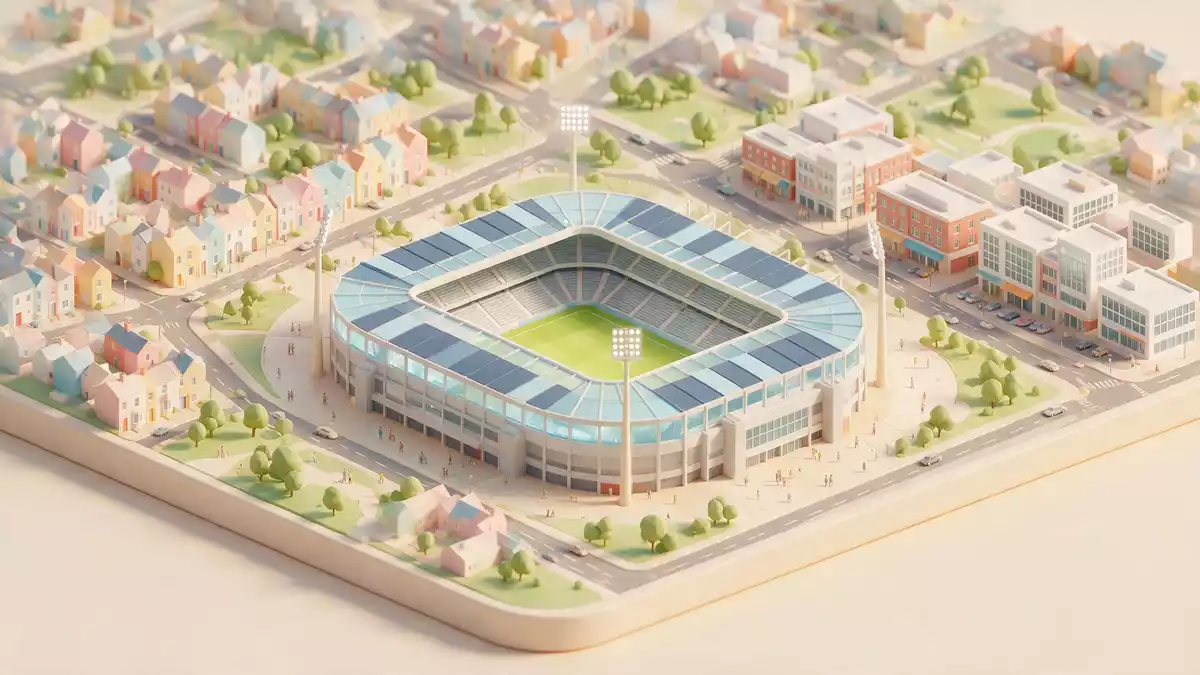
Old Trafford in Manchester is a broad, low football bowl where Manchester United have played their home matches since 1910, tying generations of club history to one arena.Opened on 19 February 1910, it was laid out under the supervision of Scottish stadium architect Archibald Leitch and built with the Manchester practice Brameld and Smith.Original stadium built 1909
The Theatre of Dreams: a classic early twentieth-century stadium
Old Trafford stands in the Trafford district of Greater Manchester, a short distance south-west of central Manchester, on Sir Matt Busby Way.Trafford in Greater Manchester From the outside, the stadium reads as a continuous rectangle with curved corners, with its stands wrapped around the pitch rather than broken into isolated blocks.A basic rectangle with curved corners The south side, long associated with the main stand, is lined by tiers rising above the road, while the north side carries the largest stand of the ground, known in recent decades as the Sir Alex Ferguson Stand.Opening 1910 and Sir Alex Ferguson Stand
When Old Trafford opened in 1910, its capacity stood at around 80,000 spectators, a figure reached with a combination of a seated main stand and earth-bank terraces around the other sides.Capacity approximately 80,000 The first match on 19 February 1910 brought Liverpool to Manchester United’s new home, ending in a 4–3 win for the visitors, and the ground soon gained the nickname “The Theatre of Dreams” as domestic and international fixtures accumulated.First game against Liverpool in 1910 The rectangular plan with its sweeping sides let Leitch and his collaborators frame the pitch with a continuous crowd, a central idea of early twentieth-century British stadium design.
War damage, rebuilding and the shift to all-seater football
During the Second World War, Old Trafford suffered heavy bombing damage and was used as a military depot, leading to a substantial post-war rebuild that reopened the ground in 1949.Heavily damaged in March 1941 The reconstruction changed the detailing but kept the basic bowl plan, and by the 1950s floodlighting and roofing projects were underway, allowing evening matches and covered stands around much of the pitch.Floodlighting completed in 1957 Through the 1960s, 1970s and early 1980s, capacity fluctuated as seating spread across the stands and new structural work was completed, reaching 56,385 by 1985.
The conversion of Old Trafford to an all-seater stadium in the early 1990s dropped the capacity to approximately 44,000, the lowest in its post-war history, and marked the end of standing terraces on the ground.Conversion to all-seater reduced capacity The subsequent expansions raised capacity again, first through work completed by 1996 that brought the figure to around 58,000 and the construction of a large north stand,Capacity milestones then through further tiers on the east and west sides and corner infill projects at the north-east and north-west quadrants.Quadrants added in 2006 These phases produced the present arrangement of steep, multi-tiered stands around each touchline and goal, while keeping the pitch at the heart of a single enclosure.
Scale, atmosphere and the experience of a matchday bowl
Old Trafford’s modern capacity lies in the mid-70,000 range, placing it among the largest football grounds in England, second only to Wembley Stadium when club and national venues are considered together.Second-largest football stadium in the United Kingdom The seating wraps around all four sides, with tiers rising above one another rather than sitting as isolated blocks; in the north stand, the stack of levels gives a sense of height, while the Stretford End behind one goal has long been associated with intense home support.Capacity figure and club tenant The bowl configuration means that wherever a spectator sits, the view is framed by banks of red seats and the green of the pitch, with the roof structures setting a visible edge to the arena.
Record attendances at Old Trafford date back to the era of terraces, with more than 76,000 spectators recorded for an FA Cup semi-final between Wolverhampton Wanderers and Grimsby Town on 25 March 1939.Record attendance in 1939 Later, in the all-seater era, attendances for Manchester United matches have reached over 76,000 for fixtures such as the league game against Blackburn Rovers in 2007.Highest all-seater attendance Over more than a century, domestic league games, FA Cup ties and European nights have shared the same basic setting: a rectangular pitch enclosed by high stands, with the Theatre of Dreams nickname reflecting the club’s achievements on this ground.
Visiting Old Trafford: what travellers from Western Europe should know
- Old Trafford stands in Trafford, south-west of Manchester city centre, with its main approaches along Sir Matt Busby Way and Chester Road in Greater Manchester.
- The stadium interior is reached by staircases and ramps rising to the seating tiers, with climbs to higher levels involving multiple flights of steps inside the stand structures.
- Old Trafford lies near the Manchester Ship Canal and the Salford Quays area, placing the ground within a wider landscape of regenerated docks and modern cultural venues.
- The official language is English and the currency is the pound sterling.
Searching for Old Trafford on social platforms
These links open searches for Old Trafford on each platform.
Frequently asked questions about Old Trafford
Where is Old Trafford and who plays there?
Old Trafford is in the Trafford district of Greater Manchester on Sir Matt Busby Way, and it is the long-standing home stadium of Manchester United Football Club.
What should visitors expect inside the stadium?
Visitors enter a single enclosed bowl of steep stands around a natural grass pitch, with staircases, concourses and tiers laid out along each of the four sides.
What makes Old Trafford distinctive among football grounds?
Old Trafford combines its early twentieth-century rectangular bowl layout with a capacity in the mid-70,000 range and more than a century of continuous Manchester United history.


