
Old Trafford and the football ground that became Manchester’s landmark
Published on 09/22/2026 at 16:05 | Editorial responsibility: Rafael Müller, Editor-in-Chief AD HOC NEWS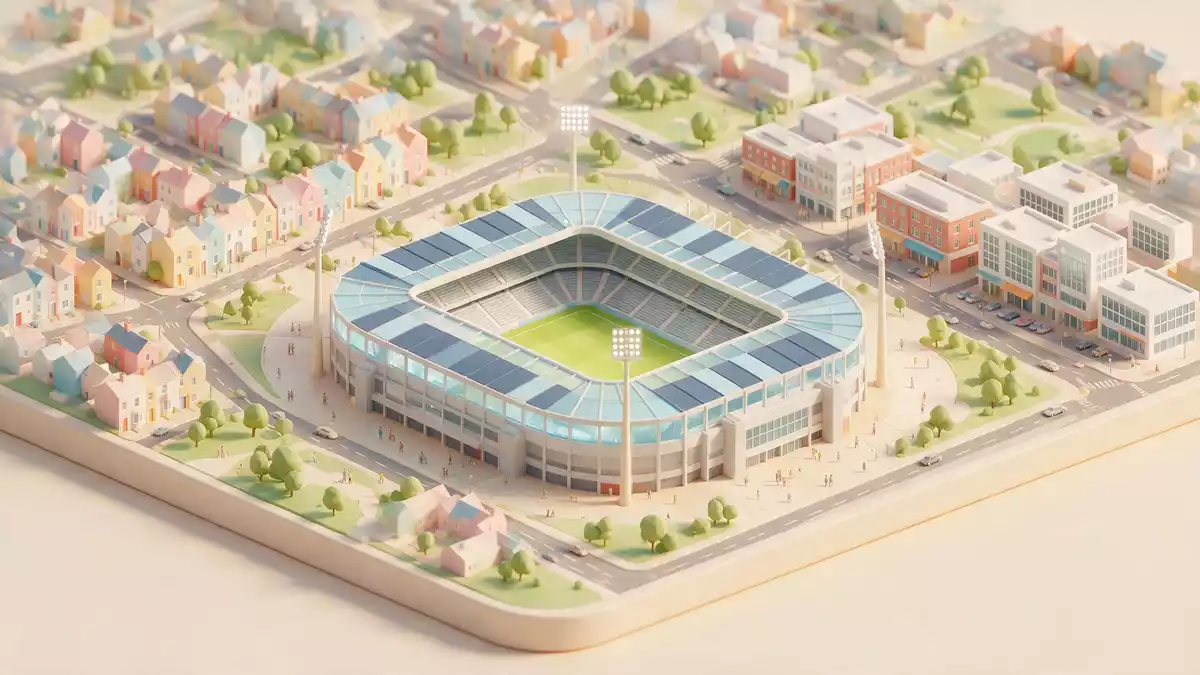
Old Trafford is the football stadium of Manchester United, set beside the Bridgewater Canal in the metropolitan borough of Trafford. Its stands form a large enclosed bowl, with red seating, a broad roofline and the pitch at the centre. The stadium’s identity is inseparable from the club, whose history has made this ground a major cultural landmark in north-west England.
Old Trafford began with a stadium built for scale
The stadium opened in 1910, after a design by the Scottish architect Archibald Leitch. Leitch shaped many British football grounds, and his work at Old Trafford established the basic arrangement of stands around a central playing field. The original stadium included a covered main stand and large open terraces.
Old Trafford was built near the Manchester Ship Canal and the Bridgewater Canal, in an area connected with the city’s industrial expansion. Brick, steel and concrete define its architectural language. The ground belongs to the period when football stadiums developed from modest local enclosures into large civic spaces.
Its early form changed through additions, rebuilding and adaptation. The stadium was damaged during the Second World War and football returned there in 1949. The post-war ground became the setting for Manchester United’s domestic and European history, while successive redevelopment shaped the stands familiar to visitors.
Four stands, one footballing landscape
Old Trafford’s seating bowl is organised around named stands rather than a single uniform façade. The Sir Alex Ferguson Stand occupies the north side. The East Stand and West Stand face one another behind the goals, while the South Stand contains the main entrance and the club’s executive areas.
The Sir Bobby Charlton Stand carries the name of the England international and Manchester United player who died in 2023. The stand names connect the physical stadium with figures from the club’s past. Statues outside the ground include Sir Matt Busby, Sir Alex Ferguson and the “United Trinity” of George Best, Denis Law and Bobby Charlton.
Inside, the pitch is surrounded by steep tiers of red seats and large roof structures. The lower edge of the bowl sits close to the playing surface, while the upper tiers rise behind it. The arrangement makes the stadium readable as a football ground from every approach: stands, turnstiles, floodlights and club signage are all part of the same visual vocabulary.
Old Trafford also contains the Manchester United Museum and Stadium Tour. Exhibits present club shirts, trophies, photographs and objects associated with players and managers. The tour links public displays with parts of the stadium, including the players’ tunnel, the dressing-room area and seating close to the pitch.
From railway suburb to football destination
Old Trafford stands in Trafford, south-west of central Manchester. The district includes the stadium, Lancashire County Cricket Club’s ground and the former Manchester United training area at the Cliff farther north. The football stadium’s name is therefore tied to a wider sporting landscape.
The club’s move to the site in 1910 gave Manchester United a permanent home on the southern side of the city. The ground’s history includes league football, European matches, domestic cup finals and international fixtures. Wembley remains England’s national stadium, but Old Trafford has hosted major football occasions of its own, including matches during UEFA Euro 1996.
The stadium is also connected with the Munich air disaster of 1958. Manchester United players and staff were among those killed when the team’s aircraft crashed in Bavaria after a European match. Memorials around Old Trafford preserve the names of those who died, including a plaque and a clock associated with the disaster.
The ground’s cultural meaning extends beyond individual matches. It is a place of remembrance, local employment, international sport and family ritual. A visit combines the physical scale of a large stadium with displays that trace Manchester United’s development from a late Victorian football club into a global sporting institution.
Visiting Old Trafford: what travellers from Western Europe should know
- Old Trafford lies in Trafford, south-west of Manchester city centre, beside the Bridgewater Canal and close to Lancashire County Cricket Club. The Metrolink tram network serves the Old Trafford area.
- The stadium is reached through turnstiles, concourses, stairways and tiered seating. Upper levels involve substantial steps, and accessible routes are arranged separately within the ground.
- The Manchester United Museum and Stadium Tour occupies part of the stadium complex. The route includes club displays, the players’ tunnel and views of the pitch.
- Manchester Piccadilly and Manchester Victoria are the city’s principal railway stations. Manchester Airport is south of the stadium, while the A56 Chester Road runs beside the ground.
Searching for Old Trafford on social platforms
These links open searches for Old Trafford on each platform.
Frequently asked questions about Old Trafford
Where is Old Trafford?
Old Trafford is in Trafford, south-west of Manchester city centre. The stadium stands beside the Bridgewater Canal and near Lancashire County Cricket Club.
What can visitors see at Old Trafford?
The stadium contains the Manchester United Museum and Stadium Tour, with club exhibits and access to areas connected with matchday operations.
What makes Old Trafford distinctive?
Its red seating bowl, named stands, memorials and long association with Manchester United make Old Trafford both a working football ground and a site of sporting memory.


