Old Trafford and the evolving Theatre of Dreams
Published on 09/11/2026 at 21:26 | Editorial responsibility: Rafael Müller, Editor-in-Chief AD HOC NEWS
Old Trafford is the football stadium in the Old Trafford area of Greater Manchester where Manchester United have played their home matches since 1910, a ground whose changing scale and structure tell the story of English football’s evolution over more than a century.
From Archibald Leitch’s original ground to a modern all-seater stadium
Old Trafford was constructed between 1909 and 1910 as the new home of Manchester United, with the first match at the stadium taking place on 19 February 1910 in a game against Liverpool.the first game at Old Trafford The stadium’s early design is attributed to the Scottish architect Archibald Leitch, whose work also shaped other major British grounds of the period.Archibald Leitch In its inaugural form, Old Trafford reflected the Edwardian era’s approach to football architecture, with substantial stands framing the pitch and space for large crowds.
The stadium has undergone repeated alterations and extensions since that opening season, responding to changing expectations of comfort and safety. After decades during which terraces accommodated standing spectators around much of the ground, Old Trafford became an all-seater stadium following the recommendations of the Taylor Report into British football grounds published in 1990.the Taylor Report Additional tiers have been added to several sections of the stadium in the years since, increasing capacity while retaining the basic rectangular bowl form focused tightly on the pitch.
The Theatre of Dreams and the stadium’s famous stands
Old Trafford is widely known by the nickname “Theatre of Dreams”, a phrase that encapsulates the association between the ground and Manchester United’s successes in domestic and European football.its nickname is Theatre of Dreams The layout is defined by four principal stands, each aligned to one side of the pitch and carrying its own history and identity in club culture. Together they create a steep-sided interior focused firmly on the rectangular playing surface, giving spectators clear views across the grass and towards the goals at either end.
The North Stand, East Stand, South Stand and West Stand enclose the pitch and are linked at the corners by seating that has been raised in stages over the decades. The record attendance at Old Trafford was set in March 1939, when more than 76,000 spectators watched an FA Cup tie between Wolverhampton Wanderers and Grimsby Town, a figure that underlines the scale of the arena even in the era of standing terraces.record attendance in 1939 In its present form the cantilever roofs over the stands cover the seating without the need for columns interrupting sightlines, enhancing the sense of a continuous bowl of spectators surrounding the pitch.cantilever roof over all four stands
Old Trafford’s location in Greater Manchester
The stadium stands on Sir Matt Busby Way in the Old Trafford district of the Metropolitan Borough of Trafford, in Greater Manchester, England.Sir Matt Busby Way The area lies to the south-west of Manchester’s traditional city centre, in a corridor of mixed commercial and residential development that is also home to Old Trafford Cricket Ground. The football stadium and the cricket ground sit at opposite ends of local roads that have become strongly associated with sport, making this part of Greater Manchester one of the city region’s most concentrated clusters of major sporting venues.Old Trafford is an area of Trafford
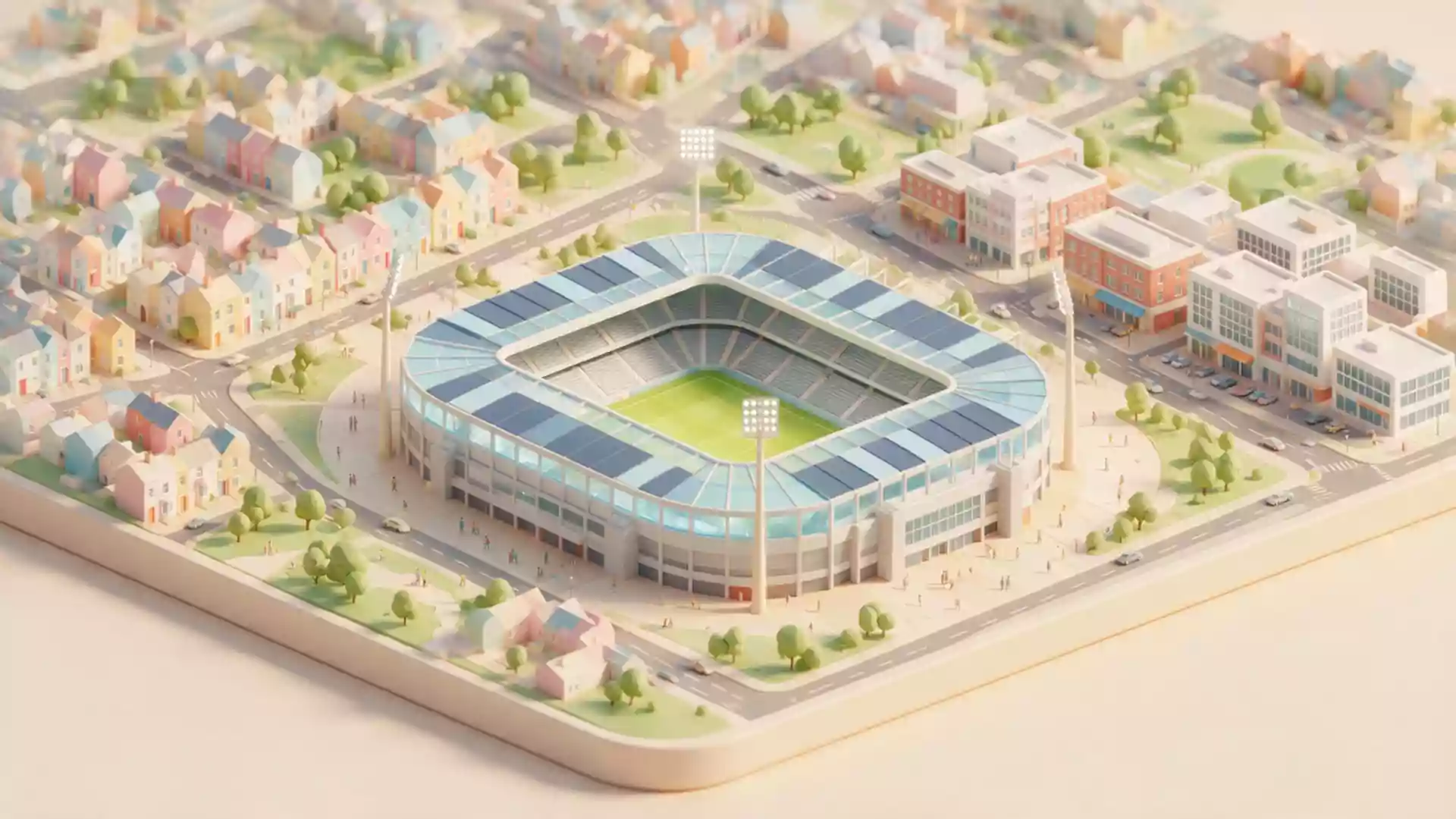
Manchester United’s ground is easily recognised in aerial views by the compact rectangle of the pitch surrounded by the tall stands and cantilever roofs, with railway lines and main roads framing the site. The stadium’s address places it within the postcode M16 0RA, a detail that appears across club material and transport guides.Old Trafford, Sir Matt Busby Way Just beyond the stadium perimeter, the surrounding streets carry a mix of matchday facilities and everyday services, and the nearby Metrolink stops connect the ground with central Manchester and other parts of the city region.
Visiting Old Trafford: what travellers from Western Europe should know
- Old Trafford stands on Sir Matt Busby Way in the Old Trafford district of Trafford, south-west of central Manchester, and is reached by urban roads and rail lines serving the wider city.
- The stadium interior is structured around tiers of seating rising above the pitch, with staircases, concourses and gangways linking the different levels; reaching the upper tiers involves climbing long flights of steps.
- Metrolink light-rail services link Old Trafford station with major rail hubs such as Manchester Piccadilly, providing an overground route that delivers visitors within walking distance of the stadium.
- The official language is English and the currency is the pound sterling.
Searching for Old Trafford on social platforms
These links open searches for Old Trafford on each platform.
Frequently asked questions about Old Trafford
Where is Old Trafford located within Greater Manchester?
Old Trafford stands on Sir Matt Busby Way in the Old Trafford district of the Borough of Trafford, south-west of Manchester’s city centre in north-west England.
What can a visitor expect on a first visit to Old Trafford?
A visitor encounters a large rectangular football stadium with steep tiers of seating surrounding the pitch, cantilever roofs over the stands and concourses connecting different levels.
What makes Old Trafford distinctive among football stadiums?
Old Trafford is closely associated with Manchester United’s history, carries the nickname “Theatre of Dreams” and combines Archibald Leitch’s early twentieth-century design roots with extensive later expansion.