
Old San Juan: stone walls, blue streets and layered history
Published on 09/07/2026 at 18:07 | Editorial responsibility: Rafael Müller, Editor-in-Chief AD HOC NEWS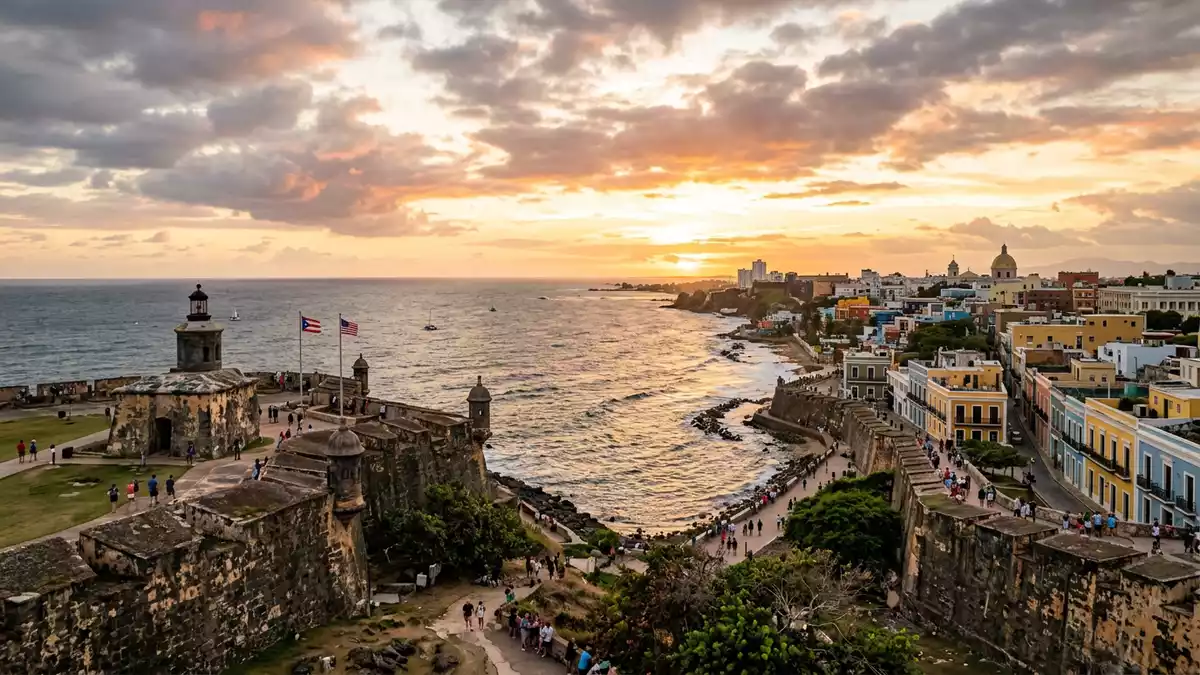
Old San Juan in San Juan, Puerto Rico is a compact historic district where massive stone fortifications meet narrow cobbled streets and brightly painted townhouses. The quarter occupies the north-western part of the small San Juan Islet and preserves a layered Spanish colonial townscape dating back to the early sixteenth century.historic district on the San Juan Islet
Stone ramparts and ocean-facing forts
The most striking feature of Old San Juan is the ring of fortifications that once defended the approach to San Juan Bay. Along the north-western tip of the islet, Castillo San Felipe del Morro, known locally as El Morro, rises in multiple tiers of stone terraces and bastions above the Atlantic surf.Castillo San Felipe del Morro in Old San Juan Its walls and ramparts form a stepped profile, with cannon positions looking out towards the open sea and inward across a broad grassy esplanade that separates the fort from the street grid of the old town.
Further east, the fortifications continue with Castillo San Cristóbal, an extensive landward fortress whose angled outer defences protected the city from attack across the main island.San Juan National Historic Site Together with the surviving city walls and bastions, these forts form the core of the San Juan National Historic Site, managed as a single historic ensemble. The fortification system has been recognised as part of the World Heritage inscription that includes La Fortaleza, the official residence of the governor, and sections of the surrounding walls.UNESCO recognition of the Old San Juan fortifications
Colonial streets, churches and townhouses
Beyond the ramparts, Old San Juan unfolds as a grid of streets paved with dark cobblestones and lined with tightly packed buildings whose façades carry balconies, shutters and ornamental ironwork. The district developed as the urban centre of the Spanish colony from the early sixteenth century, and many structures date from the sixteenth and seventeenth centuries.sixteenth- and seventeenth-century Spanish colonial buildings Residential houses typically rise two or three storeys, with ground-floor doorways opening directly onto the pavement and upper floors extending over the street with projecting balconies.
Religious and civic architecture punctuates this domestic fabric. The Cathedral of San Juan Bautista, one of the oldest cathedrals in the Americas, stands within the district as a substantial stone church with a prominent façade and interior chapels.San Juan Cathedral and other early buildings Nearby, the Church of San José presents an earlier Gothic-influenced profile, while La Casa Blanca, originally associated with Juan Ponce de León, occupies a plot within the historic street grid as a substantial early residence. Squares such as Plaza Colón and the spaces around the San Juan City Hall provide open plazas framed by arcades and façades, with fountains and monuments marking their centres.architectural styles and plazas in Old San Juan
Layers of heritage and everyday life
Old San Juan is formally recognised as a Puerto Rico Registered Historic Zone and a National Historic Landmark District listed on the United States National Register of Historic Places.National Historic Landmark District designation The historic district has also been described as the oldest continuously inhabited urban centre in Puerto Rico and the oldest historic colonial district under United States jurisdiction, reflecting its continuous role as a settled town since the early sixteenth century.oldest continuously inhabited settlement Founded in 1521 by Spanish conquistador Juan Ponce de León as a fortified capital, the area retains this dual character of stronghold and town, with military structures and domestic streets sharing the small islet.foundation by Juan Ponce de León in 1521
Within this protected framework, Old San Juan functions as a mixed residential and commercial quarter. Historic barracks such as the Ballajá complex have been adapted to cultural uses, including museums and cultural centres, while former casinos and civic halls host events. Shops, cafés and restaurants occupy the ground floors of many townhouses, opening onto the narrow pavements and small plazas. The result is a district where heritage designations coexist with everyday activity, and where architectural styles ranging from Gothic and Renaissance to Baroque, Art Nouveau and Art Deco can be traced in façades, cornices and detailing along streets that remain walkable in scale.range of architectural typologies and defensive stone walls
Visiting Old San Juan: what travellers from Western Europe should know
- Old San Juan occupies the north-western part of the San Juan Islet on the northern coast of Puerto Rico and is connected to the main island by road bridges.
- The historic district is largely walkable, with cobbled streets, some steep gradients and sections of the fortifications reached by stairways and ramps inside the forts.
- Castillo San Felipe del Morro and Castillo San Cristóbal form part of the San Juan National Historic Site, managed by the U.S. National Park Service, and are reached on foot from within the old town.
- The official languages are Spanish and English and the currency is the United States dollar (USD).
- Entry requirements depend on your nationality; UK travellers can check the FCDO travel advice at gov.uk/foreign-travel-advice, Irish travellers the Department of Foreign Affairs at ireland.ie.
Searching for Old San Juan on social platforms
These links open searches for Old San Juan on each platform.
Frequently asked questions about Old San Juan
Where is Old San Juan located?
Old San Juan occupies the north-western triangular section of the San Juan Islet on the northern coast of Puerto Rico and forms the historic district of the city of San Juan.
What should visitors expect when walking through Old San Juan?
Visitors encounter cobbled streets, closely spaced townhouses, churches and plazas framed by historic architecture, with substantial stone fortifications and ocean views at the edges of the district.
What makes Old San Juan distinctive among historic districts?
Its combination of early Spanish colonial urban fabric, large-scale coastal forts, continuous habitation since the sixteenth century and formal protection as a National Historic Landmark District together make Old San Juan distinctive.


