
Okinawa Churaumi Suizokukan and its vast Kuroshio Sea tank
Published on 09/12/2026 at 12:00 | Editorial responsibility: Rafael Müller, Editor-in-Chief AD HOC NEWS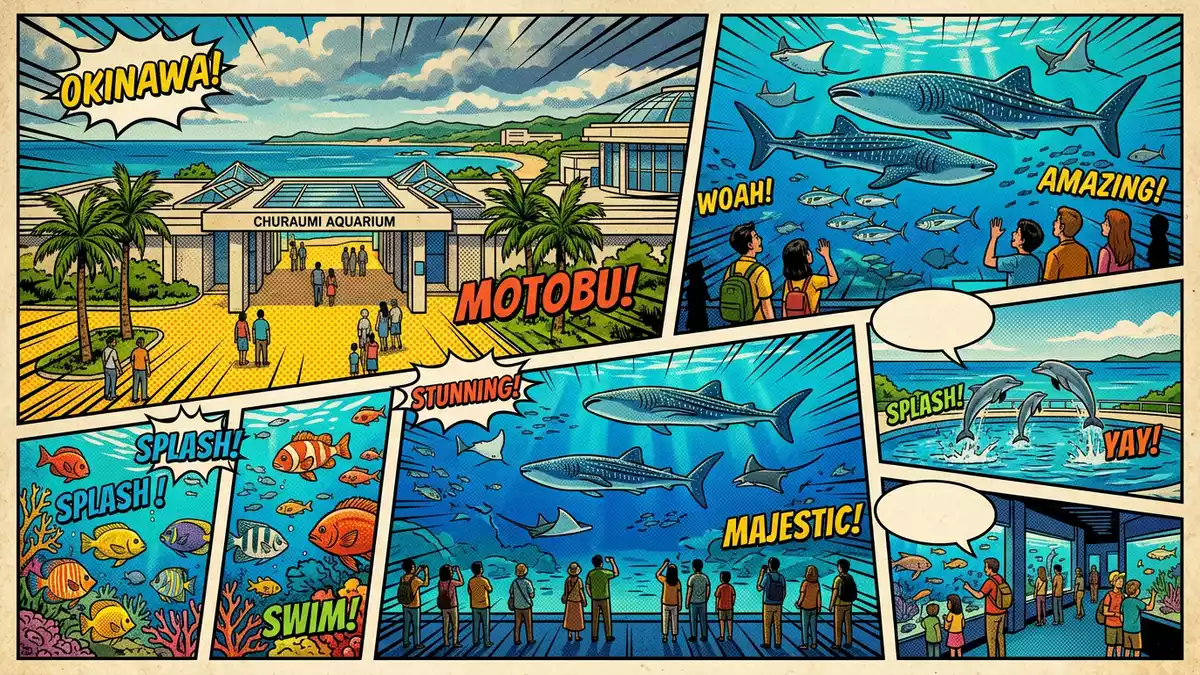
Okinawa Churaumi Suizokukan in Motobu on Okinawa’s Motobu Peninsula is a large public aquarium whose centrepiece is a vast tank evoking the Kuroshio Current off Japan’s southern islands, making the relationship between Okinawa and the surrounding ocean visible at architectural scale. Opened in November 2002 as the rebuilt successor to an earlier oceanarium at the same coastal park, it anchors the northern part of the island as a place to encounter large pelagic species such as whale sharks under controlled conditions rather than out at sea.
A coastal aquarium shaped around the open Pacific
Okinawa Churaumi Suizokukan stands within Ocean Expo Park, a landscaped coastal zone on the Motobu Peninsula that was first developed for the 1975 International Ocean Expo and later reconfigured as a permanent recreation and education area.Ocean Expo Park on the Motobu Peninsula The aquarium complex occupies a terrace above the shoreline, with its main exhibition volumes oriented towards the East China Sea and secondary structures extending inland along the park’s circulation routes.location at 424 Ishikawa in Motobu
The decision to rebuild the ageing predecessor in 2002 produced a facility arranged around large-volume tanks and broad viewing spaces rather than narrow corridors, with clear axial connections from the park’s entrance plazas down towards the sea.reopened as Okinawa Churaumi Aquarium in November 2002 From outside, stepped roofs and terraces echo the slope of the coastal hillside, while elevated walkways link the aquarium to neighbouring attractions within Ocean Expo Park, including open-air lawns and botanical areas that share the same sea views.
The Kuroshio Sea tank and its giant inhabitants
Inside the complex, the most striking feature is the Kuroshio Sea tank, a single body of water with a capacity of 7,500 m3 and a depth of about 10 m, designed to house large filter-feeding sharks and rays alongside schools of smaller fish.Kuroshio Sea tank water volume and dimensions A massive acrylic viewing panel measuring over 22 m in length and more than 8 m in height forms one wall of the space known as the Aqua Room, creating a framed underwater vista in which a whale shark and accompanying manta rays pass and recede against a background of mid-water schooling fish.acrylic panel dimensions and whale shark length
The tank is configured so that visitors experience it from more than one level: an upper route passes above the surface, while lower galleries and a tiered seating area let groups watch the movements of the whale shark, captive-bred manta rays and their companions for extended periods.viewing from panel and Aqua Room The whale shark currently kept here, named Jinta, has been in human care since 1995 and is reported to have spent longer in captivity than any other individual of its species, linking the present facility directly to the earlier aquarium that stood at this park.Jinta’s captivity since March 1995
From coral reefs to shark research within one complex
Beyond the Kuroshio Sea tank, Okinawa Churaumi Suizokukan devotes extensive floor area to ecological displays that begin with shallow coral reef environments and progress through deeper offshore zones, structured as a “Journey to the Kuroshio” sequence within the building.Journey to the Kuroshio exhibition area Among its tanks are reef exhibits reflecting the high coral diversity around Okinawa, tropical fish habitats and enclosures dedicated to shark species, supported by interpretation panels that explain their biology and the specifics of the local marine environment.
A dedicated Shark Research Lab within the complex introduces visitors to ongoing scientific work on elasmobranchs, presenting specimens, video footage and graphics about shark anatomy, reproduction and behaviour.Shark Research Lab and research displays Elsewhere, smaller exhibits highlight themes such as deep-sea fauna and freshwater life, making the aquarium both a leisure destination and an organised survey of marine ecosystems, all contained within a single building that sits only a short distance from the actual shore.
Visiting Okinawa Churaumi Suizokukan: what travellers from Western Europe should know
- Okinawa Churaumi Suizokukan stands within Ocean Expo Park in Motobu Town, on the northern part of Okinawa Island; the nearest major gateway is Naha Airport, from which road routes and express buses serve the Motobu Peninsula.access via Okinawa Expressway and buses
- The grounds are stepped and include outdoor paths linking the aquarium with other park facilities, so visitors move across terraces, gentle slopes and flights of stairs rather than level corridors alone.location on sloping coastal terrain
- The aquarium complex sits beside the sea, with outdoor areas exposed to marine breezes and weather; interior spaces include large halls with substantial vertical circulation between gallery levels.
- The official language is Japanese and the currency is the yen.
- Entry requirements depend on your nationality; UK travellers can check the FCDO travel advice at gov.uk/foreign-travel-advice, Irish travellers the Department of Foreign Affairs at ireland.ie.
Searching for Okinawa Churaumi Suizokukan on social platforms
These links open searches for Okinawa Churaumi Suizokukan on each platform.Frequently asked questions about Okinawa Churaumi Suizokukan
Where is Okinawa Churaumi Suizokukan located?
It is in Motobu Town on the Motobu Peninsula in northern Okinawa Island, within the coastal Ocean Expo Park at 424 Ishikawa.
What can visitors expect inside the aquarium?
Visitors move through coral reef and deep-sea galleries towards the Kuroshio Sea tank, where a whale shark, manta rays and other large fish swim in a single vast volume.
What makes Okinawa Churaumi Suizokukan distinctive among aquariums?
The combination of its 7,500 m3 Kuroshio Sea tank with a huge acrylic viewing wall, long-term care of a whale shark and integrated shark research facilities gives it a scale and scientific focus tied closely to Okinawa’s surrounding ocean.


