
Okavango Delta’s wide, flat inland fan
Published on 09/17/2026 at 11:47 | Editorial responsibility: Rafael Müller, Editor-in-Chief AD HOC NEWS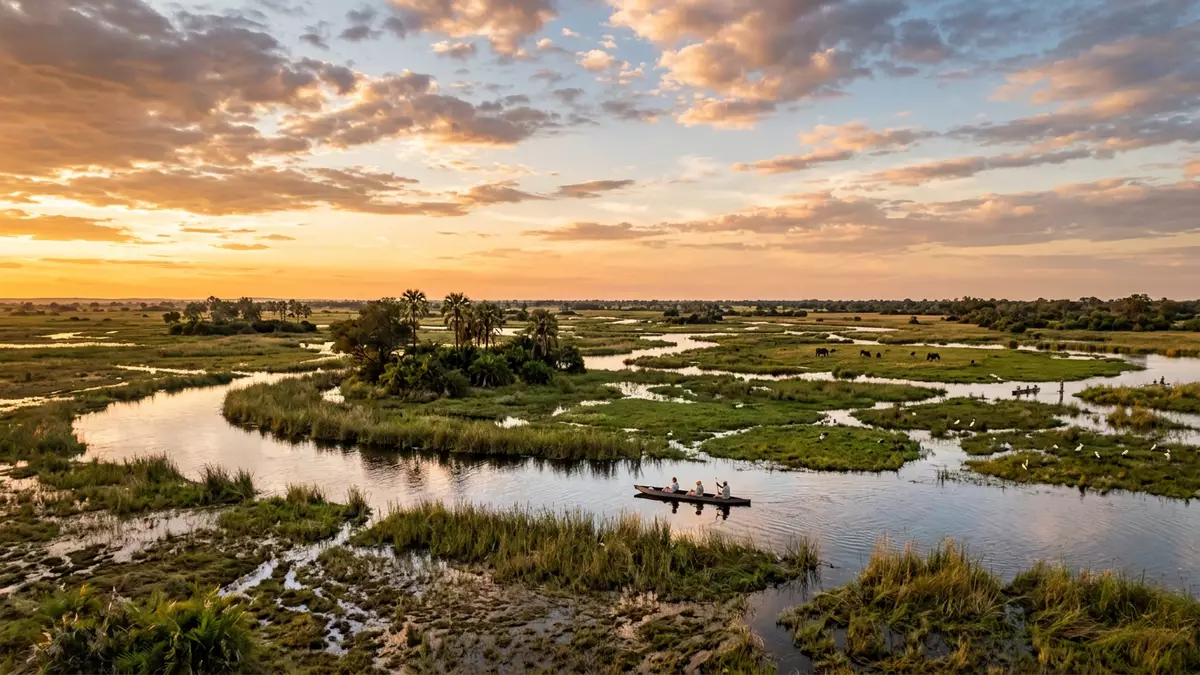
Okavango Delta spreads across north-western Botswana as a broad inland fan of water, reed beds and seasonally flooded grassland. The name usually brings Maun to mind, but the landscape itself is the stronger attraction: flat ground, low channels and a wetland system that opens across the Kalahari edge.
Okavango Delta’s flat inland wetland
The delta is an alluvial fan rather than a river mouth on the sea, and that form gives it a wide, low profile. It lies in north-western Botswana and is recognised as a World Heritage property under the name World Heritage property, with its permanent swamps and seasonally flooded grassland set out across a very large area.
The water system reaches far into the dry interior, and the delta is tied to the Okavango River basin. That river rises in the highlands of Angola and then spreads out into a broad wetland in Botswana, where channels, marshes and islands create the delta’s layered appearance.
Water, channels and islands
The visual character of Okavango Delta comes from contrast: open water beside reed beds, marsh beside dry islands, and narrow channels beside broad floodplains. Its UNESCO listing records permanent swamps, seasonal grassland and an inscribed property of more than two million hectares.
The delta also belongs to a landscape shaped by the Kalahari Basin and the southern end of the East African Rift system. A low gradient, an inland basin and broad sediment deposits combine in a setting that reads as water spread thinly across land rather than a single river course.
Okavango Delta and Maun in regional context
Maun serves as the best-known gateway town for the delta, and it sits on the edge of the wetland world that begins beyond the last major roads. The delta is also linked to the wider region through the Okavango River system and the seasonal flood pattern that reaches the northern parts of Botswana.
The World Heritage inscription dates from 2014 and identifies the place under natural criteria vii, ix and x. That status sits alongside the delta’s physical form: a large interior wetland, not a coastal delta, with a surface pattern defined by water moving over level ground.
Visiting Okavango Delta: what travellers from Western Europe should know
- Maun is the main access point for the delta, with regional air services and road connections into northern Botswana.
- The terrain is very flat in the wetland itself, but travel beyond the town often involves water routes, sandy tracks and isolated lodges.
- The place lies in a low-lying inland basin, so the landscape is spread wide rather than rising into marked hills or cliffs.
- Botswana’s official language is English and the currency is the Botswana pula.
- Entry requirements depend on your nationality; UK travellers can check the FCDO travel advice at gov.uk/foreign-travel-advice, Irish travellers the Department of Foreign Affairs at ireland.ie.
Searching for Okavango Delta on social platforms
These links open searches for Okavango Delta on each platform.
Frequently asked questions about Okavango Delta
Where is Okavango Delta?
Okavango Delta lies in north-western Botswana, close to Maun, and forms part of the Okavango River basin. It spreads into an inland wetland rather than draining into the sea.
What does a visit involve?
Travel here revolves around the landscape itself: water channels, floodplains, islands and the route out from Maun. The setting is broad and level, with movement often tied to roads, tracks and boats.
What makes Okavango Delta distinct?
Its inland delta form is the key feature, together with its UNESCO World Heritage status and its mix of permanent swamps and seasonally flooded grassland. The place combines open water and dry islands within a single wetland system.


