
Oia, where cliff houses meet the Aegean
Published on 09/23/2026 at 21:35 | Editorial responsibility: Rafael Müller, Editor-in-Chief AD HOC NEWS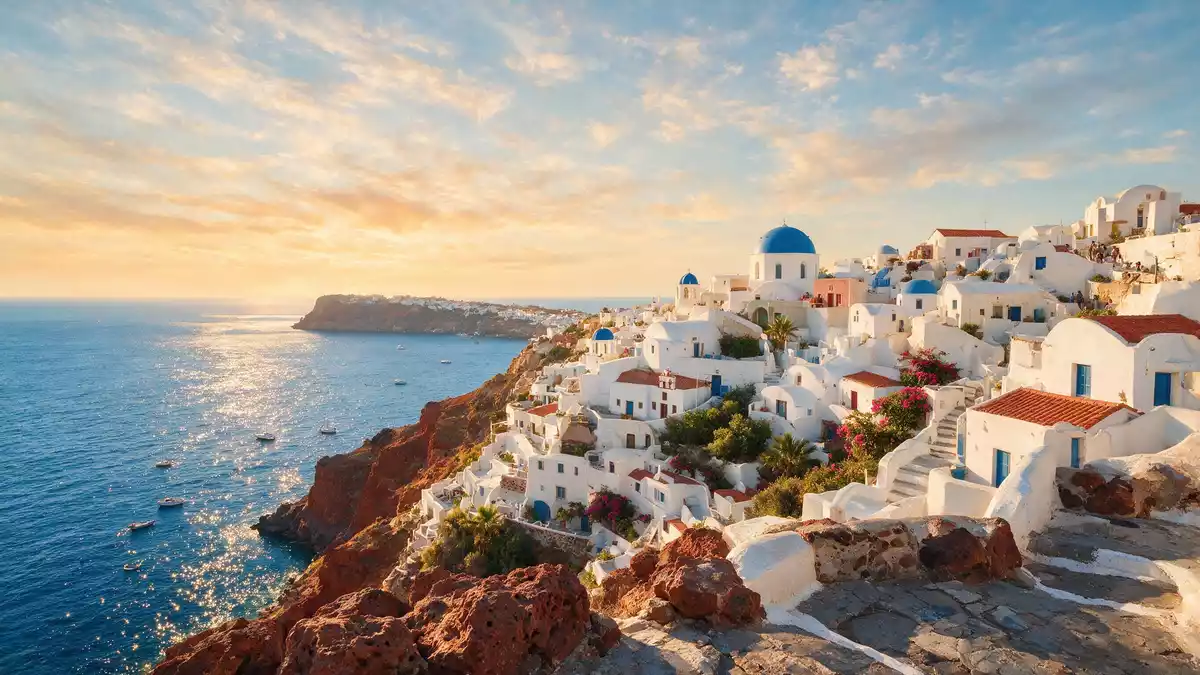
Oia occupies the north-western edge of Santorini, where whitewashed houses and blue-domed churches follow the volcanic caldera. The village is recognised by its cave dwellings, maritime mansions and steep paths above the Aegean.
Oia’s houses are shaped by the caldera
Oia stretches along the northern rim of Santorini’s caldera. Built into the slope, the settlement combines narrow passageways, small squares and houses arranged above the sea.
Many traditional homes are yposkafa, dwellings cut into volcanic material rather than built as separate blocks. Their curved interiors sit behind white façades, while coloured doors, shutters and domes punctuate the streets. Oia’s cave houses are associated with the crews of sailing ships.
Higher in the village stand the captains’ houses. These two-storey residences reflect the wealth created by maritime trade in the late nineteenth and early twentieth centuries. Their neoclassical details differ from the simpler dwellings set into the cliff.
From Apanomeria to a maritime village
Oia was known as Apano Meria, meaning the upper side, before the name Oia became established in the nineteenth century. Residents retain the name Apanomerites in local usage.
The settlement formed part of the Venetian defensive landscape of Santorini. In 1207, Marco Sanudo founded the Duchy of Naxos, bringing feudal rule to the island. The fortress of Agios Nikolaos, also called Goulas, occupied the oldest part of Oia.
From the late nineteenth century, Oia prospered through merchant shipping across the eastern Mediterranean. Trade connected Santorini with ports including Alexandria and destinations linked to Russia. Wine, pumice and agricultural goods formed part of the island’s maritime economy.
The 1956 earthquake damaged much of Oia and changed the appearance of the settlement. Restored houses, churches and castle remains now stand beside buildings adapted for accommodation, restaurants and cultural use.
Castle ruins, churches and the maritime museum
The Castle of Oia, also known as Fort Londsa, occupies a prominent point above the caldera. Its surviving ruins belong to the former Venetian fortress, while the surrounding paths open towards the sea and the volcanic islands.
Churches form part of Oia’s architectural rhythm. White walls, blue domes, bell towers and small courtyards appear between the houses. Panagia Platsani stands near the central part of the village, and other churches preserve connections with sailors and maritime families.
The Naval Maritime Museum occupies a nineteenth-century captain’s mansion. Its displays include nautical charts, ship models, maritime equipment, photographs and objects connected with Thira’s seafaring history.
Below the village, Ammoudi is reached by a steep stairway from the cliff-top. Armeni lies beneath Oia on the southern side. These harbour settlements connect the high village with the water that shaped its commercial history.
Visiting Oia: what travellers from Western Europe should know
- Oia lies at the northern tip of Santorini. Buses from Fira travel north through Firostefani and Imerovigli, with a terminal near Oia’s main square.
- The village occupies a steep caldera slope. Ammoudi lies below Oia and is reached by a long staircase of roughly 300 steps.
- The main pedestrian route is Nikolaou Nomikou, a cobbled street that follows the caldera edge through the settlement.
- The official language is Greek and the currency is the euro.
Searching for Oia on social platforms
These links open searches for Oia on each platform.
Frequently asked questions about Oia
Where is Oia?
Oia is a village on the north-western tip of Santorini in the Cyclades, within Greece’s South Aegean region. It follows the northern edge of the island’s caldera.
What can visitors expect in Oia?
Visitors encounter narrow lanes, whitewashed houses, cave dwellings, blue-domed churches, castle ruins and steep routes towards Ammoudi and Armeni.
What makes Oia distinctive?
Oia brings together volcanic cliff architecture and a maritime history. Its cave houses, captains’ mansions and Venetian fortress ruins remain visible within the same settlement.


