
Oia’s cliffside village of cave houses and captains’ mansions
Published on 09/24/2026 at 05:44 | Editorial responsibility: Rafael Müller, Editor-in-Chief AD HOC NEWS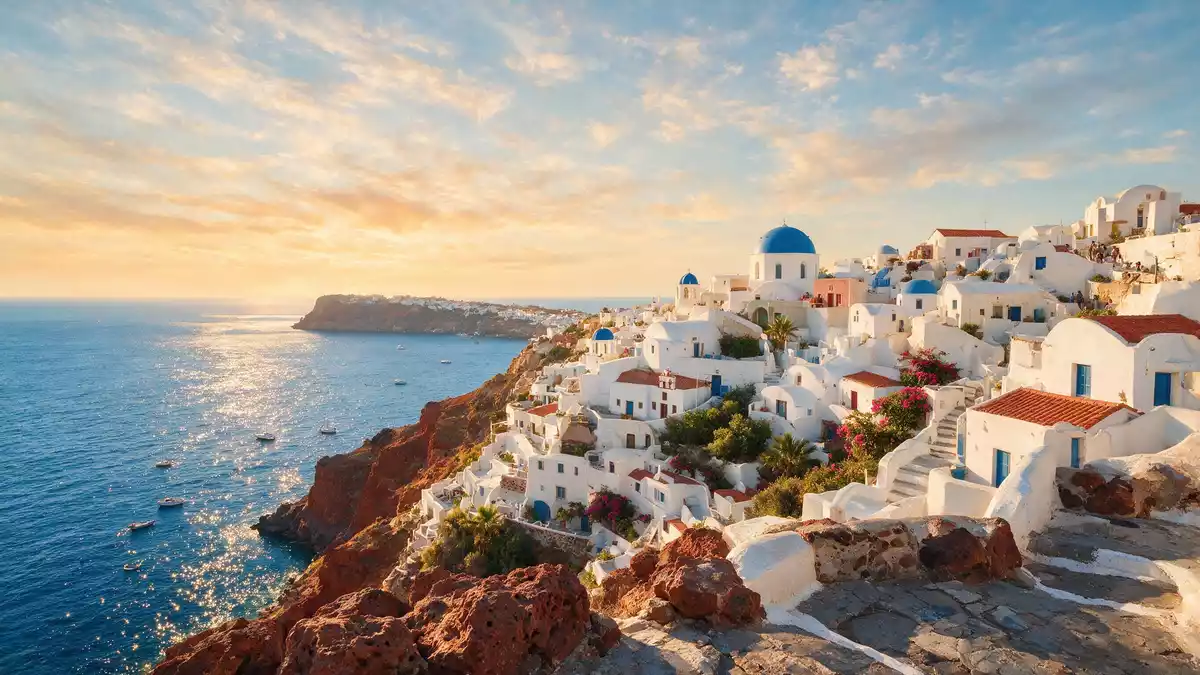
Oia occupies the northern rim of Santorin’s volcanic caldera, where whitewashed buildings follow the cliff above the Aegean. Cave houses cut into volcanic rock stand beside captains’ mansions, churches and the ruins of a medieval castle.
Oia’s houses are carved into the caldera wall
The village is built from two distinct residential forms. Yposkafa, or undercut cavern houses, extend into the soft volcanic cliff, with white façades, arched entrances and small terraces facing the caldera. Their interiors are partly excavated rather than assembled from separate blocks.
Higher along the settlement are kapetanospita, the houses associated with ship owners and captains. These residences have larger rooms, more formal façades and a stronger presence above the smaller cliff dwellings. Together, the two forms record the social divisions of Oia’s maritime community. Oia’s two dwelling types remain central to its architectural character.
From Apanomeria to a traditional settlement
Oia’s recorded history reaches back to the thirteenth century, when Frankish and Venetian rule shaped Santorin’s fortified settlements. The western castle ruins are linked with Kasteli of Agios Nikolaos, also known as Apanomeria or Pano Meria. The medieval castle settlement forms the historical core of the village.
The name Oia became established in the nineteenth century, after centuries in which the settlement was connected with Venetian, Ottoman and island history. Maritime trade brought wealth to Santorin, and the village’s houses, churches and lanes preserve that connection through their forms and materials.
The castle, churches and maritime memory
At the western end, the ruined castle stands above the caldera. Its masonry and elevated position distinguish it from the bright residential façades nearby. The site is associated with a fortified settlement rather than a single freestanding monument.
Churches with blue details punctuate the dense village fabric, while the Naval Maritime Museum occupies a nineteenth-century captain’s house. Models, instruments, documents and photographs connect the building with Oia’s seafaring past. The maritime museum adds an interior view of the commercial world represented outside by the captains’ houses.
The settlement carries the formal designation of a traditional settlement, recorded in 1993. The 1993 designation identifies the architectural fabric as a protected expression of Cycladic and Thiran building traditions.
Visiting Oia: what travellers from Western Europe should know
- Oia lies at the northern end of Santorin, above the caldera. Roads connect it with Fira and the island’s airport, while local buses serve the village.
- The main settlement follows a pedestrian ridge. Steps descend from the caldera lanes towards Ammoudi harbour, and the cliffside route includes uneven stone surfaces.
- The village is about 150 metres above sea level. Its position brings steep gradients between the upper lanes, the castle area and the water below.
- The official language is Greek and the currency is the euro.
- Entry requirements depend on your nationality; UK travellers can check the FCDO travel advice at gov.uk/foreign-travel-advice, Irish travellers the Department of Foreign Affairs at ireland.ie.
Searching for Oia on social platforms
These links open searches for Oia on each platform.
Frequently asked questions about Oia
Where is Oia?
Oia is a village at the northern end of Santorin, on the rim of the island’s volcanic caldera. It overlooks the Aegean Sea and lies within the Cyclades of Greece.
What can visitors expect in Oia?
The settlement contains pedestrian lanes, whitewashed façades, cave houses, churches, captains’ mansions and castle ruins. Steps connect the upper village with lower coastal areas.
What makes Oia distinctive?
Its cliffside architecture combines dwellings excavated into volcanic rock with larger maritime residences. The village also preserves a medieval fortified core and a formal traditional-settlement character.


