
Oia on Santorin’s caldera rim
Published on 09/07/2026 at 06:32 | Editorial responsibility: Rafael Müller, Editor-in-Chief AD HOC NEWS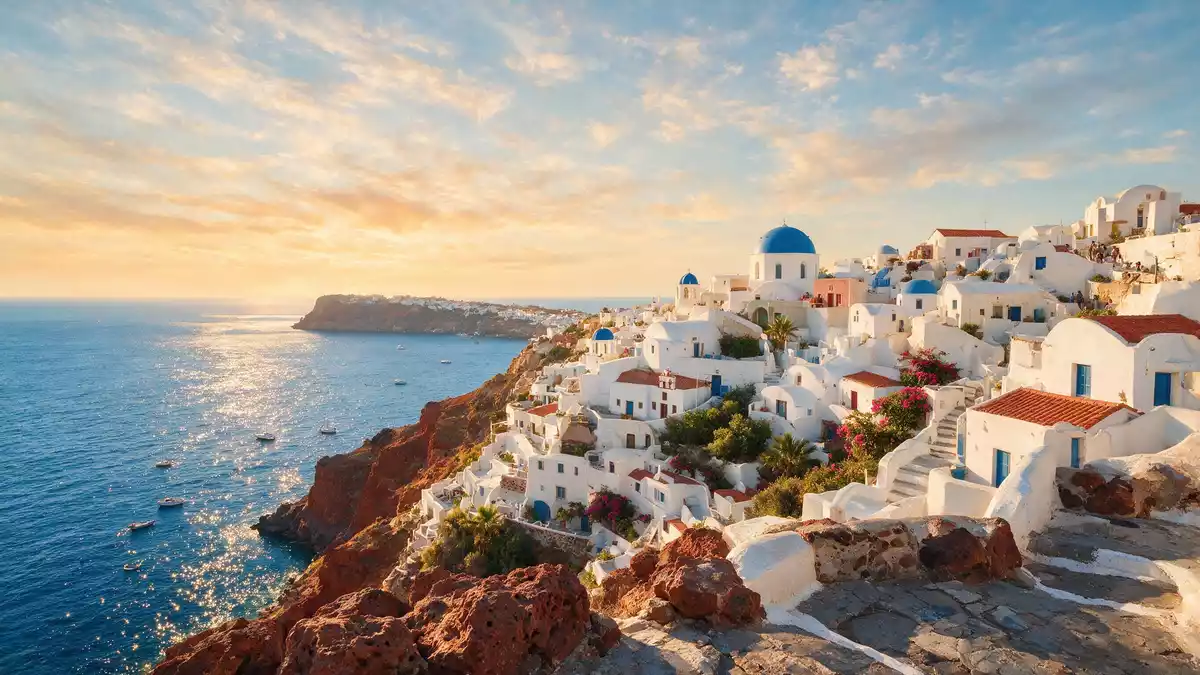
Oia is a village on Santorin in Greece, stretched along the northern rim of the island’s volcanic caldera where whitewashed houses overlook the Aegean Sea. Built on steep cliffs tens of metres above the water, it combines traditional Cycladic cave dwellings with grand captains’ houses that recall its maritime past in the late nineteenth and early twentieth centuries.
A village strung along the caldera
Oia occupies the north-western tip of Santorin, forming a continuous settlement along the edge of the flooded volcanic crater. The village extends for almost two kilometres along the caldera’s northern side, with houses stepping down towards the sea while remaining well above the shoreline.extends for almost two kilometres The cliffs beneath it form part of the caldera wall, and the settlement lies between roughly 70 and 100 m (230 and 330 ft) above sea level, giving broad views over the water and towards the island of Thirassia.
The caldera itself is a large, multi-part volcanic basin, and Oia stands at its northern end near some of the highest sections of the rim.the Oia settlement at the northern end The settlement’s layout follows the contour of the cliff: a main route runs roughly along the ridge, while smaller alleys and stairways descend between buildings to lower terraces and viewpoints.
Cave houses and captains’ mansions
Architecture is Oia’s clearest feature, and much of its character comes from the contrast between simple cave houses and more elaborate captains’ mansions. Many dwellings on the caldera side are carved into the soft volcanic rock, forming undercut cavern houses with modest façades and thick walls extending into the cliff.traditional undercut cavern houses These cave houses once accommodated workers and sailors, their compact rooms dug partly below grade and finished with whitewashed exteriors.
By contrast, the captains’ houses — locally known as kapetanospita — stand higher on the slopes and adopt neoclassical forms. These mansions are usually above ground rather than carved into rock, with more regular geometry, courtyards and a clearer separation between levels.kapetanospita ship owners’ homes Their presence reflects the prosperity Oia enjoyed in the late nineteenth and early twentieth centuries, when ship owners and captains formed a distinct local elite linked to trade across the eastern Mediterranean.
Traditional Cycladic settlement and castle history
Oia forms a traditional settlement within the Cyclades, with elements that have become widely associated with Santorin. The dominant colour is white, applied to houses, retaining walls and church exteriors, while the blue domes of several churches stand out above the clustered buildings.white houses and blue domes Flat roofs and compact volumes respond to the local climate and earlier building practices, and narrow alleys weave between structures, sometimes covered and sometimes open to the sky.
Historically, Oia also formed one of Santorin’s fortified sites. During Venetian rule in the fifteenth century, a castle known as Agios Nikolaos was established on the edge of the caldera near the village.castle of Agios Nikolaos Remnants of this fortified area remain integrated into the present settlement, particularly towards the north-western point where the land projects into the sea and the cliffside path reaches its outer end.
Visiting Oia: what travellers from Western Europe should know
- Oia lies on the north-western side of Santorin, above the caldera. It is reached by road from Fira, with buses and taxis running between the two settlements.
- The village stands on steep volcanic cliffs. Moving between different levels involves stairways and sloped paths, many of which are narrow and paved with stone.
- On the caldera side, terraces and paths border unfenced drops. Footing is generally firm, but the combination of steps and exposed edges makes attention to the terrain important.
- The official language is Greek and the currency is the euro.
Searching for Oia on social platforms
These links open searches for Oia on each platform.Frequently asked questions about Oia
Where is Oia on Santorin?
Oia stands on the north-western tip of Santorin in Greece, stretched along the northern rim of the island’s volcanic caldera above the Aegean Sea.
What should visitors expect in Oia?
Visitors encounter a dense village built on cliffs, with whitewashed cave houses, neoclassical captains’ mansions, narrow alleys and churches with blue domes overlooking the caldera.
What makes Oia distinctive among Cycladic villages?
Oia combines carved cave dwellings, ship owners’ houses and a former Venetian castle site, all arranged along a dramatic caldera rim rather than on flat ground.


