Oia on Santorin: life along a volcanic cliff
Published on 09/11/2026 at 21:30 | Editorial responsibility: Rafael Müller, Editor-in-Chief AD HOC NEWS
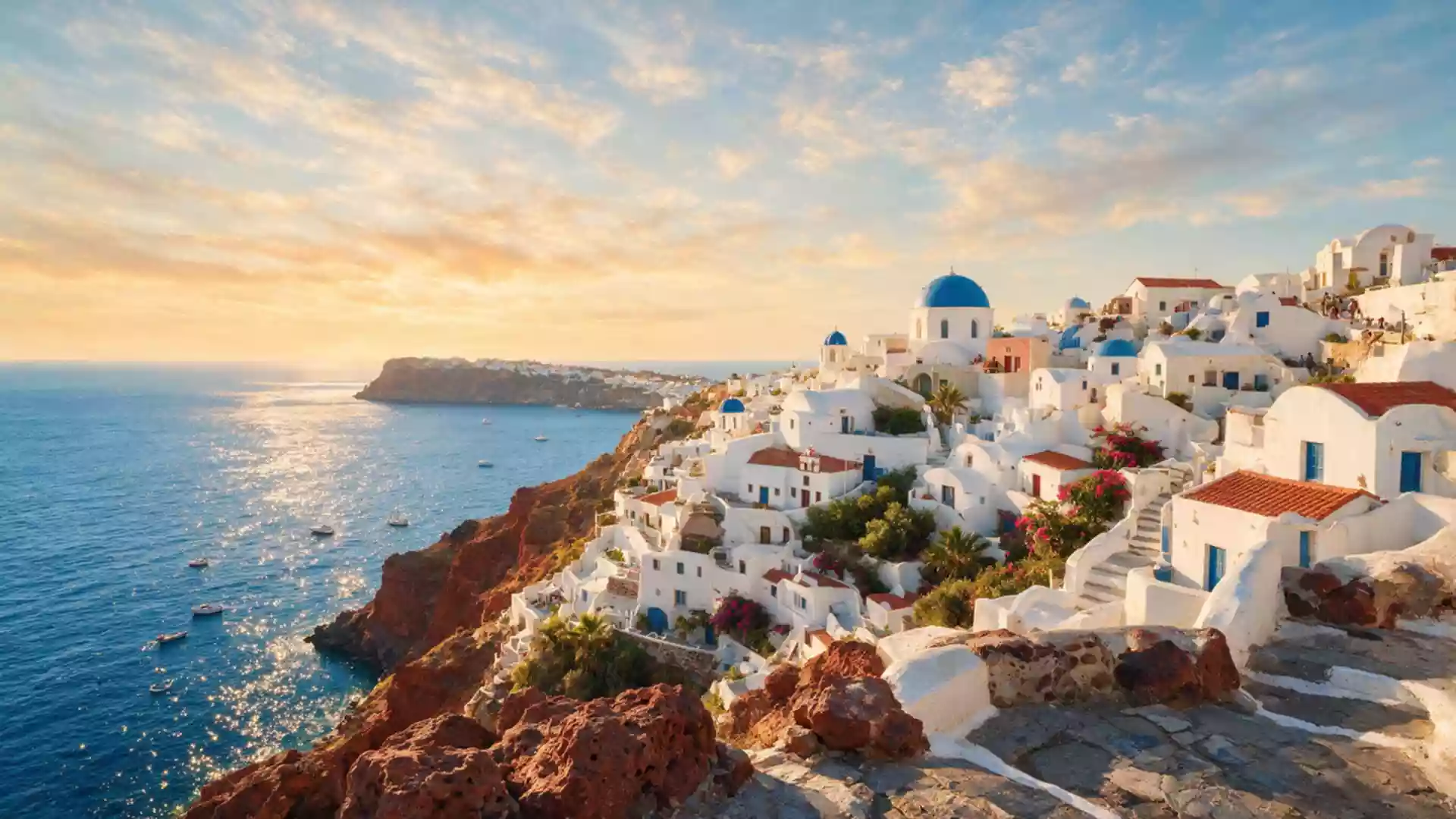
On the north-western edge of Santorin in Greece, Oia stretches along the rim of a volcanic caldera, with whitewashed houses and churches stepping down a steep cliff above the Aegean Sea. The village belongs to the Cyclades island group and forms part of the municipality of Santorini, its present name dating from the nineteenth century when the older designation Apano Meria was replaced.
Village on the edge of a flooded crater
Oia occupies the northern tip of Santorin, following the line of the island’s flooded volcanic crater for a considerable distance and facing out across the Aegean Sea towards Thirassia and the smaller volcanic islets in the bay. The settlement stands more than 100 m (328 ft) above the water on a slope of dark volcanic rock, its terraces holding houses, paths and small courtyards that step down the cliff in tight succession.Oia sits on the northwestern tip of Santorini The wider landscape belongs to the Santorini volcanic group, a ring of islands formed from lava and ash around the caldera created in the Bronze Age Minoan eruption of Thera.the Santorini volcanic group and caldera
The terrain beneath Oia falls steeply towards the sea, cut by narrow stairways and zigzag paths that link the upper settlement with small harbours at the foot of the cliff such as Ammoudi Bay. From the upper terraces, the view takes in the curve of the caldera and the scattered islands that mark the remnants of the original volcano, a geographical setting that explains why the village was once closely tied to seafaring and maritime trade across the eastern Mediterranean.
Cave houses and captains’ mansions
The built fabric of Oia is defined by two main dwelling types that reflect both the volcanic terrain and the village’s maritime past. Cave houses are cut directly into the soft pumice and volcanic rock of the caldera cliff, their rooms extending back into the slope and their whitewashed facades forming a continuous front along the terraces. These houses were historically occupied by ship crews and workers, who lived in compact spaces carved out of the rock above the harbour.cave houses dug into volcanic rock Above them, larger buildings with neoclassical details stand out as captains’ mansions, known locally as kapetanospita, built by shipowners and merchants during the village’s prosperous nineteenth-century shipping era.neoclassical captains' mansions
Many of the houses share characteristics typical of Cycladic settlements: cubic forms, flat roofs, white-painted walls and small courtyards squeezed between neighbouring buildings. Churches with blue domes punctuate the skyline, often perched on terraces overlooking the caldera and surrounded by narrow alleys. Oia has been formally recognised as a traditional settlement preserving Cycladic and Thiran architecture, which helps maintain the visual continuity of white houses, blue domes and stone paths along the cliff.traditional settlement preserving Cycladic and Thiran architecture
From medieval kastell to maritime village
The roots of Oia lie in a fortified core known as Agios Nikolaos Kastell, one of several castellos established on Santorin under Frankish and Venetian rule in the thirteenth century when Marco Sanudo’s Duchy of Naxos extended its influence across the Cyclades.Oia linked to Marco Sanudo's Duchy of Naxos The castle, also referred to as Apanomeria, stood on the caldera edge, giving the settlement both a defensive position and direct access to the sea below.Agios Nikolaos Castle as one of Santorini's fortresses
By the seventeenth and eighteenth centuries, Oia had developed into a structured settlement oriented towards shipping, and in the nineteenth century it grew wealthy as a base for merchants and shipowners whose vessels traded across the Mediterranean, the Black Sea, the Red Sea and other routes. Wealth from this activity financed substantial houses, storage facilities and churches, many of which still stand along the caldera rim and in the older quarters around the former kastell.prosperous maritime community in the 17th to 19th centuries In 1956 a powerful earthquake struck Santorin and caused severe damage in Oia, destroying many buildings on the cliff and prompting emigration from the village.1956 earthquake and subsequent rebuilding
Visiting Oia: what travellers from Western Europe should know
- Oia lies at the northern end of Santorin in Greece, above the caldera’s sea-filled basin; it can be reached by road from Fira and from Santorini’s airport and harbour.
- The village is built on a steep volcanic slope with many stairways and stepped paths, and moving between the upper terraces and the harbours below involves climbing or descending long flights of steps.
- The settlement belongs to Greece, where the official language is Greek and the currency is the euro.
- The landscape around Oia includes the caldera cliffs, terraces with houses and chapels, and small harbours such as Ammoudi Bay directly below the village.
Searching for Oia on social platforms
These links open searches for Oia on each platform.
Frequently asked questions about Oia
Where is Oia located?
Oia is a village on the northern tip of Santorin, a volcanic island in the Cyclades group in Greece, standing on the rim of the island’s caldera.
What should visitors expect in Oia?
Visitors encounter whitewashed cave houses and captains’ mansions stepping down a steep volcanic cliff, narrow alleys, stairways, churches with blue domes and views across the flooded crater.
What makes Oia distinctive among Cycladic villages?
Oia’s combination of cliff-carved cave houses, neoclassical maritime mansions, the medieval Agios Nikolaos Kastell and its continuous line along the caldera rim gives the village a particular character within the Cyclades.