

Oia on Santorin: cliffside cave houses and captains’ mansions
Published on 09/15/2026 at 07:50 | Editorial responsibility: Rafael Müller, Editor-in-Chief AD HOC NEWS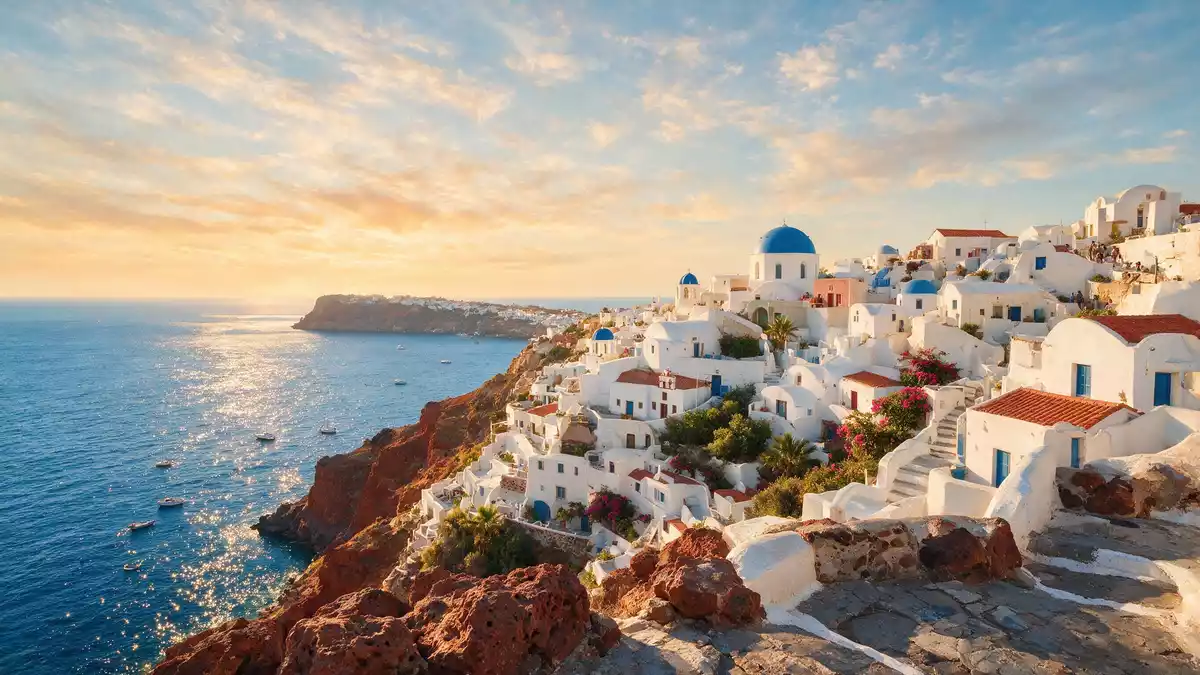
Oia on Santorin in Greece occupies the northern rim of the island’s volcanic caldera, a settlement where cave houses carved into the cliff sit beside neoclassical captains’ mansions and blue-domed churches.Oia on Santorini’s caldera forms one of the best-known Cycladic villages, combining medieval fortification with nineteenth-century maritime prosperity and post-earthquake reconstruction into a continuous cliffside front.
From Kasteli of Agios Nikolaos to Oia
The origins of Oia lie in a medieval fortress known as Kasteli of Agios Nikolaos, raised during Frankish and Venetian rule over Santorin in the thirteenth century.Kasteli of Agios Nikolaos stood as one of five castle settlements on the island, forming part of the network of kastelia that defended the Aegean duchies linked to Venetian power.fortified castle-towns This fortified core, perched on the caldera edge, set the initial pattern of compact lanes and defensive walls that still shape the village’s upper streets.
Under Venetian and then Ottoman rule, the settlement developed a maritime character, with Apano Meria or Pano Meria serving as the “upper side” of the village linked to the castle and ship-owning families.Apano Meria and kastelli During the nineteenth century, as Ottoman control loosened and the Greek state emerged, the place expanded from fortress into a settlement known as Oia, its name replacing earlier forms while its street layout continued to follow the ridge of the caldera.name change to Oia The medieval castle, the later tower known as Goulas and fragments of walls remain visible near the northern tip, keeping the defensive phase legible beside the later houses.
Cave houses and captains’ mansions in volcanic rock
Oia’s built fabric rests directly on the geology of Santorin’s caldera, with soft volcanic rock allowing houses to be carved as much as constructed.cave architecture of Oia Along the cliff, yposkafa cave houses cut into the rock form dense clusters, their whitewashed façades fronting narrow alleys and small terraces that overlook the water in the caldera below.undercut cavern houses These dwellings, used historically by sailors and ship crews, sit partly below ground, with rooms arranged in sequence along excavated interiors.
Set back from the cliff edge and higher on the slope, larger houses built by shipowners and captains adopt a contrasting neoclassical style, with strict geometries and more formal façades.kapetanospita shipowners’ houses These kapetanospita often rise more than one storey and form a band of more spacious dwellings separated from the compact cave clusters by small lanes and retaining walls.Cycladic and neoclassical blend Churches with blue-painted domes and simple bell towers punctuate this mix, their white surfaces and coloured roofs standing out against the dark volcanic rock and the sea.
Earthquake, reconstruction and traditional settlement status
In July 1956 a strong earthquake struck the Aegean, with Oia suffering extensive damage as stone and earth houses along the caldera edge collapsed and many residents left the village.July 1956 earthquake The centre, including the marble-paved main street and adjacent squares, was rebuilt over roughly a decade, with new houses using concrete structures and barrel-shaped roofs that can still be seen beside restored traditional buildings.earthquake damage and rebuilding
Late twentieth-century reconstruction consolidated Oia as a traditional settlement, preserving Cycladic and Thiran architecture across the cliffside terraces.traditional settlement designation The rebuilt cave houses, captains’ residences and churches follow earlier forms closely, producing a continuous band of white façades and blue details along the caldera rim that reflects both historical layers and codified architectural choices.post-1956 reconstruction
Visiting Oia: what travellers from Western Europe should know
- Oia lies on the northern tip of Santorin, on the western side of the island above the flooded volcanic crater; the main road from Fira follows the ridge to reach the village.
- The settlement climbs along the caldera slope, with many paths formed as stairways; moving between cliffside levels involves long flights of steps on paved and sometimes narrow lanes.
- The inland side of Oia contains streets with fewer elevation changes, while the cliff-facing districts lead towards terraces and viewpoints that stand above the water far below.
- Oia stands in Greece, where the official language is Greek and the currency is the euro.
Searching for Oia on social platforms
These links open searches for Oia on each platform.Frequently asked questions about Oia
Where is Oia located?
Oia is a village on the northern rim of the caldera on Santorin, an island in the southern Aegean Sea belonging to Greece.
What should visitors expect in Oia’s layout and buildings?
Visitors encounter cave houses carved into volcanic rock, neoclassical captains’ mansions and churches, arranged along steep paths and stairways overlooking the water.
What makes Oia distinctive among Cycladic settlements?
Oia combines a medieval castle core, nineteenth-century maritime residences and post-1956 reconstruction into a continuous white-and-blue cliffside village on the caldera.


