
Oia and the cliff edge of Santorin
Published on 08/27/2026 at 16:36 | Editorial responsibility: Rafael Müller, Editor-in-Chief AD HOC NEWS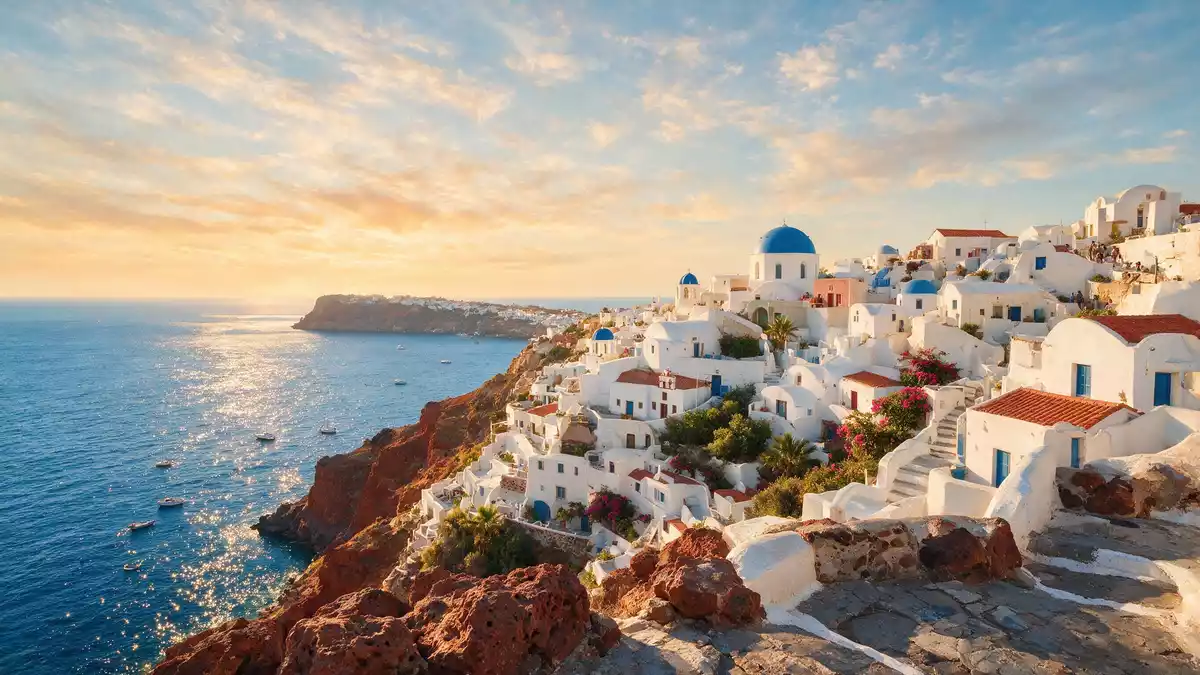
Oia on Santorin is a cliffside settlement shaped by volcanic rock, whitewashed houses and the long curve of the caldera. Its two most visible forms are the cave houses cut into the slope and the captains’ houses above them.
Oia’s layered cliff settlement
The village sits on the north-western edge of Santorin, above the caldera and facing the Aegean Sea. Its setting is tied to the traditional settlement designation, which appears in accounts of Oia’s built form and heritage status.
Oia’s streets run through a compact hillside fabric rather than a grid. The built ensemble includes rock-hewn dwellings, churches with blue domes and larger houses linked to the island’s seafaring past.
From cave houses to captains’ homes
The settlement is associated with two main house types: cave houses, also called hyposkafa, and kapetanospita, the captains’ houses. The latter are identified with ship owners and a more formal street presence, while the cave houses are cut into the volcanic slope.
The distinction between these forms gives Oia much of its character. The cave houses sit close to the rock, while the captains’ houses present broader façades and a more structured profile, reflecting different social layers within the village.
Oia in the Venetian and post-Venetian period
Oia belongs to the historic landscape of Santorin that was shaped under Venetian rule. Some histories place its fortified settlement phase in the thirteenth century, and one strand of the record links it with Agios Nikolaos Castle and Marco Sanudo’s Duchy of Naxos.
The village is also linked to 1993, when it was declared a traditional settlement. That formal status sits well with its preserved Cycladic character, visible in white walls, cubic forms and narrow passages between houses.
Visiting Oia: what travellers from Western Europe should know
- Oia lies on the north-western edge of Santorin, overlooking the caldera. It is reached by road from Fira and by local transport across the island.
- The settlement is built on a steep volcanic slope. Expect stairways, uneven lanes and changes in level between the road above and the cliff edge below.
- The village’s built fabric includes cave houses, captains’ houses and church domes. Those forms are part of the place, not separate attractions.
- The official language is Greek and the currency is the euro.
Searching for Oia on social platforms
These links open searches for Oia on each platform.
Frequently asked questions about Oia
Where is Oia?
Oia is on Santorin in Greece, at the island’s north-western edge above the caldera. It looks towards the Aegean Sea and the open volcanic rim.
What does a visit involve?
A visit means steep lanes, cliffside views and a settlement built from whitewashed walls, stone paths and rock-cut dwellings. The village is compact and layered across the slope.
What makes Oia distinctive?
Its strength lies in the contrast between cave houses and captains’ houses. The combination of volcanic terrain, Cycladic forms and a historic settlement pattern gives it a clear identity.


