

Odaiba, Tokyo’s artificial island of fortresses and fun
Published on 08/28/2026 at 16:03 | Editorial responsibility: Rafael Müller, Editor-in-Chief AD HOC NEWS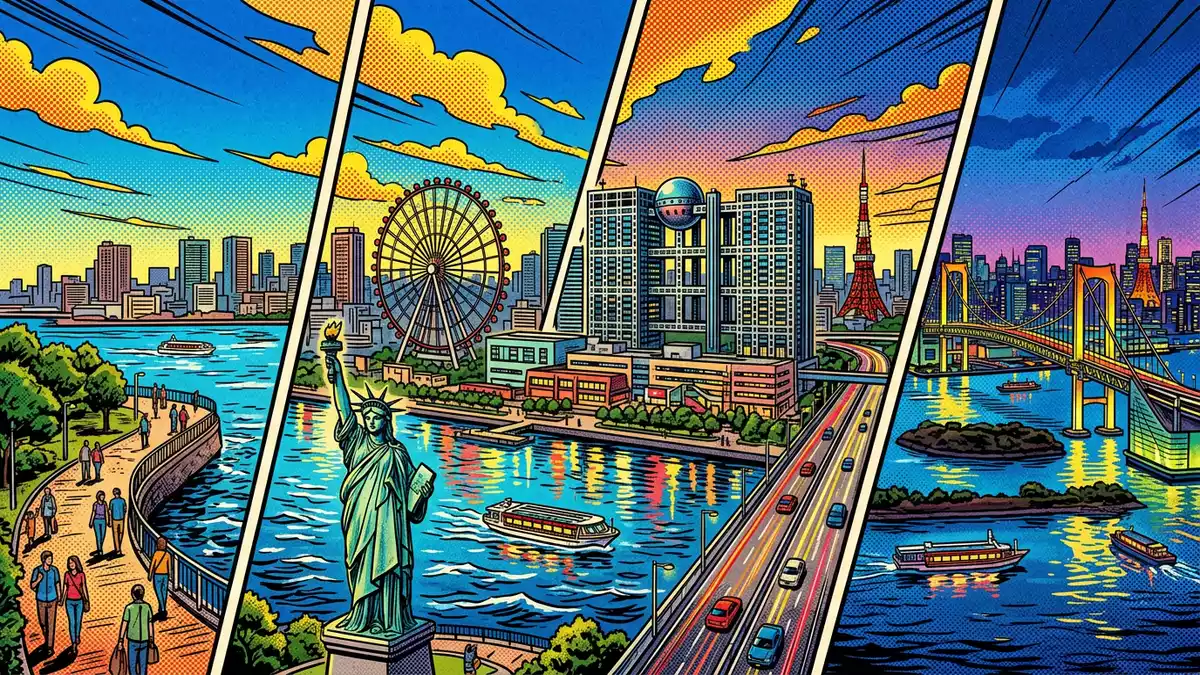
South-east of central Tokio, Odaiba transforms a chain of nineteenth-century sea fortifications into an artificial island of bayside parks, bold architecture and leisure spaces in Tokyo Bay.
From Edo-era batteries to a planned waterfront district
Odaiba began life as a set of man-made fort islands built under the Tokugawa shogunate in the late Edo period, when batteries were constructed off Shinagawa to defend the shogunal capital against foreign fleets.late Edo fort islands These defensive structures gave the area its name, derived from “daiba”, the Japanese word for a battery or fortification.origin of the name
In the twentieth century, large-scale land reclamation in Tokyo Bay turned scattered batteries and landfill plots into a continuous tract of artificial ground, forming the basis of the modern Odaiba district on reclaimed land facing the inner bay.artificial island in Tokyo Bay By the late 1980s Odaiba was included in a waterfront development plan intended to create a new urban subcentre of offices, residences and public spaces, and in the 1990s the area was reshaped into a mixed district of commercial complexes, hotels and public institutions overlooking the water.Waterfront Subcenter Development Basic Plan
Architecture and institutions on the bay
One of the most striking structures on Odaiba is the headquarters of Fuji Television, designed by architect Kenzo Tange and standing close to the waterfront with a distinctive elevated sphere housing an observation room.Fuji Television headquarters Public areas inside the complex include the “Hachitama” observation space high in the sphere and exhibition zones that display items from television productions, all set within a building that has become a visual marker of the district.Hachitama observation room
Nearby stands Miraikan, the National Museum of Emerging Science and Innovation, an institution that presents scientific displays and interactive exhibits within a contemporary building in Odaiba’s waterfront zone.National Museum of Emerging Science and Innovation Across the district, large shopping and entertainment complexes such as DiverCity Tokyo Plaza and Aquacity Odaiba combine retail floors with terraces that overlook Tokyo Bay and the inner harbour, giving the area an urban resort character alongside its office towers.shopping and entertainment district
Bridges, trains and bayside parks
Odaiba is linked to the rest of Tokio by the Rainbow Bridge, a suspension bridge that carries road traffic and rail tracks across Tokyo Bay between the Shibaura district and the Daiba area.Rainbow Bridge between Shibaura and Daiba The bridge forms one of the principal approaches to the island, complemented by the Yurikamome elevated railway, an automated transit line that runs from Shimbashi through the waterfront, and by the Rinkai Line, which connects Odaiba with other parts of the metropolitan rail network.Yurikamome and Rinkai Line access
Along the bay edge, Odaiba Seaside Park offers a stretch of greenery and artificial sandy shoreline facing the water and the Rainbow Bridge, forming a vantage point for views of Tokyo’s inner harbour and the bridge’s illuminated structure.Odaiba Seaside Park The park’s pedestrian paths connect with nearby plazas and promenades around shopping centres and hotels, creating a continuous sequence of public spaces where the reclaimed land meets the bay.
Visiting Odaiba: what travellers from Western Europe should know
- Odaiba lies in Tokyo Bay south-east of central Tokio, reached by the Yurikamome elevated railway from Shimbashi and the Rinkai Line, as well as by road over the Rainbow Bridge.
- Much of the district is flat reclaimed ground laid out with broad pavements and plazas, though internal routes in landmarks such as the Fuji Television building include stairways and escalators.
- The waterfront setting means exposed promenades along the bay, and Odaiba Seaside Park combines lawns with an artificial sandy strip where footwear suitable for sand is practical.
- The official language is Japanese and the currency is the yen.
- Entry requirements depend on your nationality; UK travellers can check the FCDO travel advice at gov.uk/foreign-travel-advice, Irish travellers the Department of Foreign Affairs at ireland.ie.
Searching for Odaiba on social platforms
These links open searches for Odaiba on each platform.
Frequently asked questions about Odaiba
Where is Odaiba located?
Odaiba is an artificial island district on reclaimed land in Tokyo Bay, lying south-east of central Tokio and linked to the mainland by bridge and rail.
What can a visitor expect on a trip to Odaiba?
A visit brings a combination of waterfront parks, large shopping and entertainment complexes, contemporary architecture and institutions such as the Fuji Television headquarters and Miraikan.
What makes Odaiba distinctive among Tokyo districts?
Its origins as Edo-period fort islands, transformation through twentieth-century land reclamation and concentration of futuristic buildings on an artificial bayfront island give Odaiba a character unlike central neighbourhoods.


