
Odaiba’s artificial island landscape in Tokio Bay
Published on 09/23/2026 at 23:52 | Editorial responsibility: Rafael Müller, Editor-in-Chief AD HOC NEWS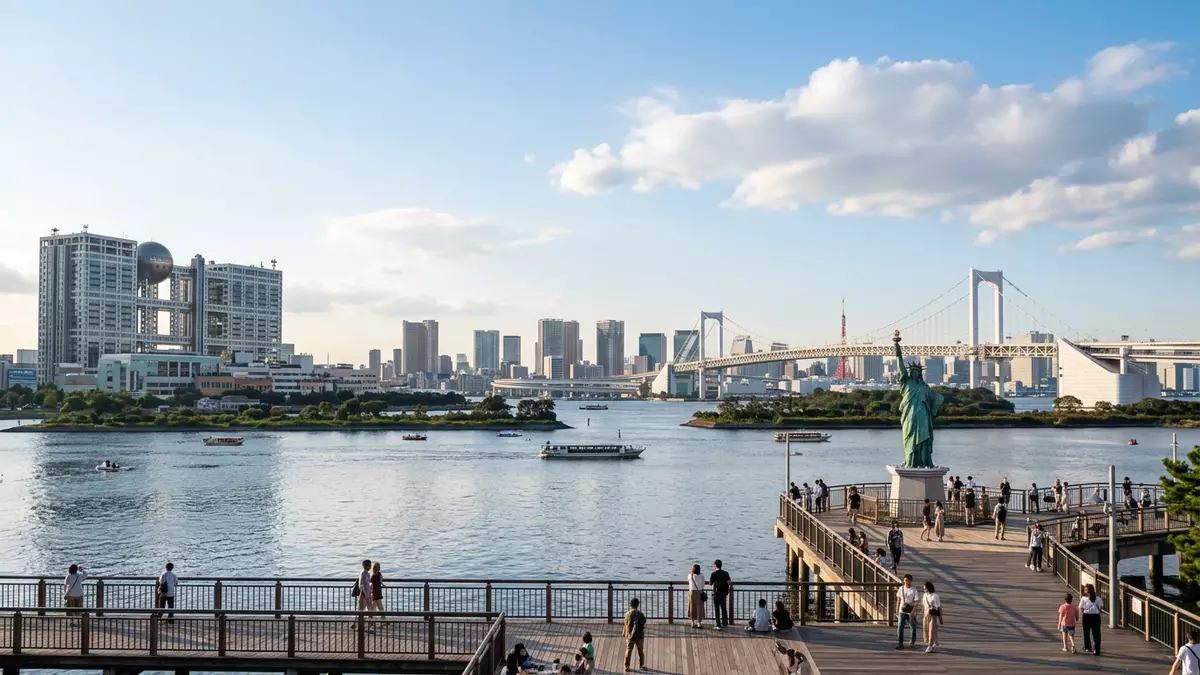
Odaiba is an artificial island district in Tokio Bay, where broad waterfront spaces meet bold architecture and traces of nineteenth-century fortifications. The district’s most visible feature is its engineered setting: reclaimed land, a sandy beach, the Rainbow Bridge and large buildings occupy a man-made edge of the capital.
Odaiba rises from Tokyo Bay’s defensive islands
The name Odaiba comes from the Japanese word daiba, referring to the cannon batteries built in the 1850s under the Tokugawa shogunate. Their history belongs to the final decades of the Edo period, when man-made islands were placed in the bay as coastal fortifications. Egawa Hidetatsu oversaw the construction of these batteries after Commodore Matthew Perry’s arrival in Edo Bay. Odaiba’s fort origins
Daiba Park preserves part of this older landscape on a low island beside the contemporary district. Earthworks and open grass occupy a setting surrounded by water, while the wider waterfront contains offices, housing, shopping complexes and leisure venues. The military meaning of the name remains visible beside the large-scale urban development.
From reclaimed platforms to a waterfront district
Odaiba’s modern form emerged through extensive land reclamation and urban planning during the late twentieth century. Straight embankments, broad promenades and large development plots give the district a distinctly planned appearance. The shoreline is an engineered edge rather than an irregular natural coast.
The Rainbow Bridge links Odaiba with the older city across Tokyo Bay. Completed in 1993, the bridge carries road traffic and rail services between the waterfronts. Its white towers and long span form a prominent part of the island’s view, while the Yurikamome elevated train crosses the bay towards Odaiba. Rainbow Bridge connection
Odaiba Seaside Park adds an artificial sandy shoreline to the district. The beach faces the bridge and the central Tokio skyline, creating a meeting point between constructed land, open water and dense metropolitan architecture. The Statue of Liberty replica near the waterfront adds another recognisable element to the scene.
Architecture, science and leisure beside the water
Modern Odaiba is marked by buildings with strong visual identities. The Fuji Television headquarters has a large metallic sphere suspended within its structure. DiverCity Tokyo Plaza is associated with a large Gundam installation, while Aqua City Odaiba forms a substantial shopping and entertainment complex along the waterside.
The district also contains Miraikan, the National Museum of Emerging Science and Innovation. Its exhibitions address science, technology and the relationship between humanity and the universe. Tokyo Big Sight, the Fuji TV headquarters and the waterfront museums give Odaiba a cultural and architectural range beyond its shopping centres. Odaiba’s major attractions
Seen from the water, the district combines several layers without separating them into different neighbourhoods. Daiba Park recalls the Edo-period batteries, the Rainbow Bridge belongs to the infrastructure of the late twentieth century, and the museums and malls represent the island’s leisure and business functions.
Visiting Odaiba: what travellers from Western Europe should know
- Odaiba lies in Tokyo Bay, south-east of central Tokio. The Yurikamome Line serves Daiba Station and other island stations, while the Rinkai Line serves Tokyo Teleport Station.
- The district is spread across broad reclaimed platforms. Walking routes connect the waterfront, shopping complexes, museums and parks, with open stretches beside the bay.
- Daiba Park occupies a separate historic fort island linked to the wider district by a narrow causeway. Its earthworks contrast with the surrounding modern buildings.
- The official language is Japanese and the currency is the Japanese yen.
Searching for Odaiba on social platforms
These links open searches for Odaiba on each platform.
Frequently asked questions about Odaiba
Where is Odaiba?
Odaiba is an artificial island district in Tokyo Bay, south-east of central Tokio. The Rainbow Bridge and urban rail lines connect it with the mainland.
What can visitors find there?
The district combines Odaiba Seaside Park, Daiba Park, museums, shopping complexes, offices and waterfront architecture. Miraikan focuses on emerging science and innovation.
What makes Odaiba distinctive?
Its landscape joins nineteenth-century coastal fortifications with reclaimed land, a modern bridge, artificial beach and large contemporary buildings beside Tokyo Bay.


