
Obelisco rises as Buenos Aires’ concrete city marker
Published on 09/22/2026 at 10:39 | Editorial responsibility: Rafael Müller, Editor-in-Chief AD HOC NEWS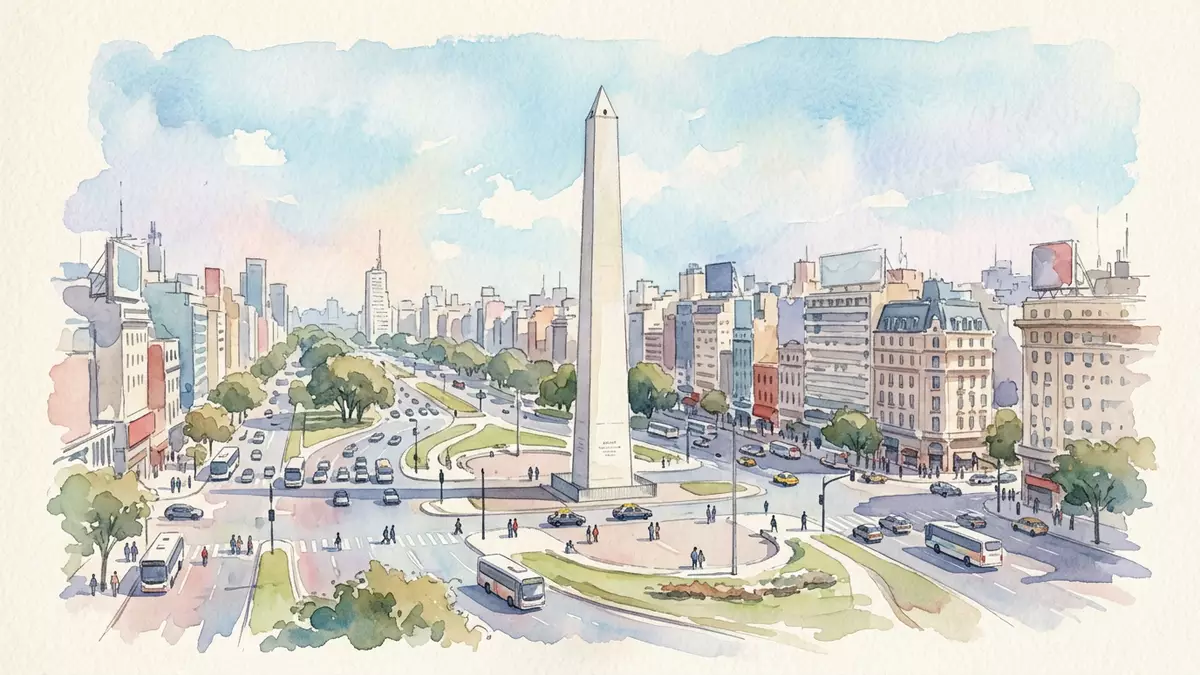
Obelisco is a slender concrete monument at the meeting point of Avenida 9 de Julio and Avenida Corrientes in Buenos Aires. Its sharp, pale shaft rises from Plaza de la República, turning a broad urban junction into a clearly defined vertical landmark. Designed by Alberto Prebisch and inaugurated on 23 May 1936, it combines a modernist form with dates connected to the city’s colonial beginnings.
Obelisco and the geometry of the crossroads
The monument is a four-sided shaft with a square base and a pointed upper section. It reaches 67.5 metres (221 ft), while the base measures about 6.8 metres (22 ft) on each side. Reinforced concrete forms the structure, with light-coloured stone cladding across its exterior.
At street level, the contrast is direct: a compact geometric mass rises amid the open space of Plaza de la República and the avenues around it. The surfaces carry little decoration, so the monument’s height, edges and pale finish remain its defining visual features. A single entrance gives access to an internal staircase leading towards the upper section.
Alberto Prebisch’s modernist monument
Alberto Prebisch designed Obelisco as an Argentine modernist work. His nearby Gran Rex Theatre, on Avenida Corrientes, belongs to the same broad period of architectural experimentation in Buenos Aires. The two buildings connect the monument with the city’s interwar cultural landscape without sharing the same function.
Obelisco was erected in 1936 for the fourth centenary of Buenos Aires’ first foundation by Pedro de Mendoza in 1536. The city’s official English tourism pages record both the date and the architect in their description of the monument: the monument’s 1936 history.
Dates and names written into the monument
Obelisco also marks the place associated with the first raising of the Argentine national flag in Buenos Aires. Its inscriptions refer to the city’s foundation, the flag and other episodes connected with porteño and Argentine history.
The monument’s historical meaning is therefore carried by names and dates as much as by its concrete form. The first foundation belongs to 1536, while the present monument belongs to 1936, creating a visible meeting between colonial history and twentieth-century urban design. The city government records its height, architect and inauguration in its historical account: the city’s historical record.
From the surrounding streets, the inscriptions are less prominent than the monument’s outline. The square base, plain shaft and pointed top form a compact vocabulary that can be read from different approaches across the avenues. Its role as a historical marker remains inseparable from its physical presence at Plaza de la República.
Visiting Obelisco: what travellers from Western Europe should know
- Obelisco stands in Plaza de la República at the intersection of Avenida 9 de Julio and Avenida Corrientes, in central Buenos Aires.
- Buenos Aires’ underground railway network serves the area, and several routes connect with the surrounding central avenues.
- The monument is viewed from the public spaces and traffic crossings around its base. Its interior staircase is narrow and leads upwards from a single entrance.
- The official language is Spanish and the currency is the Argentine peso.
Searching for Obelisco on social platforms
These links open searches for Obelisco on each platform.
Frequently asked questions about Obelisco
Where is Obelisco?
Obelisco is in Plaza de la República, where Avenida 9 de Julio meets Avenida Corrientes in central Buenos Aires.
What can visitors expect at the monument?
Visitors encounter a tall reinforced-concrete shaft, a square base, inscriptions and broad avenues surrounding the public space.
What makes Obelisco distinctive?
Its distinctive character comes from the combination of a 67.5-metre height, Alberto Prebisch’s modernist design and its connection with Buenos Aires’ foundation history.


