
Obelisco rises above Buenos Aires as a modernist white landmark
Published on 09/24/2026 at 12:10 | Editorial responsibility: Rafael Müller, Editor-in-Chief AD HOC NEWS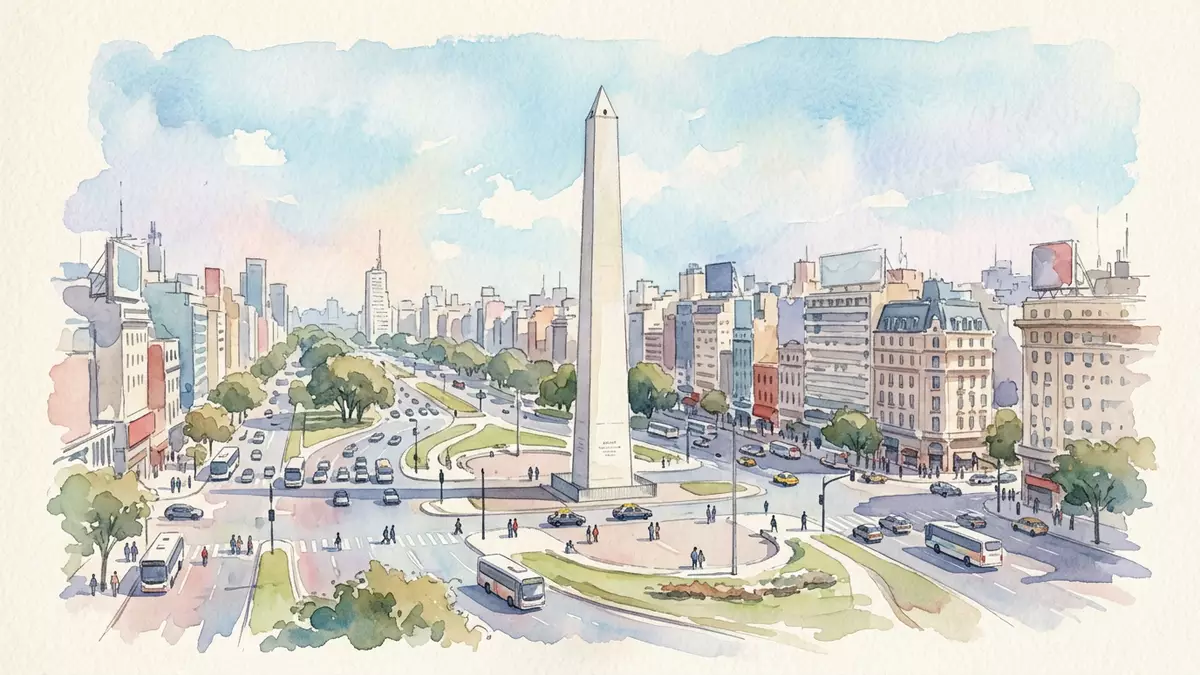
Obelisco rises above the meeting of Avenida 9 de Julio and Avenida Corrientes in Buenos Aires. Its white, tapering shaft reaches 67.5 metres (221 ft), giving the city centre a single vertical landmark among broad avenues and dense buildings.
A white shaft at the centre of Buenos Aires
The monument stands on Plaza de la República, at a major junction in the Argentine capital. Its square base measures 6.8 metres on each side, while the shaft narrows towards a small truncated summit.
Obelisco is built from reinforced concrete with white stone facing. The surface is deliberately spare, without sculpture, balconies or ornamental layers. Its geometry belongs to Argentine modernism, and the monument’s clear outline remains visible from the surrounding avenues.
Alberto Prebisch and the monument of 1936
Argentine architect Alberto Prebisch designed Obelisco. He also designed the nearby Teatro Gran Rex, another major work associated with Buenos Aires modernism. Alberto Prebisch’s design gives the monument its restrained, geometric character.
Obelisco was inaugurated on 23 May 1936. Its construction marked the fourth centenary of the first foundation of Buenos Aires by Pedro de Mendoza in 1536. The monument therefore joins a twentieth-century architectural language with a much older civic date. The 1936 inauguration remains central to its identity.
Four sides, four historical inscriptions
Obelisco has four faces, each associated with an inscription recalling an episode in the history of Buenos Aires. They refer to the first foundation in 1536, the city’s second foundation in 1580, the raising of the national flag in Buenos Aires, and the designation of the city as the federal capital.
The monument also marks the place associated with the first raising of the Argentine national flag in the city. This historical reference gives the otherwise abstract form a civic meaning. Obelisco’s civic inscriptions connect the structure with several defining dates in the capital’s history.
Visiting Obelisco: what travellers from Western Europe should know
- Obelisco stands on Plaza de la República, where Avenida 9 de Julio meets Avenida Corrientes in central Buenos Aires.
- The monument is experienced from the surrounding pavements and avenues. Its base is enclosed, and the visible structure rises directly from the traffic junction.
- Teatro Gran Rex lies nearby on Avenida Corrientes, linking Obelisco with one of the city centre’s significant theatre buildings.
- The official language is Spanish and the currency is the Argentine peso.
Searching for Obelisco on social platforms
These links open searches for Obelisco on each platform.
Frequently asked questions about Obelisco
Where is Obelisco?
Obelisco stands on Plaza de la República at the junction of Avenida 9 de Julio and Avenida Corrientes in Buenos Aires.
What can visitors expect at the monument?
The monument is viewed from the surrounding public spaces and traffic junction. Its tall concrete shaft, white facing and square base dominate the immediate urban scene.
What makes Obelisco distinctive?
Its distinctive character comes from the combination of a 67.5-metre height, a severe modernist form and historical inscriptions tied to Buenos Aires.


