
Obelisco in Buenos Aires as Argentina’s concrete city marker
Published on 09/16/2026 at 15:45 | Editorial responsibility: Rafael Müller, Editor-in-Chief AD HOC NEWS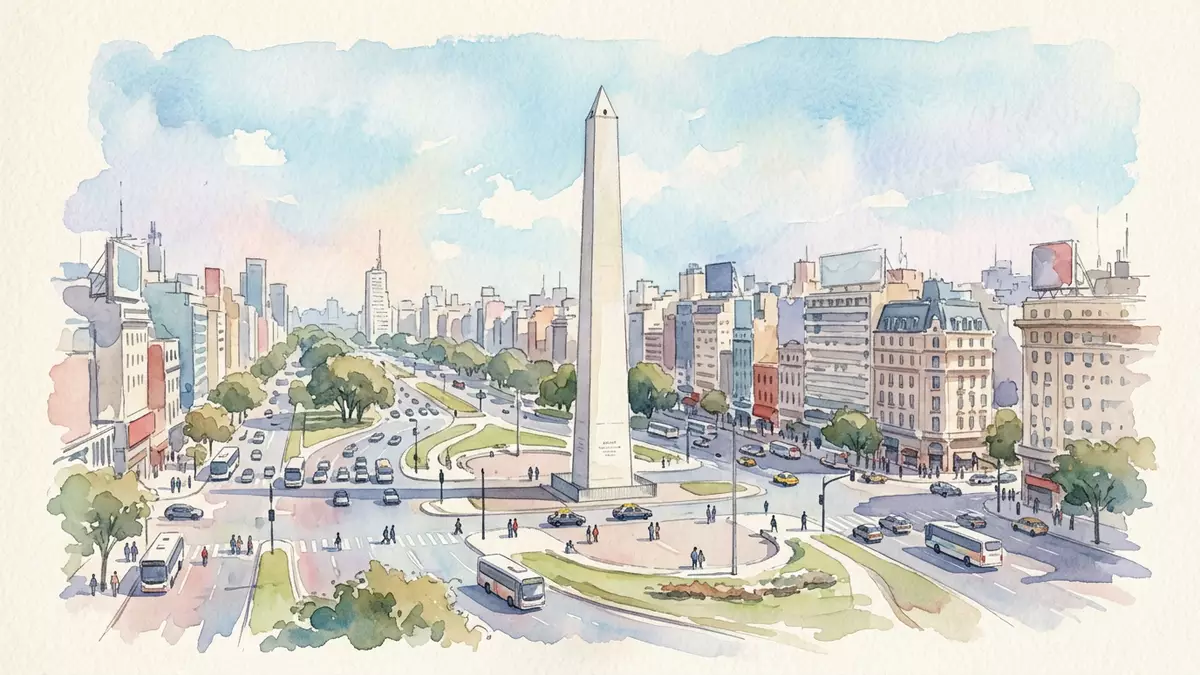
Obelisco in Buenos Aires is a slender reinforced-concrete monument rising above Plaza de la República at the junction of Avenida 9 de Julio and Avenida Corrientes, a point where colonial dates and multi-lane traffic meet in one vertical marker. Completed in 1936 to mark four hundred years since Pedro de Mendoza’s first foundation of Buenos Aires in 1536, it has become a fixed reference in the city’s central grid and a concise summary of Argentina’s twentieth-century urban ambitions.
Concrete marker at the crossing of 9 de Julio and Corrientes
Obelisco stands in the San Nicolás area of central Buenos Aires, at the centre of Plaza de la República where Avenida 9 de Julio and Avenida Corrientes intersect in a wide tangle of lanes and slip roads. The intersection brings together Corrientes, long associated with theatres and nightlife, and 9 de Julio, frequently described as among the widest urban thoroughfares in the world, so the monument reads against a backdrop of illuminated signs, bus traffic and broad asphalt rather than a traditional square.Plaza de la República at Corrientes and 9 de Julio
The shaft itself is cast in reinforced concrete, rising to around 67.5 m (221 ft) with a compact square base and plain surfaces that keep attention on its height rather than on any applied decoration.The obelisk’s height and material On each face, simple inscriptions refer to moments in Argentine and porteño history, including the founding of Buenos Aires and the first raising of the national flag at this spot, so that standing at its base means facing dates and names rather than allegorical figures or sculpted reliefs.References to the foundation and flag
Twentieth-century modernism and a four-hundred-year commemoration
The monument belongs firmly to the twentieth century in its design, even though its subject reaches back to the sixteenth century. It was inaugurated on 23 May 1936 as part of commemorations for the quadricentennial of the first foundation of Buenos Aires by the Spanish conquistador Pedro de Mendoza in 1536, a short-lived settlement that nonetheless became a starting point for later urban development and Argentine national narratives.Inauguration in May 1936 and concrete structure This pairing of dates is inscribed directly on the monument, which sets early colonial presence against the scale and geometry of interwar city planning.
Obelisco was designed by the Argentine modernist architect Alberto Prebisch, whose other work in Buenos Aires includes the Gran Rex Theatre on Avenida Corrientes, one of the city’s major Art Deco landmarks.Design by Alberto Prebisch and link to Gran Rex Theatre In Prebisch’s hands the monument took the form of a sharply edged prism with minimal detailing, aligning it with international modernist tendencies of the 1930s while still recalling the older typology of the commemorative obelisk. The choice of reinforced concrete and straightforward geometry mirrors broader changes in Buenos Aires at the time, when wide avenues were cut through existing blocks and new open spaces, including Plaza de la República, emerged among earlier building lines.
Experiencing Obelisco as an urban landmark
Approaching Obelisco on foot means stepping out onto a traffic island encircled by moving vehicles, with views along 9 de Julio towards the Río de la Plata and along Corrientes into the theatre district. From the base, the monument’s vertical line frames long perspectives down each avenue, acting as a visual hinge between diagonals and straight axes in the central grid.The obelisk as defining monument at the avenue crossing The inscriptions carved into the concrete faces stand at eye level and above, so visitors can read historical references while the traffic circulates around them, linking written dates on the shaft with the moving choreography of buses and cars below.
Inside the monument, a narrow internal staircase of steel ladders climbs to a small space near the top, used for maintenance and occasional authorised visits rather than everyday public access.Internal steel ladders for access There is no viewing platform for general visitors, so the experience of Obelisco is primarily from the outside, as part of the wider cityscape. At ground level, the monument’s concrete surface catches the changing daylight and artificial lighting from surrounding billboards, making it a neutral screen against which the colours of Buenos Aires’ central avenues constantly shift.
Visiting Obelisco: what travellers from Western Europe should know
- Obelisco stands on Plaza de la República in the San Nicolás area of Buenos Aires, at the junction of Avenida 9 de Julio and Avenida Corrientes, reached along the city’s central avenues.
- The monument rises from a paved island surrounded by multi-lane roads, with kerbs, pedestrian crossings and steps that require attention when moving between the pavements and the base.
- The official language is Spanish and the currency is the Argentine peso.
- Entry requirements depend on your nationality; UK travellers can check the FCDO travel advice at gov.uk/foreign-travel-advice, Irish travellers the Department of Foreign Affairs at ireland.ie.
Searching for Obelisco on social platforms
These links open searches for Obelisco on each platform.Frequently asked questions about Obelisco
Where is Obelisco located in Buenos Aires?
Obelisco stands on Plaza de la República in the San Nicolás area of central Buenos Aires, at the junction of Avenida 9 de Julio and Avenida Corrientes.
What can visitors expect when they reach Obelisco?
Visitors find a tall reinforced-concrete monument on a paved island surrounded by multi-lane roads, with historical inscriptions on its faces and broad views along the intersecting avenues.
What makes Obelisco distinctive among city landmarks?
Obelisco is distinctive for combining a modernist concrete form by Alberto Prebisch with commemorative inscriptions that tie its 1936 inauguration directly to Buenos Aires’ 1536 foundation and the first raising of the national flag at this site.


