
Obelisco and the hard geometry of Buenos Aires
Published on 09/15/2026 at 14:51 | Editorial responsibility: Rafael Müller, Editor-in-Chief AD HOC NEWS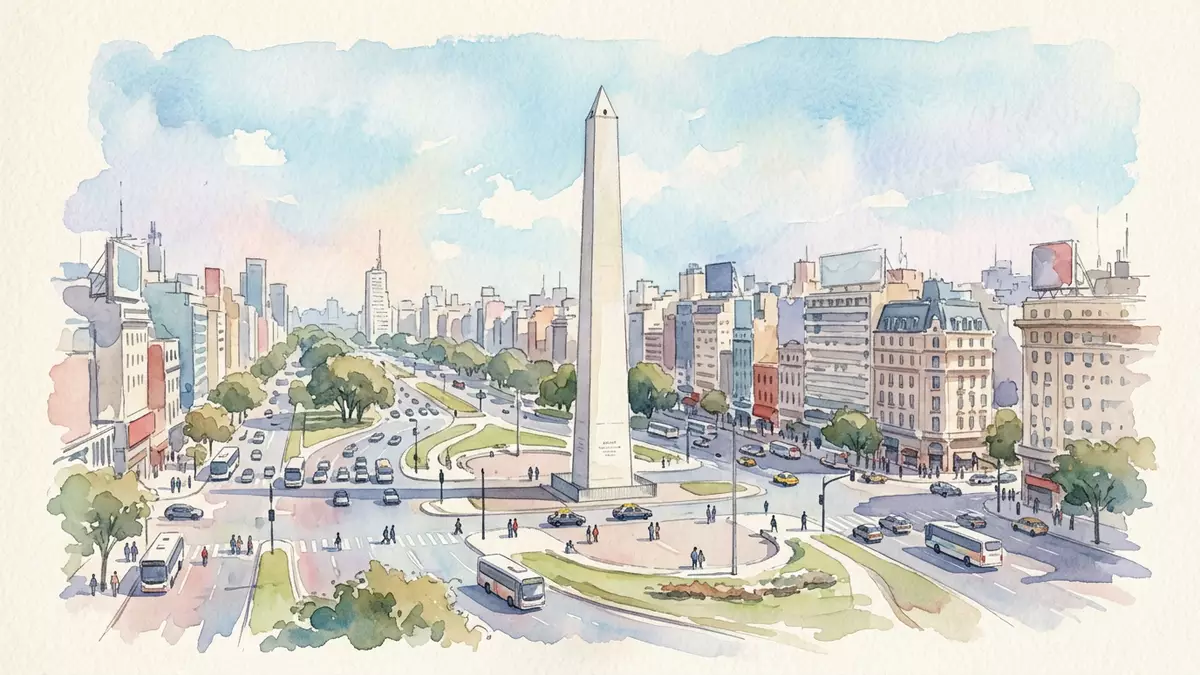
Obelisco rises from Plaza de la República in Buenos Aires as a slender concrete shaft faced with pale stone. Designed by Alberto Prebisch and inaugurated in 1936, it turns a city junction into a vertical landmark.
Alberto Prebisch and the 1936 city marker
The monument belongs to Buenos Aires modernism, with a stripped surface and a sharply simple outline. It stands at the meeting point of Avenida Corrientes and 9 de Julio, where the city opens into one of its most recognisable intersections. 1936 fixes it firmly in the interwar city, while Alberto Prebisch gives the work a clear author.
The obelisk was made as a commemorative monument for the four-hundredth anniversary of the city’s first foundation. Its form is austere rather than ornate, with straight faces that keep attention on the scale of the shaft itself. Pedro de Mendoza and the first foundation of Buenos Aires are built into its historical meaning, even as the object itself remains a plain concrete and stone form.
Four inscriptions and a civic address
The monument carries inscriptions on its faces, linking it to different moments in the city’s history. That gives the shaft a documentary surface as well as a sculptural one, and the effect is visible without any need for embellishment. The four faces are part of its identity, and the reference to Avenida Corrientes 1066 places it within the city centre rather than as an isolated monument.
The junction around it is broad and formal, with the obelisk set in an open plaza rather than tucked into a square of historic façades. That contrast between a spare vertical monument and a wide urban crossing is central to the place’s character. Plaza de la República is the named setting, and the monument’s location at the crossing of Corrientes, 9 de Julio and Diagonal Norte keeps it anchored in the city’s street plan.
Obelisco in the city’s memory
Obelisco is closely tied to Buenos Aires as a civic symbol, but the object itself is what matters most on site: a vertical marker of reinforced concrete, marked by inscriptions and a clean profile. The building material and the formal simplicity keep it legible at street level, even in a dense urban setting. reinforced concrete and white stone cladding give the shaft its hard, light surface.
The monument has the measured calm of a civic sign rather than the density of a narrative sculpture. Its power lies in the clarity of its outline, the directness of its siting and the way it marks a central crossing in Buenos Aires. Mariano de Vedia y Mitre and the 1936 decree belong to its history, but the monument remains readable first as an object in the city.
Visiting Obelisco: what travellers from Western Europe should know
- Obelisco stands in central Buenos Aires at Plaza de la República, by Avenida Corrientes and 9 de Julio. It is reached on foot from the surrounding streets and by the city’s main transport network.
- The monument is outdoors in a broad traffic-heavy crossing, so the immediate setting is open rather than enclosed. Nearby pavements and wide avenues shape the approach.
- The official language is Spanish and the currency is the Argentine peso.
- Entry requirements depend on your nationality; UK travellers can check the FCDO travel advice at gov.uk/foreign-travel-advice, Irish travellers the Department of Foreign Affairs at ireland.ie.
Searching for Obelisco on social platforms
These links open searches for Obelisco on each platform.
Frequently asked questions about Obelisco
Where is Obelisco?
It stands in Plaza de la República in central Buenos Aires, at the junction of Avenida Corrientes and 9 de Julio. The site is part of the city’s main street pattern.
What can be expected on a visit?
The monument is viewed from the street and the surrounding open plaza. It is a city landmark in a busy crossing rather than an enclosed museum space.
What makes Obelisco distinctive?
Its tall, spare shaft and white cladding give it a stark presence against the wide avenue network. The 1936 date and Alberto Prebisch’s design place it firmly within Buenos Aires modernism.


