
Obelisco and the clean lines of Buenos Aires
Published on 08/27/2026 at 22:30 | Editorial responsibility: Rafael Müller, Editor-in-Chief AD HOC NEWS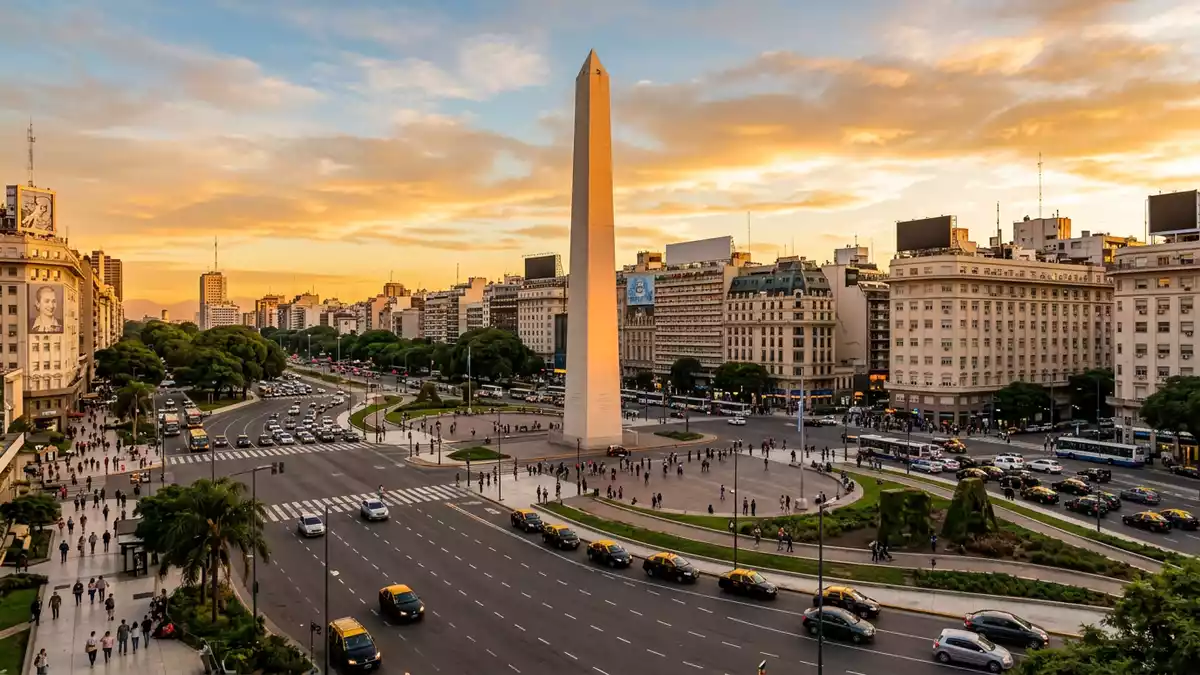
Obelisco rises from Plaza de la República as a slender concrete marker at the junction of Avenida Corrientes and Avenida 9 de Julio. It was erected in 1936, and its clear vertical profile remains the defining feature of the square.
Obelisco in the modern city centre
The monument is closely tied to Alberto Prebisch, the Argentine modernist architect behind its design. Its recorded height is 67.5 metres, and its white cladding keeps the form visually spare against the broad avenues around it.67.5 metres
The structure marks the city’s four-hundredth anniversary of its first foundation in 1536. It also stands on a site associated with the first raising of the Argentine national flag in Buenos Aires, which gives the monument a civic role beyond its geometry.Alberto Prebisch
A monument of 1936
The Obelisco belongs to the inter-war landscape of Buenos Aires, where modern public architecture often used strong volumes and a restrained surface. Its opening in 1936 places it within that wider period of civic rebuilding.1936
Concrete gives the monument its hard, uninterrupted outline, while the square around it keeps the eye on the single shaft rather than on ornament. The effect is architectural rather than decorative, with the obelisk form itself carrying the whole composition.reinforced concrete
What the structure records
Obelisco is more than a landmark at street level. The monument’s four sides are associated with inscriptions that recall episodes in the city’s history, including the first foundation, the second foundation and the flag-raising in 1812.city's history
That mix of vertical simplicity and historical reference gives the monument its lasting interest. It is a public object that works as a point in the city, a record of civic memory and a clear example of Buenos Aires modernism.Buenos Aires modernism
Visiting Obelisco: what travellers from Western Europe should know
- The monument stands in central Buenos Aires at Plaza de la República, where Corrientes meets 9 de Julio.
- It is a street monument, so the main view is from the pavement and from the surrounding avenues.
- The structure is tall and narrow, with a plain shaft that reads clearly from close range and from a distance.
- Its history is linked to Alberto Prebisch, Pedro de Mendoza and the year 1936.
Searching for Obelisco on social platforms
These links open searches for Obelisco on each platform.
Frequently asked questions about Obelisco
Where is Obelisco?
It stands in Plaza de la República in Buenos Aires, at the meeting point of Avenida Corrientes and Avenida 9 de Julio.
What should a visitor expect?
The monument is viewed from the surrounding streets and square. Its form is simple, tall and easy to read in the urban space.
What makes it distinctive?
Its 1936 origin, its association with Alberto Prebisch and its link to the city’s foundation narrative give it a strong civic identity.


