
Notre-Dame de Paris and the stone tapestry of Gothic France
Published on 09/14/2026 at 16:24 | Editorial responsibility: Rafael Müller, Editor-in-Chief AD HOC NEWS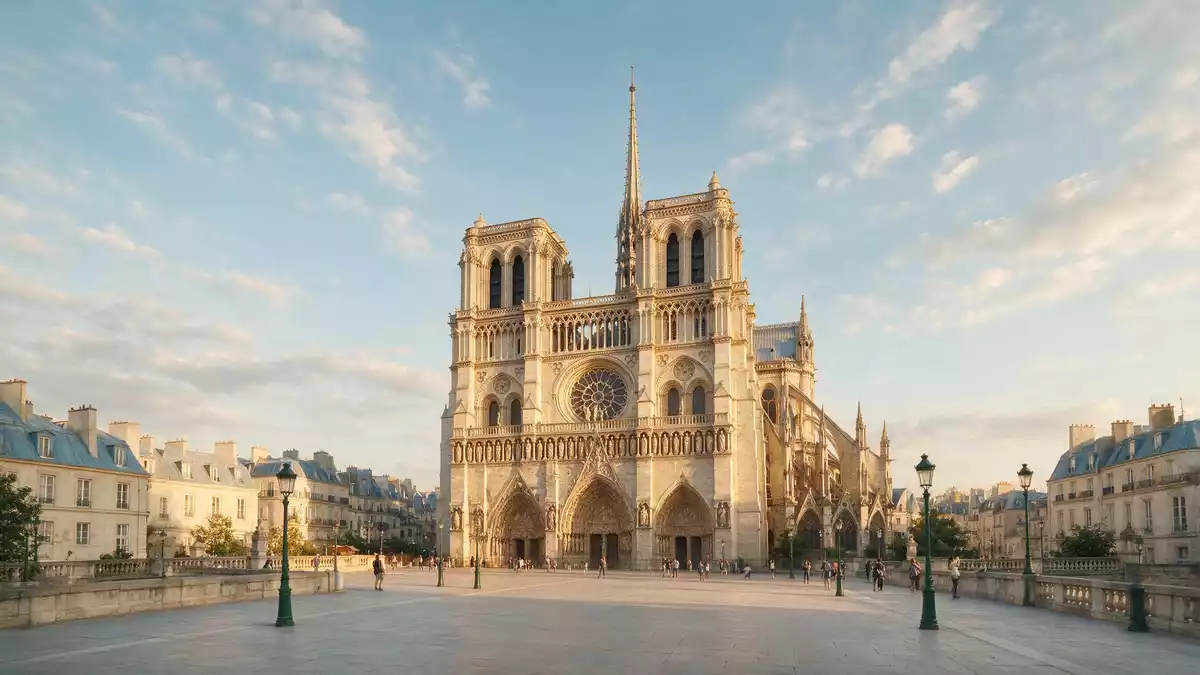
Notre-Dame de Paris is a medieval cathedral on the Île de la Cité in central Paris, where Gothic stone, sculpted façades and tall windows form one continuous tapestry of architecture and faith. Begun in the twelfth century under Bishop Maurice de Sully and developed over more than two hundred years, it anchors the city’s historic core and stands within the broader UNESCO listing of the banks of the Seine.
Gothic stone and light around the nave
The main body of Notre-Dame de Paris stretches along the eastern end of the Île de la Cité, its nave and choir aligned to form a long interior volume beneath ribbed vaults that are characteristic of French Gothic architecture.French Gothic architecture Construction of the choir and its surrounding ambulatories began in 1163, and by the late twelfth century the high altar was in place and liturgical services were already being held inside.construction of the choir The nave followed in stages, with the first bays, side aisles and galleries rising over the decades that bridged the end of the twelfth century and the opening of the thirteenth.
Outside, a ring of flying buttresses supports the upper walls around the choir and nave, transferring the weight of the vaults and roof to external supports so that large traceried windows could be opened in the stone.flying buttresses around the choir Inside these walls, stained glass filters daylight into coloured patterns, including the celebrated rose windows that were completed in the thirteenth century and sit above the transepts and western end of the cathedral.rose windows completed in the thirteenth century From the floor of the nave, the full height of the Gothic structure rises in layers of arcades, galleries and clerestory openings, giving the interior its distinctive vertical rhythm.
The western façade and towers over the parvis
The façade of Notre-Dame de Paris faces west towards the parvis, where visitors first encounter a wall of sculpted portals, arcades and towers that were completed in the thirteenth century and refined in subsequent campaigns.western façade and towers Work on the lower part of the façade and its portals was carried out in the early decades of the thirteenth century, followed by the upper stages and the twin towers, which stood largely complete around 1250.upper façade and towers The façade gathers multiple sculptural programmes, with figures of kings, saints and allegorical scenes arranged in horizontal bands and around the main doorways.
The two square towers rise above the façade with open galleries and belfry openings, forming a recognisable outline against the Paris skyline and offering views over the Seine and the surrounding city for those who climb the internal staircases.exceptional dimensions of the towers Between façade and interior lies a broad nave with side aisles and chapels, while the forecourt in front of the cathedral connects the building visually to the river and to other monuments on the island, including the Sainte-Chapelle nearby.neighbouring Sainte-Chapelle Seen from the parvis, the layered stonework of the façade, from portals to the gallery of statues, makes the front of Notre-Dame one of the most studied surfaces in European Gothic architecture.
Centuries of construction, alteration and heritage
Notre-Dame de Paris was conceived in the 1160s by Bishop Maurice de Sully, who launched a project to replace earlier churches on the site with a single, larger cathedral that reflected the developing Gothic style in France.Maurice de Sully in the 1160s The foundation stone was laid in 1163, and major stages of construction continued through the thirteenth century, with the building substantially complete by the mid-fourteenth century.years built 1163–1345 Over the eighteenth century the choir was reworked in the Baroque style under Cardinal de Noailles and architect Robert de Cotte, introducing new decoration and reconfiguring parts of the medieval interior.Baroque reworking of the choir
In the nineteenth century, extensive restoration was undertaken by Eugène Viollet-le-Duc and Jean-Baptiste Lassus, who repaired damage dating back to the French Revolution and introduced new elements that have themselves become part of the cathedral’s silhouette, including a central spire that replaced an earlier structure removed in the eighteenth century.restoration and nineteenth-century spire Across these phases, Notre-Dame de Paris has served as the stage for events in French history, among them the coronation of Henry VI of England in 1431 and Napoleon’s imperial coronation in 1804, reinforcing its role as a national symbol as well as an architectural landmark.historic coronations at Notre-Dame Its location on the Île de la Cité places it within the ensemble of the “Paris, Banks of the Seine” World Heritage site, connecting the cathedral to a wider river landscape of bridges, quays and monuments.
Visiting Notre-Dame de Paris: what travellers from Western Europe should know
- Notre-Dame de Paris stands on the eastern part of the Île de la Cité in central Paris, reached by bridges across the Seine and by Métro stations such as Cité and Saint-Michel nearby.
- The forecourt in front of the cathedral is paved, and access to the towers involves climbing a long internal staircase that is narrow and steep in places.
- The official language is French and the currency is the euro.
Searching for Notre-Dame de Paris on social platforms
These links open searches for Notre-Dame de Paris on each platform.
Frequently asked questions about Notre-Dame de Paris
Where is Notre-Dame de Paris located within Paris?
Notre-Dame de Paris stands on the eastern side of the Île de la Cité, an island in the Seine at the historic centre of Paris.
What should a visitor expect on a first visit?
A visit centres on the Gothic nave, sculpted western façade and towers, with stone vaults, stained glass and exterior buttresses forming the main architectural experience.
What makes Notre-Dame de Paris distinctive among cathedrals?
Its long construction history from 1163 to the fourteenth century, early use of flying buttresses and extensive sculptural and stained-glass decoration give it a distinctive place in Gothic architecture.


