
Notre-Dame de Paris and the stone geometry of faith
Published on 09/12/2026 at 09:53 | Editorial responsibility: Rafael Müller, Editor-in-Chief AD HOC NEWS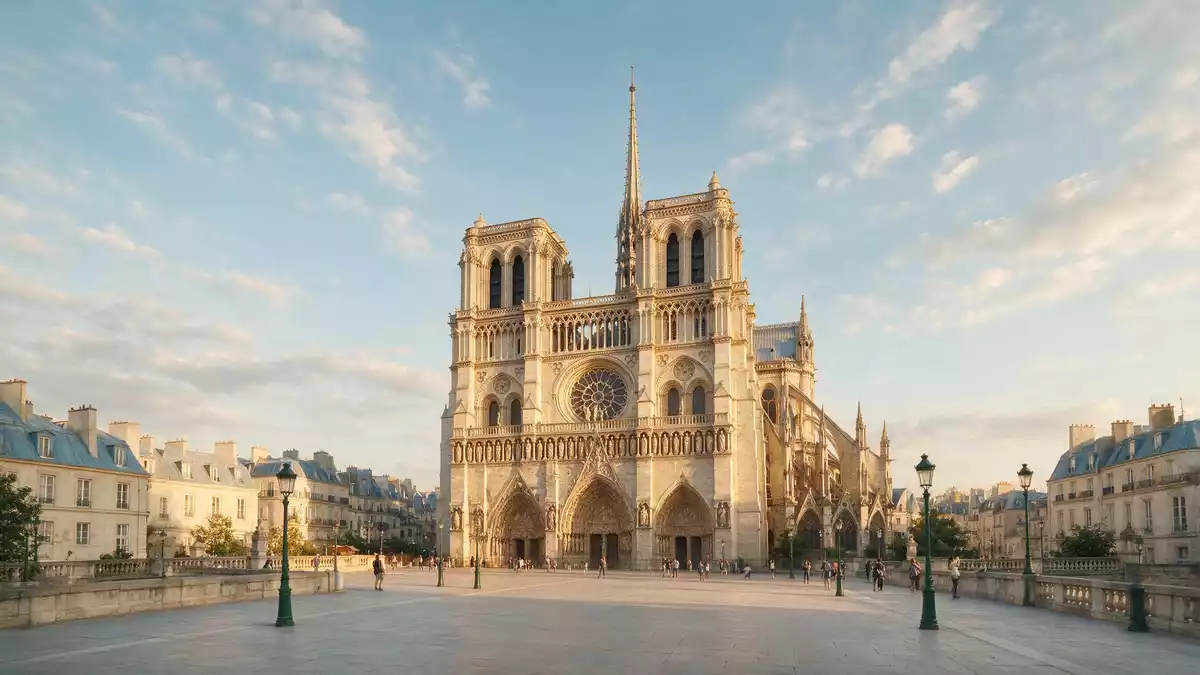
Notre-Dame de Paris rises over the eastern tip of the Île de la Cité as a vast stone structure, its long nave and twin western towers defining one of Paris’s most recognisable river silhouettes. Conceived in the twelfth century under Bishop Maurice de Sully and built over nearly two hundred years, it became the cathedral church of the Archdiocese of Paris and an early, ambitious expression of French Gothic architecture.
A Gothic stone vessel on the Seine
The cathedral stands on the Île de la Cité, a small island in the River Seine set within the 4th arrondissement, occupying the eastern end of the island above the river embankments. Its site is recorded as Parvis Notre-Dame – Place Jean-Paul-II in Paris, marking the paved forecourt in front of the main façade.Parvis Notre-Dame – Place Jean-Paul-II The cathedral’s plan follows a Latin cross, with a long nave, a short transept crossing it, and a choir and apse extending eastwards towards the tip of the island.choir and apse, short transept and nave
In measurable terms Notre-Dame de Paris is a substantial building: its overall length reaches about 128 m (420 ft), with a width of around 48 m (157 ft) across the nave and aisles.Length 128 metres and width 48 metres The interior roof of the nave rises to roughly 35 m (115 ft) above the floor, creating a tall volume of stone arcades, clerestory windows and ribbed vaults. At the west end, two square towers climb to about 69 m (226 ft), forming the familiar pair visible from the river quays and nearby bridges.
Building a cathedral across centuries
The decision to build Notre-Dame de Paris was taken in the twelfth century, when Maurice de Sully became bishop of Paris and initiated a new cathedral on the island. The laying of the first stone is recorded for 1163 in the presence of Pope Alexander III, marking the formal start of construction on the Gothic church that replaced earlier religious buildings on the site.first stone in 1163 in the presence of Pope Alexander III Work on the choir and its surrounding ambulatories occupied the initial phase from the 1160s into the 1180s, giving the eastern part of the church its core form.construction of the choir and ambulatories beginning in 1163
The western façade, nave and towers followed in the thirteenth century, extending the building westwards towards the present parvis. Construction and refinement continued through successive campaigns led by named master builders such as Jehan de Chelles, Pierre de Montreuil, Pierre de Chelles and Jean Ravy, among others listed in historical records.sequence of architects from Jehan de Chelles to Raymond Du Temple The works are generally dated from 1163 to around the middle of the fourteenth century, with completion often given as 1345, reflecting a building history that spans the late twelfth and thirteenth centuries into the early decades of the fourteenth century.construction began in 1163 and building work completed in 1345
Forms and details of French Gothic architecture
Notre-Dame de Paris is widely recognised as a major example of French Gothic architecture, with structural and decorative features that have influenced other churches. Its exterior displays tall pointed arches, clustered columns and a dense articulation of mouldings and sculpted portals on the western front. The cathedral’s design employs flying buttresses to carry the thrust of the high vaults outwards onto external supports, a characteristic technique of Gothic construction that allowed the walls to be opened with large windows.description of flying buttresses, choir and transepts
The interior plan combines a central nave flanked by double aisles and lined with square chapels, forming a sequence of bays leading from the western doors to the choir. High stone vaults spring from columns and respond to the rhythm of the bays, while stained glass windows set in the clerestory and transepts introduce coloured light into the space. Among these, the large rose windows of the north and south transepts, with diameters in the region of 13 m (around 43 ft), are particularly associated with the cathedral and preserve significant thirteenth-century glass in at least one case.rose windows and thirteenth century glass The organ, assembled over centuries, is noted for having thousands of pipes and is regarded as one of the largest church organs in France.organ thought to be the largest in France
Visiting Notre-Dame de Paris: what travellers from Western Europe should know
- Notre-Dame de Paris stands at the eastern end of the Île de la Cité, in the 4th arrondissement of Paris, on the Parvis Notre-Dame – Place Jean-Paul-II beside the River Seine. It is reached on foot from nearby bridges that link the island with the surrounding city.
- The forecourt in front of the cathedral is a broad paved square, and access to views of the façade involves walking across level stone surfaces; inside the church, the main volume is arranged along a gently rising floor under high vaults, with chapels and aisles extending to either side.
- The building lies within central Paris, where French is the official language and the currency is the euro.
Searching for Notre-Dame de Paris on social platforms
These links open searches for Notre-Dame de Paris on each platform.
Frequently asked questions about Notre-Dame de Paris
Where is Notre-Dame de Paris located within Paris?
Notre-Dame de Paris stands on the Île de la Cité, at the eastern end of the island in the River Seine, in the 4th arrondissement of Paris.
What should visitors expect when entering the cathedral?
Visitors encounter a tall Gothic interior with a long nave, double aisles, chapels and high ribbed vaults, with stained glass windows admitting coloured light into the stone space.
What makes Notre-Dame de Paris distinctive among European cathedrals?
Its combination of early French Gothic architecture, measurable scale, elaborate western façade, flying buttresses and prominent river-island location makes Notre-Dame de Paris an especially recognisable medieval cathedral.


