
Notre-Dame de Paris and the stone forest of Gothic Paris
Published on 08/16/2026 at 15:00 | Editorial responsibility: Rafael Müller, Editor-in-Chief AD HOC NEWS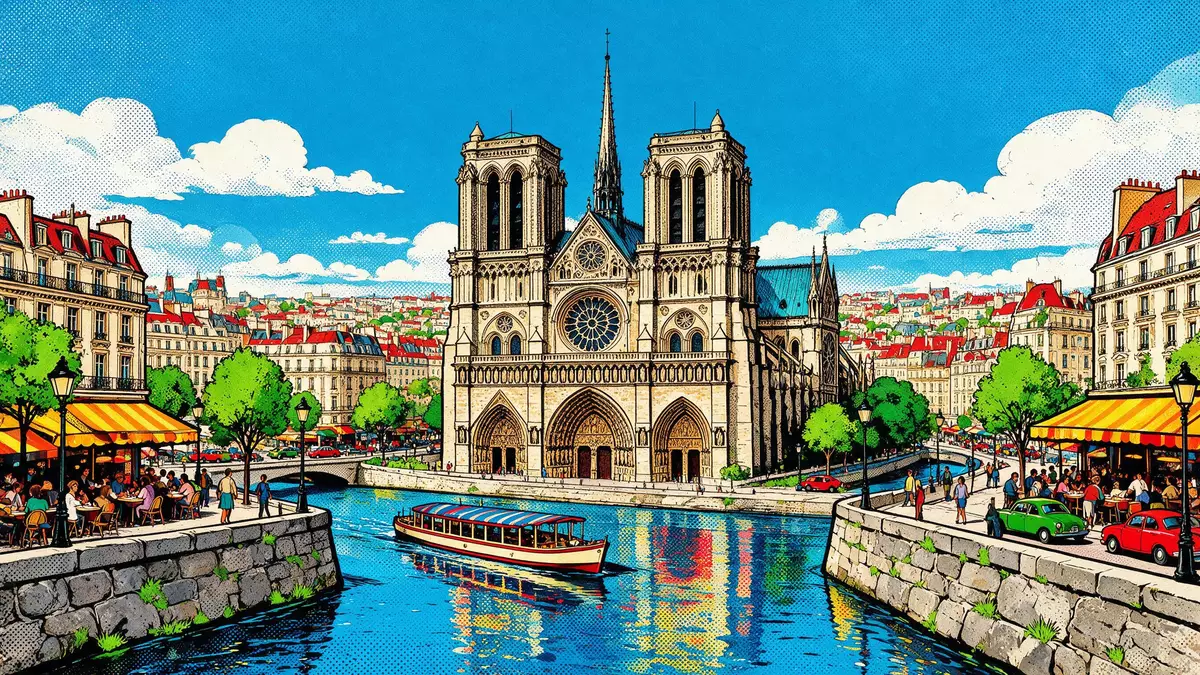
Notre-Dame de Paris anchors the centre of Paris like a stone forest rising from the River Seine, its towers, vaults and sculpture binding the city to its medieval past. Built as the cathedral of the Archdiocese of Paris on the eastern end of the Île de la Cité, it grew over centuries into one of the defining works of Gothic architecture in Europe.
Gothic architecture in stone and light
Notre-Dame de Paris is a medieval Catholic cathedral on the Île de la Cité, an island in the River Seine in the 4th arrondissement of Paris.medieval Catholic cathedral Its construction began in 1163 under King Louis VII, during a phase when Gothic builders pushed stone and glass to unprecedented heights.Construction began in 1163 Work continued into the fourteenth century, so the cathedral shows several layers of Gothic style in one monumental structure.
The building stretches to around 128 m (420 ft) in length, with a width of about 48 m (157 ft) across the transept, and its nave vaults rise to roughly 35 m (115 ft) above the floor.interior dimensions and height At the western end, the two towers climb to around 69 m (226 ft), creating the familiar outline seen from the quays on both banks of the Seine.tower height Flying buttresses brace the outer walls, stepping out towards the river and making the weight of the stone structure legible from the outside.
Sculpted façade and interior details
The west façade of Notre-Dame de Paris forms a stone screen divided into horizontal bands, with portals, a gallery of kings and the great rose window set one above another. Figures from biblical history line the portals, while carved foliage and creatures fill the spaces between them in high and low relief. The façade has become one of the best-known faces of Gothic architecture, combining structural clarity with dense storytelling in sculpture.
Inside, the plan extends as a Latin cross, with a long nave, side aisles and a projecting choir, all framed by tall clustered piers and ribbed vaults. The three great rose windows of the cathedral mark the transepts and west front, and at least one retains thirteenth-century stained glass in its tracery.thirteenth-century glass in the rose window The play of coloured glass and stone ribs gives each arm of the cross a distinct character, while still reading as part of a single continuous volume.
Historical layers on the Île de la Cité
The first stone of Notre-Dame de Paris was laid in 1163, traditionally in the presence of Pope Alexander III, and the cathedral was largely completed by 1345.from first stone to completion in 1345 The long construction period brought a succession of master builders, including figures such as Jehan de Chelles and Pierre de Montreuil, whose names recur in accounts of French Gothic work.phases of construction under successive masters Later centuries added restorations and adjustments, most famously the nineteenth-century campaign led by Eugène Viollet-le-Duc.
The cathedral stands within the section of the Seine banks between Pont de Sully and Pont d’Iéna, an area listed as a UNESCO World Heritage Site that brings together major monuments and historic riverfronts.UNESCO listing of the Seine banks Its forecourt opens towards the rest of the Île de la Cité, while bridges connect the island to the surrounding districts of Paris, placing the cathedral at a literal crossroads of the city’s historic core.
Visiting Notre-Dame de Paris: what travellers from Western Europe should know
- Notre-Dame de Paris stands on the eastern end of the Île de la Cité in central Paris, a short walk from the bridges linking the island to the Right and Left Banks.
- The surrounding area is level, but movement around the cathedral brings cobbled paving, kerbs and steps, especially near the river quays and older streets.
- The closest Paris Métro stop is Cité on Line 4, with other nearby stations including Saint-Michel Notre-Dame on the RER B and C lines.
- The official language is French and the currency is the euro.
Searching for Notre-Dame de Paris on social platforms
These links open searches for Notre-Dame de Paris on each platform.Frequently asked questions about Notre-Dame de Paris
Where is Notre-Dame de Paris located in Paris?
Notre-Dame de Paris stands on the eastern end of the Île de la Cité in the 4th arrondissement, surrounded by the River Seine in central Paris.
What should visitors expect when exploring the cathedral area?
Visitors encounter a large forecourt, stone paving and views of towers, buttresses and façades, with streets and river quays radiating away from the cathedral.
What makes Notre-Dame de Paris distinctive among cathedrals?
Its combination of tall Gothic vaults, sculpted façades, rose windows and its position on the Seine within a UNESCO-listed river landscape gives it a distinctive character.


