
Notre-Dame de Paris and the stone drama of Gothic Paris
Published on 09/04/2026 at 16:44 | Editorial responsibility: Rafael Müller, Editor-in-Chief AD HOC NEWS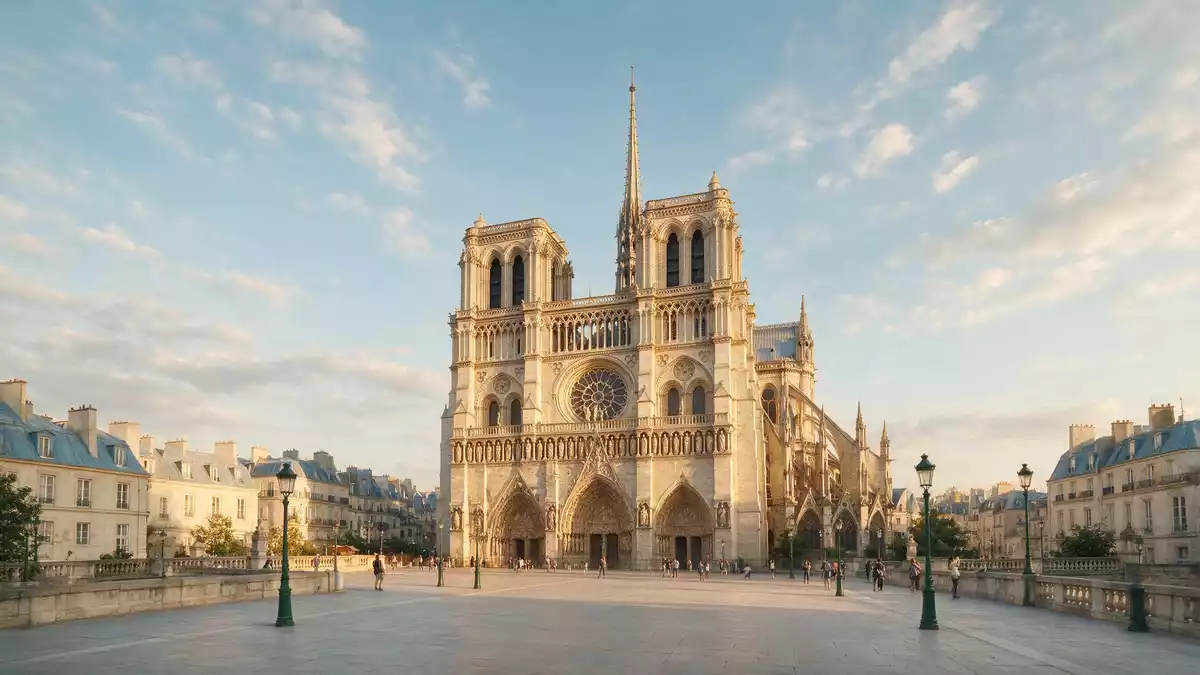
Notre-Dame de Paris stands on the eastern end of the Île de la Cité in central Paris, a vast Gothic cathedral that has shaped the city’s silhouette since the twelfth century.Île de la Cité The cathedral was commissioned under Bishop Maurice de Sully, with construction beginning in 1163 and extending across the following two centuries, giving the building its layered medieval character.construction beginning in 1163
A cathedral built over centuries of Gothic experimentation
The core of Notre-Dame de Paris belongs to the era when French Gothic architecture emerged as a distinct style, and its fabric records how the builders refined that language over time.French Gothic architecture Work on the choir began in the 1160s, followed by the nave and galleries, and later the western façade and its towers, with major phases of construction stretching from the mid-twelfth century to around 1250.major phases of construction Further additions and adjustments continued into the fourteenth century, leaving Notre-Dame as a building whose details span several generations of masons and designers.
The cathedral’s plan places the choir at the eastern end, surrounded by ambulatories and chapels, with the long nave stretching westward towards the city-facing façade.choir and ambulatories Stone rib vaults rise above the aisles and central vessel, while flying buttresses step out from the upper walls to carry loads down to the ground, marking Notre-Dame as one of the early great experiments in Gothic skeletal construction.flying buttresses
Stone, sculpture and light on the western façade
The western façade of Notre-Dame de Paris facing the Parvis de Notre-Dame is one of the most recognisable pieces of Gothic architecture, built in stages through the late twelfth and early thirteenth centuries.western façade It sets a great wall of pale limestone punctuated by portals, a horizontal gallery of statues, and the large central window above, all framed by the two massive towers that mark the cathedral in views across the Seine.two towers completed around 1250
Above the main entrance zone, the façade’s sculpted bands and tracery form a stone screen in front of the interior, while the towers rise as plain vertical masses with openings cut into their upper levels.Notre-Dame Cathedral Paris From the parvis, the transition from broad sculpture to the geometric openings of the upper façade shows how Gothic builders combined narrative carving with structural clarity in a single monumental front.
Interior perspectives and historical layers
Inside Notre-Dame de Paris, stone piers rhythmically divide the nave from its aisles, leading the eye towards the choir and high altar that were in use by the 1180s.high altar consecrated in 1182 Light enters through tall windows and large roses in the transepts, elements associated with the later Radiant Gothic phase that reshaped the upper parts of the building in the thirteenth century.Radiant Gothic transept roses
The cathedral carries later interventions within its medieval frame, including eighteenth-century changes to the choir and the extensive nineteenth-century restoration directed by Eugène Viollet-le-Duc.eighteenth-century choir changes Over its history, Notre-Dame has hosted major events such as the coronation of Napoleon Bonaparte as Emperor of the French in 1804, giving the building a political as well as religious role in French national life.Napoleon crowned Emperor
Visiting Notre-Dame de Paris: what travellers from Western Europe should know
- Notre-Dame de Paris stands on the Île de la Cité in central Paris, on the eastern side of the island, close to the Seine embankments and bridges.
- The forecourt in front of the western façade is a broad paved space, and approaches from the riverside and nearby streets involve short stretches on foot over level ground.
- The official language is French and the currency is the euro.
Searching for Notre-Dame de Paris on social platforms
These links open searches for Notre-Dame de Paris on each platform.Frequently asked questions about Notre-Dame de Paris
Where is Notre-Dame de Paris located in Paris?
Notre-Dame de Paris stands on the eastern end of the Île de la Cité, an island in the Seine at the historic centre of Paris.
What can visitors expect when they see Notre-Dame de Paris?
Visitors encounter a vast Gothic stone structure with a sculpted western façade, high interior vaults, and views across the river from the surrounding quays.
What makes Notre-Dame de Paris distinctive among European cathedrals?
Its long construction from 1163 into the fourteenth century, early use of flying buttresses, and role in major French historical events give it a particular architectural and cultural weight.


