
Notre-Dame de Paris and the stone drama of Gothic light
Published on 08/25/2026 at 22:47 | Editorial responsibility: Rafael Müller, Editor-in-Chief AD HOC NEWS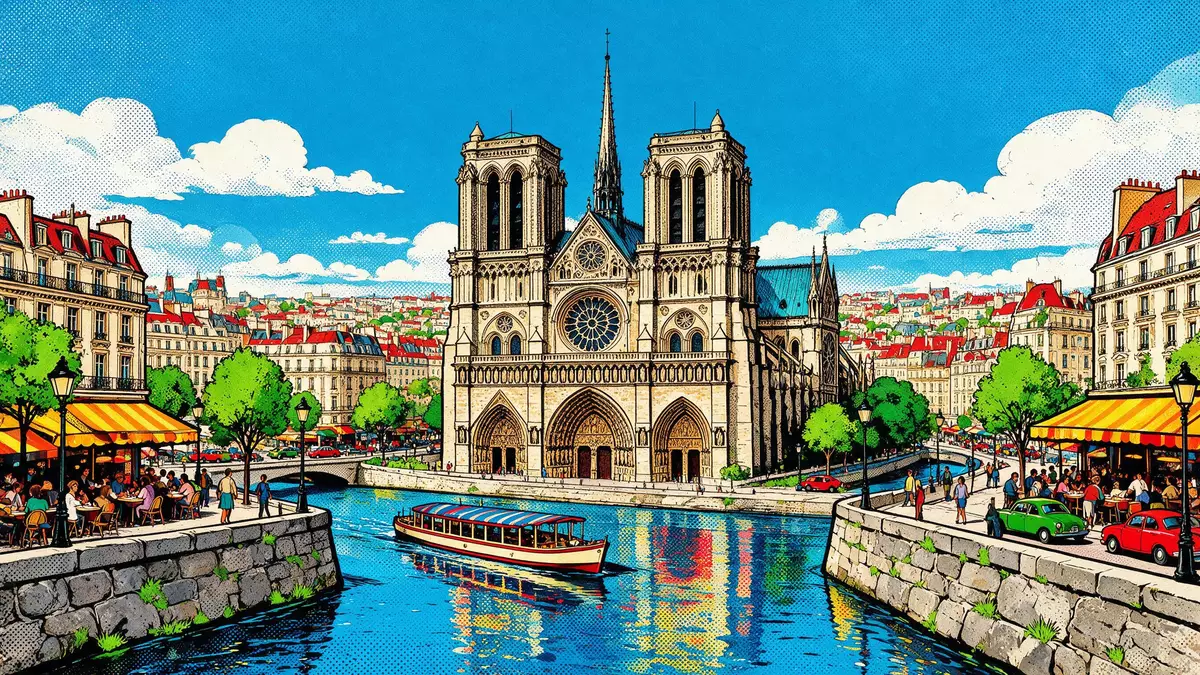
Notre-Dame de Paris stands on the eastern end of the Île de la Cité in central Paris, a French Gothic cathedral where stone and glass form a monumental drama of light and height.French Gothic cathedral Construction began in 1163 under Bishop Maurice de Sully and extended across the thirteenth and fourteenth centuries, giving the building a layered structure that reflects more than two hundred years of craftsmanship.Construction began in 1163
A cathedral shaped by centuries of building
The core of Notre-Dame de Paris took shape between the 1160s and the mid thirteenth century, with successive campaigns defining the choir, nave, western façade and towers.construction phases from 1163 to 1250 Work on the choir and its surrounding passages began soon after the foundation stone was laid, followed by the long nave, side aisles and the galleries that run above them.
By the early thirteenth century the main façade rose over the Seine, its sculpted portals and vertical organisation announcing the cathedral to the city, and the towers reached their full height around the middle of the century.upper façade and towers completed around 1250 Later medieval work continued into the fourteenth century, refining the upper levels, chapels and buttresses, so that the building visible today carries masonry from several phases of Gothic development.years built 1163–1345
French Gothic architecture in stone, glass and space
Notre-Dame de Paris is one of the clearest statements of French Gothic architecture, combining pointed arches, ribbed vaults and flying buttresses into a coherent structural system.French Gothic architecture The exterior buttresses step out from the main walls, carrying the thrust of the stone vaults down into the ground and freeing the upper levels for large areas of stained glass.
Inside, the high nave creates a tall volume of space, framed by clustered columns and arches that rise towards the vaults, while side aisles and chapels form a sequence of smaller spaces around the central core.constructed between the 12th and 14th centuries The great rose windows at the ends of the transepts belong to the Radiant Gothic phase of the early thirteenth century, with complex tracery spreading across the circular openings and coloured glass set into carefully balanced geometric patterns.Radiant Gothic roses and transepts
Notre-Dame de Paris as a historical and urban landmark
The cathedral occupies a central position on Île de la Cité, the island in the Seine that forms the historic core of Paris and has been a religious site since the early centuries of Christianity.symbol of Christian worship through the centuries The building has witnessed royal ceremonies, revolutions and restorations, including major works in the eighteenth and nineteenth centuries and large-scale nineteenth-century interventions by Eugène Viollet-le-Duc that reshaped parts of the decoration and structure.restoration by Viollet-le-Duc
Notre-Dame de Paris forms part of the Paris, Banks of the Seine ensemble that was inscribed on the UNESCO World Heritage List in 1991, recognising the cathedral and its surroundings as a major cultural landscape.World Heritage Site since 1991 From the parvis in front of the west façade, the twin towers, central portal and sculptural bands align with the urban grid of bridges, quays and neighbouring monuments, so that the cathedral reads as both a religious centre and an organising point in the city’s historic fabric.location on Île de la Cité in the 4th arrondissement
Visiting Notre-Dame de Paris: what travellers from Western Europe should know
- Notre-Dame de Paris stands on the eastern half of Île de la Cité in the 4th arrondissement of Paris, reached by bridges across the Seine and nearby metro stations.
- The area around the cathedral is paved, with steps on the approaches to the parvis and entrances, and narrow passages in some parts of the historic interior.
- The cathedral lies close to the Sainte-Chapelle and the river quays, so monuments, bridges and the island’s streets can be combined within a short walking circuit.
- France’s official language is French and the currency is the euro.
Searching for Notre-Dame de Paris on social platforms
These links open searches for Notre-Dame de Paris on each platform.
Frequently asked questions about Notre-Dame de Paris
Where is Notre-Dame de Paris located in Paris?
Notre-Dame de Paris stands at 6 Parvis Notre-Dame – Place Jean-Paul II on the eastern end of Île de la Cité in the 4th arrondissement of Paris.
What can travellers expect when visiting the cathedral?
Travellers encounter a large Gothic cathedral with a tall nave, sculpted west façade, towers overlooking the Seine and an interior organised into nave, aisles, transepts and chapels.
What makes Notre-Dame de Paris distinctive among cathedrals?
Its extended building history from 1163 into the fourteenth century, Radiant Gothic roses, prominent river-island setting and recognised World Heritage status together give Notre-Dame de Paris a distinctive character.


