
Notre-Dame de Paris and the reach of Gothic stone
Published on 09/16/2026 at 18:24 | Editorial responsibility: Rafael Müller, Editor-in-Chief AD HOC NEWS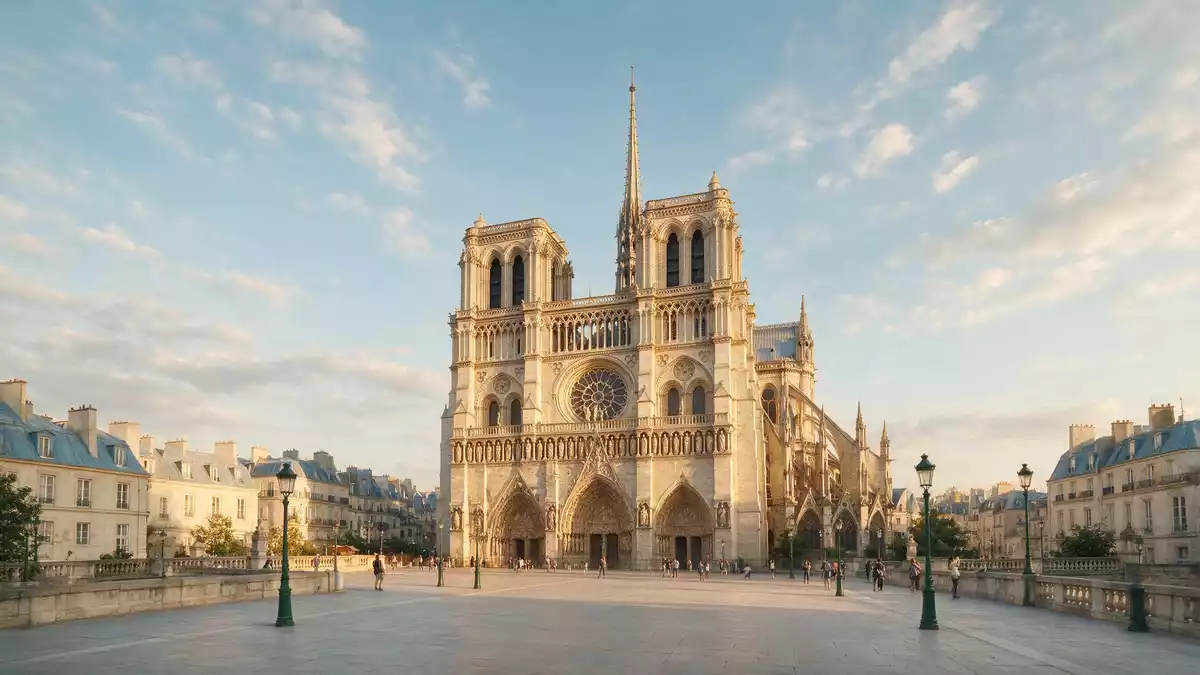
Notre-Dame de Paris rises over the eastern end of the Île de la Cité, its Gothic stone mass defining one of the most recognisable silhouettes on the Seine. Conceived in the twelfth century under Bishop Maurice de Sully and built across nearly two hundred years, it gathers medieval engineering, royal ceremony and literary myth into one vast structure.
A Gothic cathedral built over centuries
The project for Notre-Dame de Paris took shape under Maurice de Sully, bishop of Paris, who initiated construction in 1163 on the compact island at the centre of the city.bishop of Paris Maurice de Sully The cathedral belongs to the French Gothic tradition, with pointed arches, ribbed vaults and flying buttresses used on a large scale to carry masonry and channel loads away from the walls.French Gothic tradition
Main construction ran from 1163 into the fourteenth century, with work on the choir, nave, façade, towers and transept chapels advancing in phases rather than as a single campaign.construction phases from 1163 The result is a stone building about 127 m (417 ft) long, with a nave vault around 33 m (108 ft) high and twin western towers rising roughly 69 m (226 ft), proportions that give the interior a strong vertical emphasis.length and nave height
Structure, façades and sculpted stone
Seen from the west, the main façade of Notre-Dame de Paris stacks three horizontal levels of stonework: large entrance portals at ground level, a gallery of figures above them and the openings of the upper storeys framed by tracery and massive masonry. Construction of this front advanced in the decades around 1200, with work on the portals recorded between 1208 and 1225 and the upper parts and towers continuing into the middle of the thirteenth century.portals and upper façade chronology
The side elevations reveal flying buttresses spanning from the outer walls towards the upper nave, elements that allow high windows and slender internal supports. Around the transepts, large stone roses puncture the walls, set within façades developed in stages from the mid-thirteenth century under masters such as Jehan de Chelles and Pierre de Montreuil.north and south transept work Inside, sexpartite rib vaults span the nave, their stone ribs converging on clustered columns and directing weight down to the floor.
Notre-Dame de Paris in French history and culture
Notre-Dame de Paris has long been a stage for major events in French political and religious life. In 1804 Napoleon Bonaparte crowned himself Emperor of the French inside the cathedral, adopting a ceremony that placed the Gothic interior at the centre of a new imperial image.Napoleon’s coronation in 1804 Earlier, during the French Revolution in the 1790s, the building suffered desecration and changes of use that damaged much of its religious imagery.French Revolution damage
In the nineteenth century Notre-Dame de Paris was extensively restored under architects including Eugène Viollet-le-Duc, whose campaigns from the 1840s added a slender spire above the crossing and recreated many sculptural details.Viollet-le-Duc’s restoration Victor Hugo’s 1831 novel “Notre-Dame de Paris”, known in English as “The Hunchback of Notre-Dame”, fixed the cathedral in European imagination, tying its stonework, bells and gargoyles to a dramatic story set among the medieval streets of Paris.Victor Hugo’s novel
Visiting Notre-Dame de Paris: what travellers from Western Europe should know
- Notre-Dame de Paris stands on the Île de la Cité in central Paris, a short walk from the bridges over the Seine and reachable by the city’s Métro and RER lines.
- The site itself is level at street height, but the cathedral interior includes stone steps and staircases, particularly in the towers, where the ascent follows a narrow spiral route.
- The official language is French and the currency is the euro.
Searching for Notre-Dame de Paris on social platforms
These links open searches for Notre-Dame de Paris on each platform.
Frequently asked questions about Notre-Dame de Paris
Where is Notre-Dame de Paris located in Paris?
Notre-Dame de Paris stands at the eastern tip of the Île de la Cité, the island in the Seine that forms the historic centre of Paris.
What should visitors expect when entering the cathedral?
Visitors encounter a tall Gothic nave carried on clustered stone columns, with ribbed vaults overhead and chapels lining the aisles along both sides.
What makes Notre-Dame de Paris distinctive among European cathedrals?
Its combination of early Gothic engineering, monumental west façade, extensive restorations and close ties to French political history and literature gives the building a particular resonance.


