
Notre-Dame de Paris and the Gothic core of Paris
Published on 08/28/2026 at 08:31 | Editorial responsibility: Rafael Müller, Editor-in-Chief AD HOC NEWS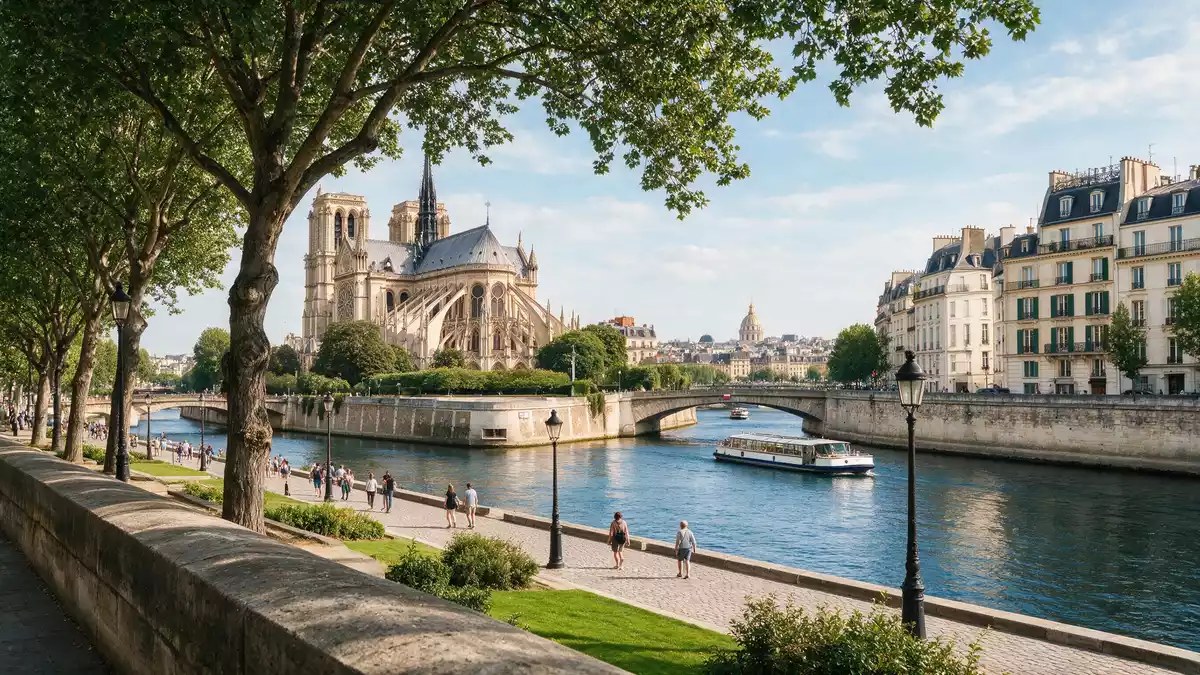
Notre-Dame de Paris rises on Île de la Cité in Paris as a great Gothic cathedral of limestone and stone vaulting. Begun under Maurice de Sully in 1163, it remains one of the city’s defining medieval monuments.
The cathedral on Île de la Cité
The building stands near the eastern end of the island, beside the Seine, and its west front is framed by twin towers. Its plan, long nave and flying buttresses belong to the great Gothic phase of French church building, while the fabric reflects work carried out over centuries. 1163 under Maurice de Sully is the date most closely linked with the start of construction, and the cathedral was largely complete by the mid-fourteenth century.
Inside, the cathedral is a sequence of stone bays, columns and side chapels gathered around the nave. the high altar was consecrated in 1189, placing the building firmly within the liturgical life of medieval Paris.
A building shaped by worship and ceremony
Notre-Dame de Paris is closely tied to the religious and political life of France. Napoleon crowned himself emperor there in 1804, and the cathedral has also served as a setting for major national ceremonies. The history of Notre-Dame shows a building that has moved between worship, ceremony and restoration without losing its core identity.
The nineteenth-century restoration associated with Eugène-Emmanuel Viollet-le-Duc added a new spire and renewed much of the cathedral’s profile. The result is a medieval structure with a visible restoration history, where masonry, tracery and sculpture belong to different campaigns yet read as one composition. the banks of the Seine form part of the wider Paris World Heritage setting.
Stone, vaults and the western front
The western façade gives Notre-Dame de Paris its most recognisable face, with portals below, a large central rose window and paired towers above. The structure’s stone ribs and buttresses carry the eye through a building that combines height with a dense surface of carving and openings.
From close by, the cathedral reads as a layered work of medieval engineering and later conservation. Its long nave, transept and choir make the interior a processional space, while the outside remains compact against the river island on which it stands. UNESCO World Heritage site status underlines its place in the historic centre of Paris.
Visiting Notre-Dame de Paris: what travellers from Western Europe should know
- The cathedral stands on Île de la Cité in central Paris, within easy reach of the city’s Métro network and the Seine quays.
- The main approach is on level city streets, and the building itself presents broad steps and a raised threshold at the western front.
- The interior is a large stone church with a long nave, side aisles and chapels.
- Entry requirements depend on your nationality; UK travellers can check the FCDO travel advice at gov.uk/foreign-travel-advice, Irish travellers the Department of Foreign Affairs at ireland.ie.
Searching for Notre-Dame de Paris on social platforms
These links open searches for Notre-Dame de Paris on each platform.
Frequently asked questions about Notre-Dame de Paris
Where is Notre-Dame de Paris?
It stands on Île de la Cité in Paris, close to the Seine. The cathedral is part of the historic centre of the French capital.
What does a visit involve?
The visit centres on the exterior, the west front and the interior of a large Gothic church. Stone vaults, chapels and the long nave give the building its scale.
What makes Notre-Dame de Paris distinctive?
Its Gothic structure, western façade and deep historical associations make it one of Paris’s most familiar landmarks. The building combines medieval form with later restoration in a single silhouette.


