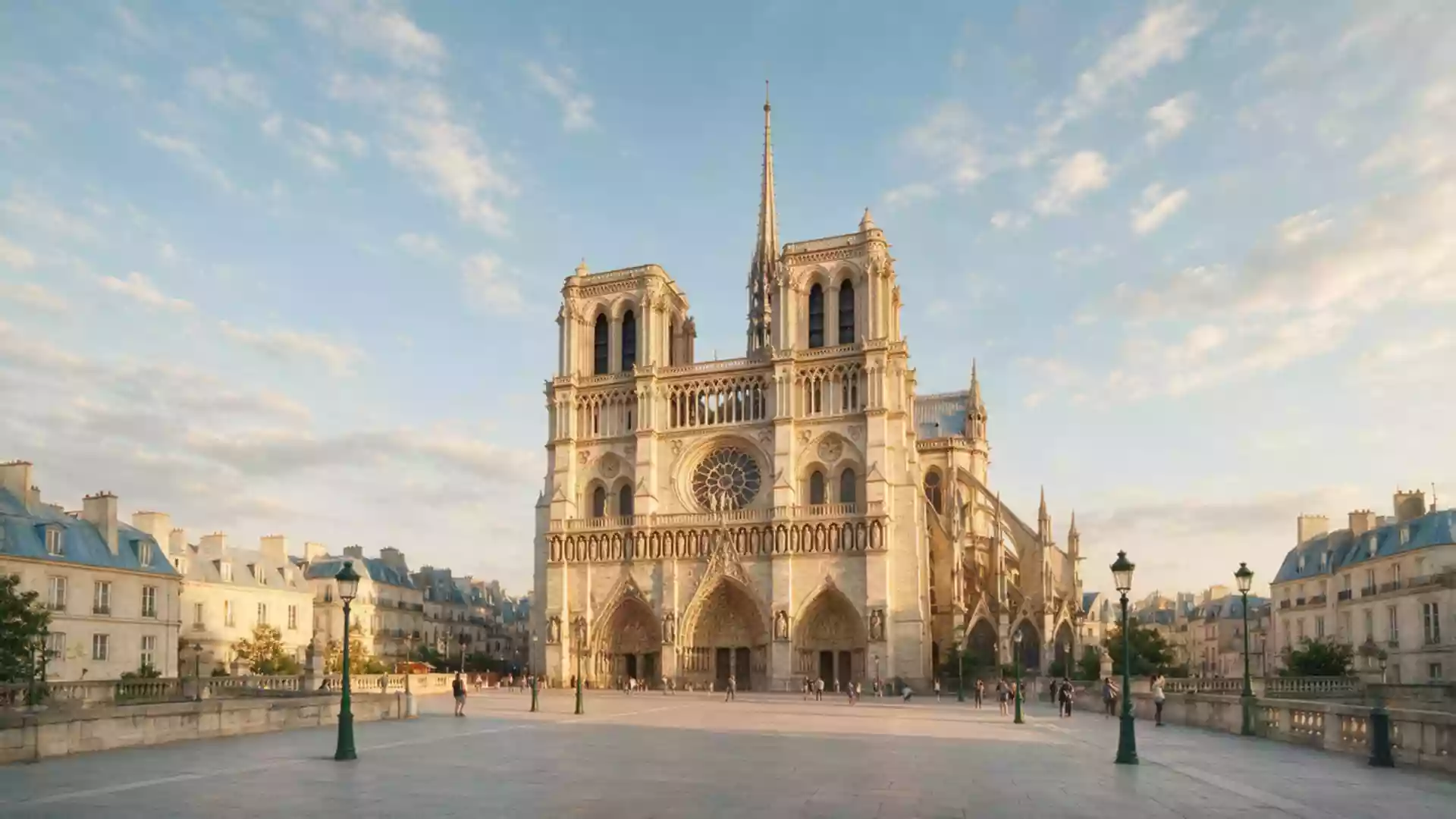
Notre-Dame de Paris and its stone forest of Gothic arches
Published on 09/09/2026 at 10:30 | Editorial responsibility: Rafael Müller, Editor-in-Chief AD HOC NEWS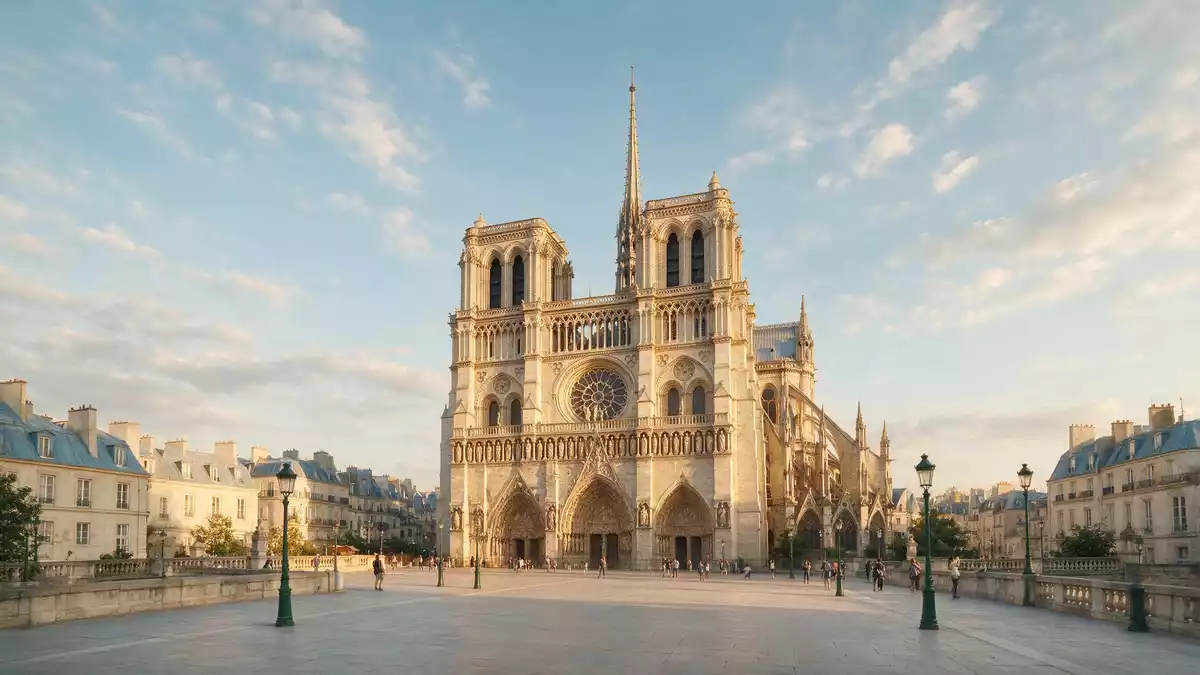
Notre-Dame de Paris anchors the eastern end of the Île de la Cité, its Gothic stone arches and towers forming a kind of architectural forest at the centre of Paris. Built from the twelfth century onwards under Bishop Maurice de Sully, the cathedral’s vast interior and sculpted exterior give the island a monumental focus that has shaped the city’s image for centuries.
A Gothic cathedral grown over two centuries
Notre-Dame de Paris stands on the Île de la Cité in the middle of the River Seine, occupying a site that has held Christian worship since the early Middle Ages.The cathedral lies at the eastern end of the island, framed by the river on both sides. Construction began in 1163 under the direction of Bishop Maurice de Sully, during the reign of King Louis VII, and the building work extended into the fourteenth century.Groundbreaking is recorded in 1163 and completion in 1345. This long building period means the fabric of Notre-Dame brings together several phases of Gothic design, from early forms in the choir and nave to later developments in the upper parts.
The plan of the cathedral follows a Latin cross, with a long nave, transepts and a choir surrounded by an ambulatory and chapels.Its layout includes multiple naves and a double ambulatory, allowing processions to move around the east end behind the high altar. The western façade, with its two square towers, was largely finished in the thirteenth century and presents a balanced composition of doorways, horizontal galleries and sculpted figures. Inside, clustered columns rise to ribbed vaults high above the stone floor, creating a vertical rhythm that draws the eye upward along the length of the church.
Architecture in stone, glass and sculpted detail
Notre-Dame de Paris is recognised as a major example of French Gothic architecture, distinguished by structural innovations and elaborate sculptural work.Its construction spanned roughly two hundred years from the mid-twelfth to the mid-fourteenth century, and the building shows how Gothic techniques developed over that time. Rib vaults carry the stone ceiling across wide spans, while external flying buttresses brace the high walls around the choir and nave.Notre-Dame was among the first large buildings to use flying buttresses on this scale, helping the builders raise the roof and open the walls to larger windows.
The cathedral is also known for its great rose windows, set in the transepts and the western façade, which bring coloured light into the interior through intricate stone tracery.Its rose windows and abundant sculptural decoration are characteristic features. Outside, ranks of statues line the portals, while the façades are punctuated by niches, friezes and gargoyles. The massive towers rise above the west front and have become among the most recognisable silhouettes in Paris, looking out over the river and the low roofs of the surrounding districts. From the parvis at the west, visitors see the layered structure of the façade, the central portal and the gallery above, all carved from pale limestone that has weathered through many centuries.
Layers of history in the heart of Paris
The history of Notre-Dame de Paris is closely tied to the history of France, and the building has carried marks of several major periods.It was built in the twelfth century, modified in the eighteenth century and restored in the nineteenth century. In the eighteenth century, extensive works reshaped parts of the interior, especially the choir, introducing Baroque elements and new furnishings.Large-scale changes to the choir and decoration took place between 1708 and 1725, reflecting the tastes of the period. During the French Revolution, the cathedral suffered damage and desecration, with religious imagery destroyed and the building used for secular purposes.Much of its religious sculpture was attacked in the 1790s, leaving gaps that later restorers sought to fill.
In the nineteenth century, growing concern about the condition of Notre-Dame led to a long restoration campaign led by architects Eugène Viollet-le-Duc and Jean-Baptiste Lassus.Viollet-le-Duc directed a major restoration for around twenty years in the nineteenth century, during which missing sculptures were replaced, decorative programmes were recomposed and structural repairs carried out. During this phase, a new central spire was added over the crossing, echoing medieval forms lost in earlier centuries.The nineteenth-century spire replaced an earlier one removed in the eighteenth century. Across these changes, the cathedral has continued to function as a place of Christian worship in Paris, with liturgy and ceremony taking place beneath its stone vaults.
Visiting Notre-Dame de Paris: what travellers from Western Europe should know
- Notre-Dame de Paris stands at the eastern end of the Île de la Cité in central Paris, surrounded by the River Seine and reached by several bridges from both banks.
- The forecourt in front of the west façade is a broad open square in stone, and the interior, when accessible, involves walking on hard floors and using steps between different levels.
- The cathedral is part of the historic centre of Paris, and nearby landmarks on the island include the Sainte-Chapelle and the Conciergerie, which share the same stretch of the Seine.
- France’s official language is French and the currency is the euro.
Searching for Notre-Dame de Paris on social platforms
These links open searches for Notre-Dame de Paris on each platform.
Frequently asked questions about Notre-Dame de Paris
Where is Notre-Dame de Paris located within Paris?
Notre-Dame de Paris stands at the eastern tip of the Île de la Cité, an island in the River Seine in central Paris, connected to both banks by bridges.
What kind of experience does a visit to the cathedral offer?
A visit focuses on Gothic architecture and Christian worship, with soaring stone vaults, stained glass windows, sculpted façades and a large open square in front of the west front.
What makes Notre-Dame de Paris distinctive among cathedrals?
Notre-Dame combines an early Gothic stone structure with later additions, flying buttresses, major rose windows and a long history of alteration and restoration at the centre of Paris.