
Notre-Dame de Paris and its stone forest of Gothic arches
Published on 09/08/2026 at 18:58 | Editorial responsibility: Rafael Müller, Editor-in-Chief AD HOC NEWS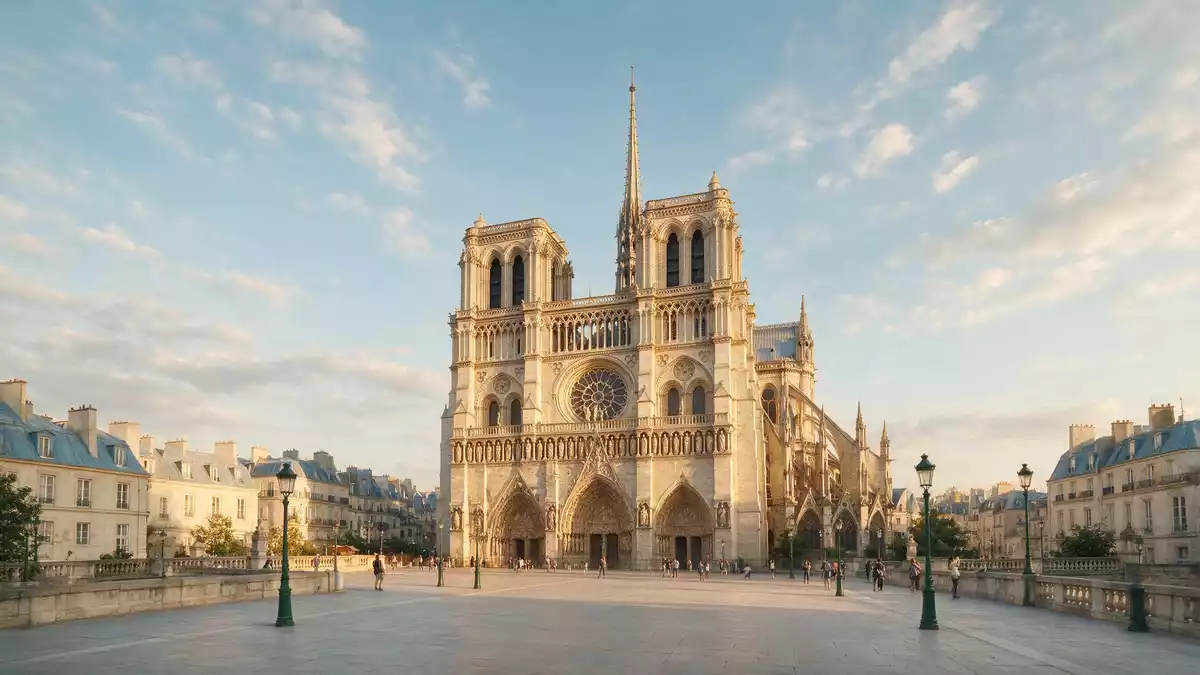
Notre-Dame de Paris is a Gothic cathedral on the eastern end of the Île de la Cité in central Paris, its stone vaults and twin towers rising above the Seine as a landmark of France’s medieval architecture and religious life.eastern end of the Île de la Cité Construction began in 1163 under Bishop Maurice de Sully and unfolded over roughly two centuries, giving the building a layered Gothic character that reflects the thirteenth century as much as the twelfth.construction began in 1163
A cathedral built on a grand medieval scale
The core of Notre-Dame de Paris is its Latin cross plan, a layout shared by many French cathedrals but executed here on an especially generous scale.Latin cross plan From west to east the building reaches about 127 m (417 ft) in length, with a width of around 48 m (157 ft), and an overall area exceeding 6,000 m² (64,583 sq ft), figures that make its footprint one of the substantial stone constructions of twelfth?century Europe.127 m length and 48 m width The western façade is dominated by two towers rising to about 69 m (226 ft), with a broad front punctuated by portals, sculpted galleries and a great rose window set into the masonry.
Inside, the nave stretches for about 60 m (197 ft), its stone vaults reaching roughly 43 m (141 ft) under the roof, creating a high vertical volume that frames the aisles and side chapels.height under the nave roof Flying buttresses arc outwards from the upper walls to carry the weight of the vaults, a structural hallmark of Gothic design that allowed the builders to open large window surfaces between the supports. The stone structure is articulated by dozens of pillars, with the interior punctuated by more than a hundred windows, including the famous rose windows of the transepts.number of windows and pillars
Layers of Gothic style from choir to transept
The construction history of Notre-Dame de Paris runs from the late twelfth century into the mid?fourteenth century, and the building’s fabric reflects that chronological span in its progression from early Gothic to more elaborate Radiant Gothic forms.construction phases 1163–1363 Work began with the choir and its double ambulatory between 1163 and 1182, creating the eastern liturgical core that still anchors the plan. In the following decades, masons extended the nave, its aisles and galleries, then raised the main façade and sculpted portals, reaching the upper towers and high terraces by around 1250.
Later thirteenth?century campaigns added the north and south transepts with their large rose windows, adopting the Radiant Gothic style in the upper parts to bring more daylight to the choir and crossing.Radiant Gothic transept roses Named architects such as Jehan de Chelles, Pierre de Montreuil and Pierre de Chelles are associated with phases of this work, particularly on the transept façades, chapels of the apse and refined exterior portals.medieval architects of the transept The result is a single cathedral whose details span roughly two hundred years of Gothic development, yet whose proportions and stone vocabulary remain coherent from floor to vault.
Notre-Dame in French history and world heritage
Notre-Dame de Paris has been closely linked to French political and cultural history since the Middle Ages, hosting ceremonies that embedded it in the national narrative. In 1431, Henry VI of England was crowned King of France within its walls during the Hundred Years’ War, and in 1804 Napoleon Bonaparte chose the cathedral for his coronation as Emperor of the French.coronations of Henry VI and Napoleon During the French Revolution the building suffered damage, with religious imagery targeted and the interior repurposed, yet the stone structure endured into the nineteenth century.damage during the French Revolution
A major restoration campaign began in the mid?nineteenth century under architect Eugène Viollet?le?Duc, who undertook extensive work on the fabric and added elements such as a tall spire over the crossing, reinforcing the cathedral’s Gothic image for later generations.Viollet-le-Duc restoration Notre-Dame de Paris forms part of the UNESCO World Heritage listing for the banks of the Seine in Paris, a recognition that anchors the building among the city’s major historic monuments.UNESCO World Heritage Site designation Across its long history, from medieval construction through revolutionary turmoil and restoration, the cathedral has remained a stone presence on the Île de la Cité, visible from the river quays and surrounding bridges.
Visiting Notre-Dame de Paris: what travellers from Western Europe should know
- Notre-Dame de Paris stands on the Île de la Cité in the Seine, at 6 Parvis Notre?Dame – Place Jean?Paul II in the 4th arrondissement of Paris.
- The cathedral is reached by city streets and bridges that cross the river; nearby public transport stops serve the island and the surrounding historic centre.
- The building rises to tower heights of about 69 m (226 ft), and approaches involve walking on stone pavements and negotiating steps within historic structures.
- The official language is French and the currency is the euro, used across France for transport, food and other services.
Searching for Notre-Dame de Paris on social platforms
These links open searches for Notre-Dame de Paris on each platform.Frequently asked questions about Notre-Dame de Paris
Where is Notre-Dame de Paris located within Paris?
Notre-Dame de Paris stands at the eastern end of the Île de la Cité in the Seine, in the historic centre of Paris.
What should visitors expect when they approach the cathedral?
Visitors encounter a large Gothic stone building with twin western towers, a long nave, carved portals and an interior shaped by high vaults, pillars and stained glass.
What makes Notre-Dame de Paris distinctive among cathedrals?
Its extended medieval building period, major nineteenth?century restoration, prominent role in French history and location on the Île de la Cité combine to give the cathedral a distinctive presence.


