Nine Arch Bridge in Ella and its stone arches above the jungle
Published on 08/30/2026 at 11:08 | Editorial responsibility: Rafael Müller, Editor-in-Chief AD HOC NEWS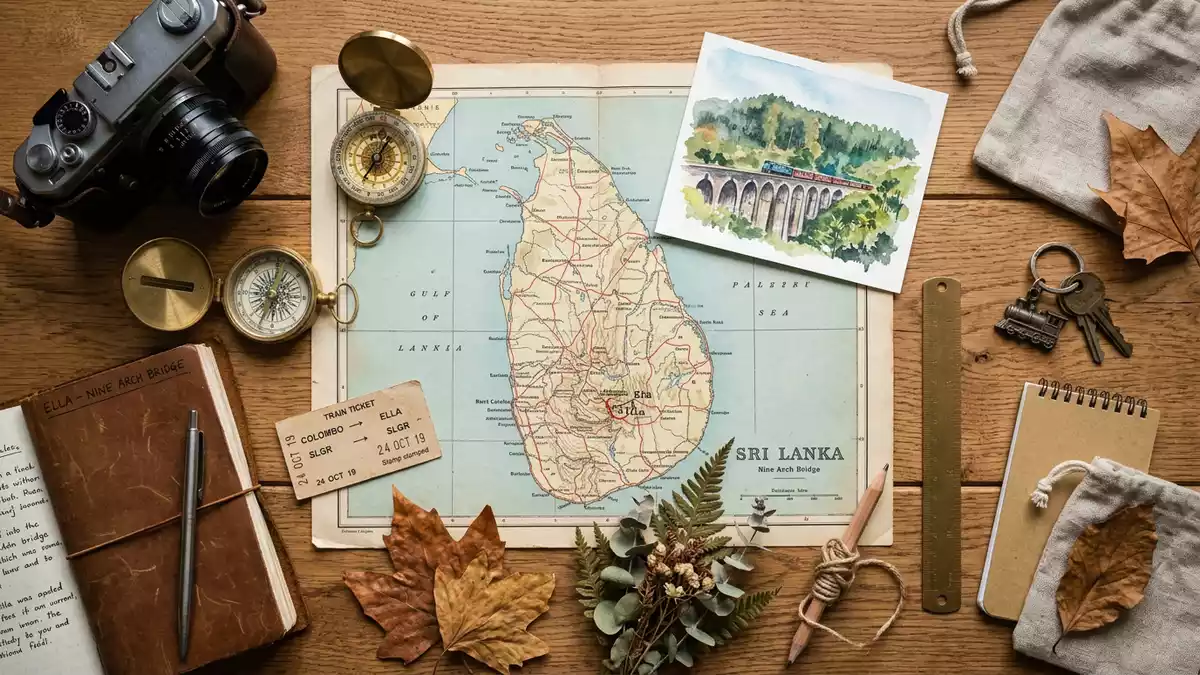
Nine Arch Bridge near Ella in Sri Lanka is a stone and brick railway viaduct carrying the upcountry line across a forested ravine, its sequence of arches curving through tea-covered hills. Built during the early twentieth-century expansion of British Ceylon’s highland railway, it links the line between Ella and Demodara with a structure completed in 1921.
A colonial viaduct of stone, brick and arches
Nine Arch Bridge belongs to the upcountry railway between Ella and Demodara, a section developed under British colonial administration to move goods and passengers through Sri Lanka’s hill country. The bridge stands at Demodara, on the route towards Badulla, and forms part of what travellers recognise as the highland railway between Kandy and Ella.Demodara Nine Arches Bridge The structure carries the single track across a steep-sided valley lined with tea bushes and patches of forest.
The viaduct takes its name from the nine masonry arches that rise in a row from the valley floor, supporting the deck above. Descriptions of the bridge record an overall length of around 91 m (299 ft) and a height of about 24 m (79 ft) above the ground, figures that place it among the notable pieces of railway engineering in Sri Lanka.91 m long and 24 m high The arches are built in brick and stone, with the rest of the structure faced in masonry that has weathered into earthy tones against the greenery.
Construction in the era of British Ceylon
Nine Arch Bridge belongs to the early twentieth-century expansion of the upcountry railway in what was then British Ceylon, a programme that extended the line from Bandarawela towards Badulla under colonial administration.early twentieth-century expansion Historical notes describe construction beginning in the 1910s, with completion dated to 1919 and the bridge brought into service in 1921.
Accounts of the project name Harold Cuthbert Marwood as the engineer in charge of the section of railway that includes the viaduct, working under the approval of M. Cole Bowen as Chief Construction Engineer for railway extensions.Harold Cuthbert Marwood The broader upcountry railway line is associated with D. J. Wimalasurendra, a Ceylonese engineer linked to major infrastructure projects of the period.D. J. Wimalasurendra Local tradition also credits the builder P. K. Appuhami with carrying out work on the bridge in consultation with British engineers, reflecting the mix of colonial supervision and local labour that characterised such projects.
A bridge built largely without structural steel
Descriptions of Nine Arch Bridge emphasise that it was built largely without structural steel, relying instead on bricks, stone and cement for its main body.constructed without steel The viaduct is recorded as using concrete cornice blocks to support the arches and sand–cement blocks for the facing, a materials palette typical of railway structures of the era but remarkable here for the absence of metal in the supporting fabric.
The bridge’s profile is defined by its nine evenly spaced arch openings, rising from robust piers and carrying the track on a gentle curve. Its masonry surfaces show the colour variations of stone and brick laid in courses, while beneath it the valley floor is lined with vegetation and footpaths that offer views up to the trains passing overhead.curved masonry viaduct The combination of colonial engineering and the surrounding landscape has given Nine Arch Bridge a strong visual identity within Sri Lanka’s hill country.
Visiting Nine Arch Bridge: what travellers from Western Europe should know
- Nine Arch Bridge stands on the railway line between Ella and Demodara in Sri Lanka’s Uva Province, reached from Ella along tracks and footpaths through tea fields.
- The terrain around the bridge involves walking on uneven paths, short slopes and steps cut into earth and rock, with viewpoints located above and below the level of the tracks.
- The bridge lies in Sri Lanka, where the official languages are Sinhala and Tamil and the currency is the Sri Lankan rupee.
- Entry requirements depend on your nationality; UK travellers can check the FCDO travel advice at gov.uk/foreign-travel-advice, Irish travellers the Department of Foreign Affairs at ireland.ie.
Searching for Nine Arch Bridge on social platforms
These links open searches for Nine Arch Bridge on each platform.
Frequently asked questions about Nine Arch Bridge
Where is Nine Arch Bridge located?
Nine Arch Bridge is on the railway line between Ella and Demodara in Sri Lanka’s Uva highlands, above a valley planted with tea and forest.
What can visitors expect when they reach the bridge?
Visitors find a stone and brick viaduct with nine arches, trains passing overhead, and viewpoints reached by paths along the slopes and under the span.
What makes Nine Arch Bridge distinctive among Sri Lankan railway structures?
The bridge combines a curved row of nine masonry arches, early twentieth-century colonial railway engineering and construction largely without structural steel.