
Niagara Falls and the power of three great cascades
Published on 09/14/2026 at 11:21 | Editorial responsibility: Rafael Müller, Editor-in-Chief AD HOC NEWS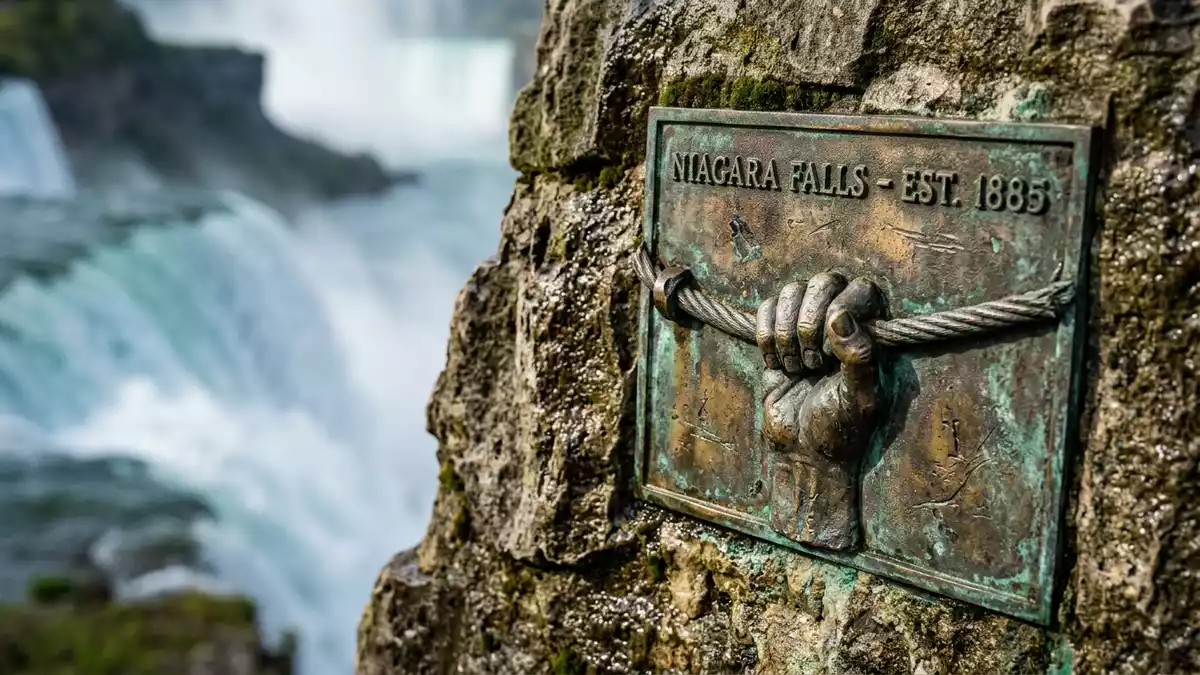
Niagara Falls is a set of three great waterfalls on the Niagara River, marking the border between the U.S. state of New York and the Canadian province of Ontario. This concentration of water, height and width has carved a deep gorge and created one of North America’s most recognisable river landscapes.
Three waterfalls sharing one river
The heart of Niagara Falls is the Niagara River, a channel linking Lake Erie and Lake Ontario and forming part of the boundary between the United States and Canada.The river runs for about 58 km and drops over the cliff edge in three distinct segments. The largest of these is Horseshoe Falls, also known as the Canadian Falls, whose curving crest spans about 670 m (2,200 ft) and drops around 57 m (188 ft) to the river below.Its arc hugs the Canadian bank and sends a thick curtain of water into the gorge.
On the American side, the Niagara River breaks into American Falls and Bridal Veil Falls, separated by Luna Island.American Falls carries a broad crest of roughly 320 m (1,060 ft), with the water dropping to a mound of rock before reaching the river; measured to the river surface, the height is close to that of Horseshoe Falls. Bridal Veil Falls, far narrower, has a crest of about 15 m (50 ft) and a drop comparable to American Falls, offering a finer, veil-like cascade beside its larger neighbour.Together the three segments form the collective Niagara Falls.
Water, height and the Niagara Gorge
Niagara Falls sits at the head of Niagara Gorge, a deep, narrow corridor carved by the river as it has cut back through layers of rock. The combination of vertical drop and flow rate gives the waterfalls their scale: large volumes of water pour over each crest every second, striking the base with substantial force and throwing spray high into the air.This flow also supports major hydroelectric installations on both sides of the border, which divert part of the river through power stations while leaving the main cataracts intact.
The cliff edge itself is composed of resistant caprock overlying softer layers, a structure that allows the falls to retreat gradually upstream as erosion undercuts the harder strata.Geologists trace the formation of Niagara Gorge to the end of the last Ice Age, when meltwater from retreating glaciers began to pour from the upper Great Lakes towards Lake Ontario. The present arrangement of Horseshoe Falls, American Falls and Bridal Veil Falls reflects both that long-term erosion and interventions such as stabilisation works on the American side, where rockfalls have altered the outline of the cliff.
A cross-border landscape shaped for visitors
Niagara Falls has been a destination for travellers since the nineteenth century, and both countries have created parks and viewing areas along the gorge. On the American side, Niagara Falls State Park in New York provides access to viewpoints close to American Falls and Bridal Veil Falls, with paths leading to platforms where the water can be seen from different angles.The park is recognised as one of the oldest state parks in the United States, set aside to protect the scenery along the river.
Across the border in Ontario, viewing areas around Horseshoe Falls look down onto the broad curve of the main cataract, with paths and railings following the rim of the gorge.Tourism organisations on both sides present the three waterfalls as a single shared attraction, while the river and the gorge connect them into one continuous landscape. The result is a cross-border setting in which the water, cliffs, parks and built viewpoints together frame the falls for visitors.
Visiting Niagara Falls: what travellers from Western Europe should know
- Niagara Falls lies on the Niagara River between the U.S. state of New York and the Canadian province of Ontario, with the city of Niagara Falls on each bank linked by international bridges.
- The terrain around the gorge includes paved paths, parkland and stepped approaches to viewing platforms, with railings along the cliff edge and changes in level near the river.
- The surrounding region experiences warm summers and cold winters, and spray from the waterfalls can make surfaces near the viewpoints damp in all seasons.
- The official languages are English on both sides of the border, and the currencies are the United States dollar and the Canadian dollar.
- Entry requirements depend on your nationality; UK travellers can check the FCDO travel advice at gov.uk/foreign-travel-advice, Irish travellers the Department of Foreign Affairs at ireland.ie.
Searching for Niagara Falls on social platforms
These links open searches for Niagara Falls on each platform.
Frequently asked questions about Niagara Falls
Where is Niagara Falls located?
Niagara Falls is on the Niagara River between New York in the United States and Ontario in Canada, with the waterfalls straddling the international border.
What should visitors expect when they see Niagara Falls?
Visitors encounter three major waterfalls dropping into a deep gorge, with viewing areas on both sides of the river and paths leading close to the water and the cliff edge.
What makes Niagara Falls distinctive among waterfalls?
Niagara Falls is distinguished by the combination of three separate cascades, substantial height and flow, and a setting that spans two countries along a single river.


