
Ngorongoro Crater’s vast volcanic amphitheatre of wildlife
Published on 09/15/2026 at 09:54 | Editorial responsibility: Rafael Müller, Editor-in-Chief AD HOC NEWS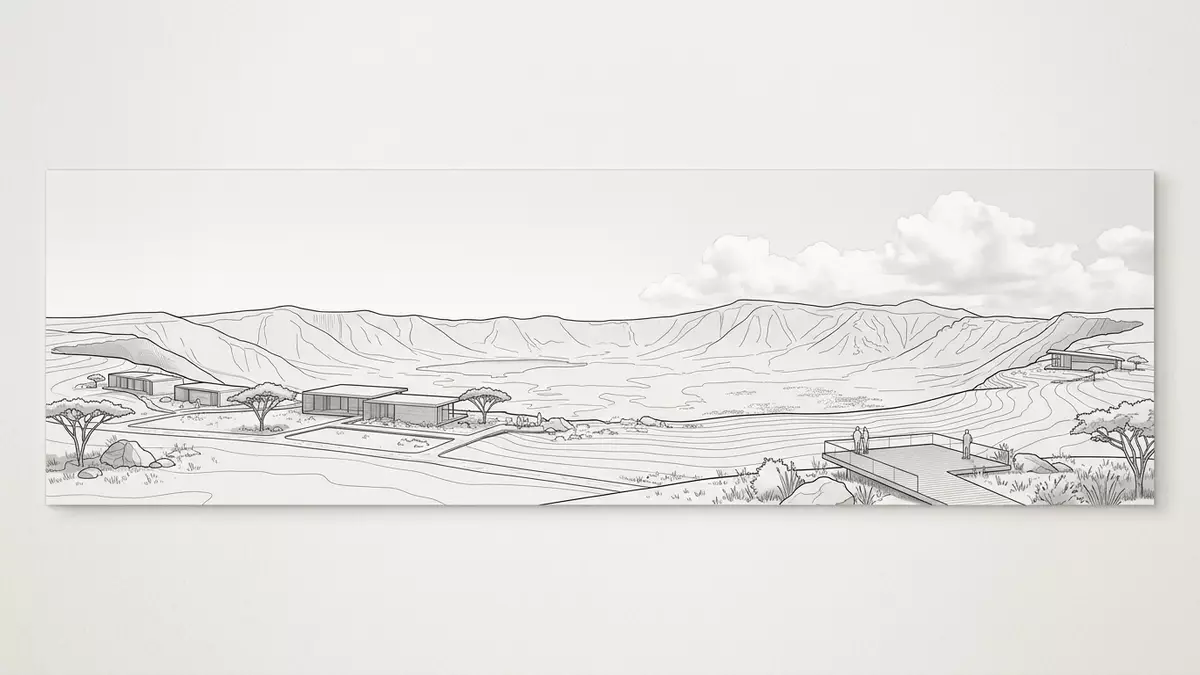
Ngorongoro Crater in northern Tanzania is an immense volcanic basin where steep, grassed walls enclose an almost continuous floor of open plains, wetlands and scattered woodland. At the heart of the Ngorongoro Conservation Area, this caldera’s enclosed landscape and dense wildlife give it the character of a natural amphitheatre in the East African highlands.
A gigantic caldera in the Great Rift Valley highlands
Ngorongoro Crater lies within the Eastern, or Great, Rift Valley system in northern Tanzania, west of Arusha and within the Ngorongoro Division of Ngorongoro District in Arusha Region. The crater forms the central feature of the Ngorongoro Conservation Area, which was inscribed as a UNESCO World Heritage Site in 1979 for its geological significance and its remarkable record of wildlife and human evolution, linking its protection directly to the crater and its surrounding highlands.Ngorongoro Conservation Area The conservation area extends far beyond the crater rim, but Ngorongoro Crater remains its defining landmark, a single volcanic depression that concentrates habitats and animals within a clearly recognisable boundary.
Geologically, Ngorongoro Crater is an extinct volcanic caldera formed when an ancient volcano erupted and its cone collapsed inward, leaving a broad, enclosed basin. Geological records and regional syntheses describe the Ngorongoro volcanic group as part of a chain of extinct basaltic shield volcanoes forming the Ngorongoro Volcanic Highlands on the western flank of the Gregory Rift Valley, with volcanism that dates back to the late stages of the Cenozoic era.Ngorongoro Volcanic Highlands Within this highland chain, Ngorongoro Crater stands out as the largest unflooded and unbroken caldera recognised in the area, its rim forming a continuous, high circle around the floor.
Scale, elevation and the enclosed landscape
The sheer scale of Ngorongoro Crater is central to its character. The caldera measures around 16 to 19 km (10 to 12 miles) across, with a floor covering about 260 sq km (100 sq miles) of grassland, wetland and woodland, figures that recur across geological and conservation descriptions of the site.caldera measures between 10 and 12 miles The walls drop by roughly 610 m (2,000 ft) from rim to floor, creating a pronounced difference in elevation between the highland rim and the basin below.2000ft deep volcanic caldera At their highest points the rim rises to over 2,200 m (around 7,500 ft) above sea level, producing a cool, often misted crest that contrasts with the more open conditions on the crater floor.rim elevation figures
Viewed from the rim, Ngorongoro Crater appears as a single, continuous basin, its floor dominated by open short-grass plains that support grazing herds. The interior also includes a small saline lake, often referred to as Lake Makat, and permanent wetlands such as the Gorigor swamp, which occupy low-lying hollows within the basin.Lake Makat and Gorigor swamp Around these water bodies, belts of thicker vegetation and mixed woodland rise towards the talus slopes at the foot of the inner walls, while patches of forest cling to steeper sections. The continuous rim and the enclosed mixture of grassland, water and woodland give the crater its amphitheatre-like form, with the high edges framing the life on the floor.
A dense wildlife sanctuary within the caldera
Ngorongoro Crater is globally recognised for the concentration and variety of large mammals living permanently within its enclosed floor. Conservation summaries and ecological accounts describe around 25,000 large animals resident in the basin, including many of the most familiar East African grazing species such as wildebeest, zebra, buffalo, warthog and different gazelles, all visible across the grass plains when conditions suit.abundance of wildlife with of 25,000 wild animals Among these grazing herds move predators including spotted hyenas and lions, the latter recorded at one of the highest densities known for the species, supported by the constant presence of prey within the basin.densest population of lions
Beyond grazers and predators, the crater’s mosaic of habitats supports elephants, black rhinoceroses and leopards, along with different antelope species including eland and both Grant’s and Thomson’s gazelles, reflecting the range of food and cover available.array of animals including elephants and rhinos The combination of a permanent highland basin, reliable surface water and a continuity of grassland and wetland has allowed large mammals to live within the crater for extended periods, making the interior a renowned site for observing East African wildlife in a single, contained landscape. At the same time, the crater forms only one part of the wider Ngorongoro Conservation Area, whose boundaries also encompass other volcanic features and important sites linked to human evolution at nearby locations such as Olduvai Gorge and Laetoli.
Visiting Ngorongoro Crater: what travellers from Western Europe should know
- Ngorongoro Crater lies within the Ngorongoro Conservation Area in northern Tanzania, west of Arusha, reached by road from regional centres such as Arusha and Karatu.
- The rim road and viewpoints sit at over 2,200 m (around 7,500 ft), and descents to the floor use steep roads with pronounced gradients between highland crest and basin.
- Within the crater, excursions follow established tracks across open grassland and past wetlands, with changes in altitude and terrain between the floor, swamp margins and the inner slopes.
- The official language is Swahili and the currency is the Tanzanian shilling.
- Entry requirements depend on your nationality; UK travellers can check the FCDO travel advice at gov.uk/foreign-travel-advice, Irish travellers the Department of Foreign Affairs at ireland.ie.
Searching for Ngorongoro Crater on social platforms
These links open searches for Ngorongoro Crater on each platform.
Frequently asked questions about Ngorongoro Crater
Where is Ngorongoro Crater?
Ngorongoro Crater lies in northern Tanzania within the Ngorongoro Conservation Area, west of Arusha in the highlands along the Eastern Rift Valley.
What can visitors expect inside the crater?
The crater floor is an enclosed basin of grassland, wetlands and scattered woodland, supporting large herds of grazing animals and predators such as lions and hyenas.
What makes Ngorongoro Crater distinctive among African landscapes?
Its status as a vast, intact volcanic caldera with continuous rims, a clearly bounded floor and a dense concentration of wildlife gives Ngorongoro Crater an amphitheatre-like character unusual in East Africa.


