
Ngorongoro Crater and its volcanic bowl
Published on 09/16/2026 at 16:09 | Editorial responsibility: Rafael Müller, Editor-in-Chief AD HOC NEWS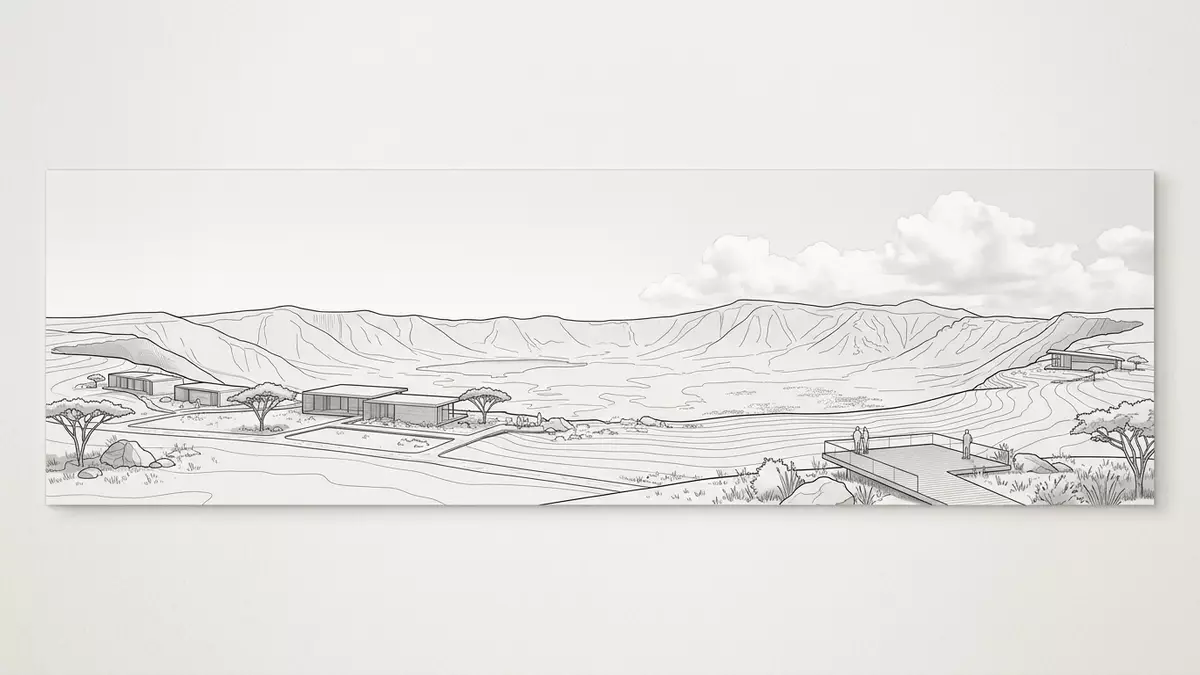
Ngorongoro Crater is a vast volcanic bowl in northern Tanzania, inside the Ngorongoro Conservation Area. It pairs steep enclosing walls with a floor that still carries grassland, marsh and water.
Ngorongoro Crater’s volcanic walls and floor
The crater is the remnant of a collapsed volcano, and it has long been linked with the Gregory Rift of the East African Rift System. Its form is a broad caldera, with a deep interior and a rim that reads clearly in the landscape.largest unbroken caldera
Reports on the site place it at about 20 km across and around 610 m deep, with a floor of roughly 260 km². That scale is part of its visual force: the crater remains legible as a single geological form rather than a broken series of basins.about 20 kilometres
UNESCO status and the wider conservation area
The crater sits within the Ngorongoro Conservation Area, a mixed landscape that was inscribed on the World Heritage List in 1979 and later gained cultural recognition in 2010. The wider protected area extends across highland plains, savanna, woodlands and forests, placing the crater within a much larger setting of landforms and habitats.World Heritage List in 1979
The association with Olduvai Gorge gives the area an archaeological dimension as well as a geological one. In practical terms, the crater is not an isolated hole in the ground, but part of a layered protected landscape with a long recorded history.Olduvai Gorge
Ngorongoro Crater as a landscape of rock and habitat
Basalt, rhyolite, ignimbrites and agglomerates are listed among the crater’s rocks, and the floor includes small cones and an alkaline lake. Those elements make the interior more varied than a simple empty basin, with visible traces of volcanic history across the floor.basalt to rhyolite
The crater is also part of a living conservation area where wildlife and Maasai pastoralism share the broader land use of the region. The result is a place where geology, ecology and human landscape management sit in the same frame.multiple land use area
Visiting Ngorongoro Crater: what travellers from Western Europe should know
- The crater lies in northern Tanzania, within the Ngorongoro Conservation Area in Arusha Region. Road access is the usual route, and the wider area is tied to the Serengeti plains and the eastern arm of the Great Rift Valley.
- The terrain is steep-sided, with a high rim and a floor far below it. The geological form is a caldera, so the place reads as a deep enclosed basin rather than an open valley.
- The official language is Swahili and the currency is the Tanzanian shilling.
- Entry requirements depend on your nationality; UK travellers can check the FCDO travel advice at gov.uk/foreign-travel-advice, Irish travellers the Department of Foreign Affairs at ireland.ie.
Searching for Ngorongoro Crater on social platforms
These links open searches for Ngorongoro Crater on each platform.
Frequently asked questions about Ngorongoro Crater
Where is Ngorongoro Crater?
Ngorongoro Crater lies in northern Tanzania, inside the Ngorongoro Conservation Area in Arusha Region. It forms part of a larger Rift Valley landscape.
What does a visit involve?
The place is defined by its steep rim, deep interior and broad crater floor. Visitors encounter a geological basin rather than a conventional summit landscape.
What makes Ngorongoro Crater distinctive?
Its distinction lies in the intact volcanic form, the UNESCO setting and the mixture of rocks, lake, grassland and marsh on the floor. The crater combines geology and conservation in one enclosed landform.


