
Nemrut Dagi and the stone heads above Adiyaman
Published on 08/25/2026 at 18:14 | Editorial responsibility: Rafael Müller, Editor-in-Chief AD HOC NEWS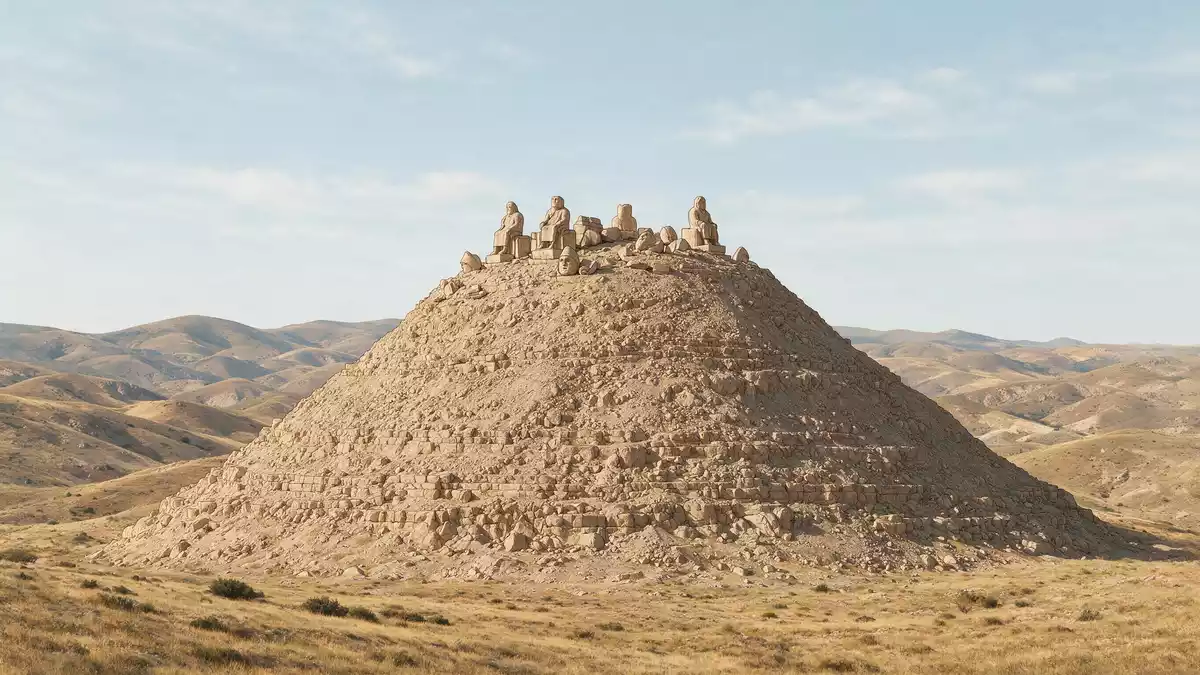
Nemrut Dagi in Adiyaman is a high mountain in south?east Turkey crowned by a Hellenistic tomb?sanctuary and terraces of colossal stone figures. Rising to around 2,150 m (7,054 ft) in the Eastern Taurus range, it combines a royal monument from the first century BC with wide views over the surrounding plateaux.
A mountain summit turned into a royal sanctuary
Nemrut Dagi forms part of the Eastern Taurus mountains in Adiyaman Province, with the archaeological complex lying close to the summit rather than in a valley or on a low hill.Eastern Taurus mountains The site is identified as the Hierotheseion, a temple?tomb and “house of the gods” commissioned by Antiochos I of Commagene, who ruled between 69 and 34 BC over a small kingdom bridging Anatolia and northern Mesopotamia.Antiochos I of Commagene
The summit complex is organised around a central loose stone mound or tumulus, with broad terraces cut into the mountain on the eastern and western sides and a further arrangement to the north.tumulus and terraces These terraces carry rows of seated stone figures representing deities, eagles, lions and Antiochos himself, flanked by reliefs showing the king in contact with the gods and with his ancestors from Persian and Macedonian dynasties.fusion of Persian and Hellenistic traditions The whole composition turns the summit into a ceremonial platform where the mountain, the tomb and the sculpted pantheon are bound together.
Colossal statues and broken stone heads
The most striking feature for visitors is the group of colossal seated figures aligned on the terraces, carved in stone and originally rising to many metres in height from their bases.colossal statues on the terraces Over time, the heads of these figures have largely been separated from their bodies and now rest on the gravel and stone of the terrace floors, creating the well?known field of detached stone faces that has become closely associated with Nemrut Dagi.
Among the deities represented are syncretic figures combining Greek and Persian names and attributes, such as Zeus?Oromasdes and Apollo?Mithras?Helios?Hermes, alongside Tyche as a fertility and fortune figure and Herakles?Ares?Artagnes.syncretic pantheon The seated figure of Antiochos I appears among them, placing the king’s image within a line of gods and cosmic forces. Reliefs along the retaining walls show him shaking hands with these deities, underlining the place of the Commagene ruler within the scheme. The stone heads, with their stylised beards, headdresses and calm expressions, are scattered across the terraces in front of fragments of their once upright bodies, giving the summit a distinctive sculptural landscape.
Nemrut Dagi as a protected landscape and archaeological park
Nemrut Dagi and its summit ensemble have been recognised as a cultural World Heritage Site since 1987, under UNESCO criteria that highlight both the creative design and the fusion of traditions in its architecture and sculpture.World Heritage inscription in 1987 The mountain lies within Nemrut Dagi National Park, a protected area established to safeguard the archaeological remains and the surrounding highland terrain in Adiyaman Province.Nemrut Dagi National Park
The park sits within the district of Kahta and can be approached by road from both Kahta and the provincial centre of Adiyaman, with access routes climbing from the fertile Euphrates hinterland into the stony Taurus uplands.Kahta district in Adiyaman Province The summit area itself consists of gravel, broken stone blocks and stepped approaches between the terraces, with the tumulus dominating the centre and the heads and bodies of the statues placed around it. The combination of high?altitude light, open views and weathered stone gives the sanctuary a rugged character very different from lowland archaeological sites.
Visiting Nemrut Dagi: what travellers from Western Europe should know
- Nemrut Dagi rises in Adiyaman Province in south?east Turkey, with the summit sanctuary reached by mountain roads from the town of Kahta and from the city of Adiyaman.
- The upper part of the approach passes through high?altitude terrain, and the final stretch to the terraces and stone heads involves walking on uneven gravel and stone rather than paved urban surfaces.
- The sanctuary lies in Nemrut Dagi National Park in the Eastern Taurus range, so visitors encounter both archaeological remains and a mountain environment rather than a city square or enclosed museum hall.
- The official language in this part of Turkey is Turkish and the currency is the Turkish lira.
- Entry requirements depend on your nationality; UK travellers can check the FCDO travel advice at gov.uk/foreign-travel-advice, Irish travellers the Department of Foreign Affairs at ireland.ie.
Searching for Nemrut Dagi on social platforms
These links open searches for Nemrut Dagi on each platform.
Frequently asked questions about Nemrut Dagi
Where is Nemrut Dagi and what kind of place is it?
Nemrut Dagi is a mountain in Adiyaman Province in south?east Turkey, part of the Eastern Taurus range, with a Hellenistic tomb?sanctuary built close to its summit.
What should visitors expect on a visit to Nemrut Dagi?
Visitors encounter high?altitude terrain, terraces built into the summit area, a central stone tumulus and rows of colossal statues with detached stone heads lying across the gravelled platforms.
What makes Nemrut Dagi distinctive among archaeological sites?
The combination of a first?century BC royal monument by Antiochos I of Commagene, colossal syncretic deities and a mountain summit setting gives Nemrut Dagi a character unlike lowland ruins or city monuments.


