
Nemrut Dagi and the stone guardians of ancient Commagene
Published on 08/21/2026 at 18:34 | Editorial responsibility: Rafael Müller, Editor-in-Chief AD HOC NEWS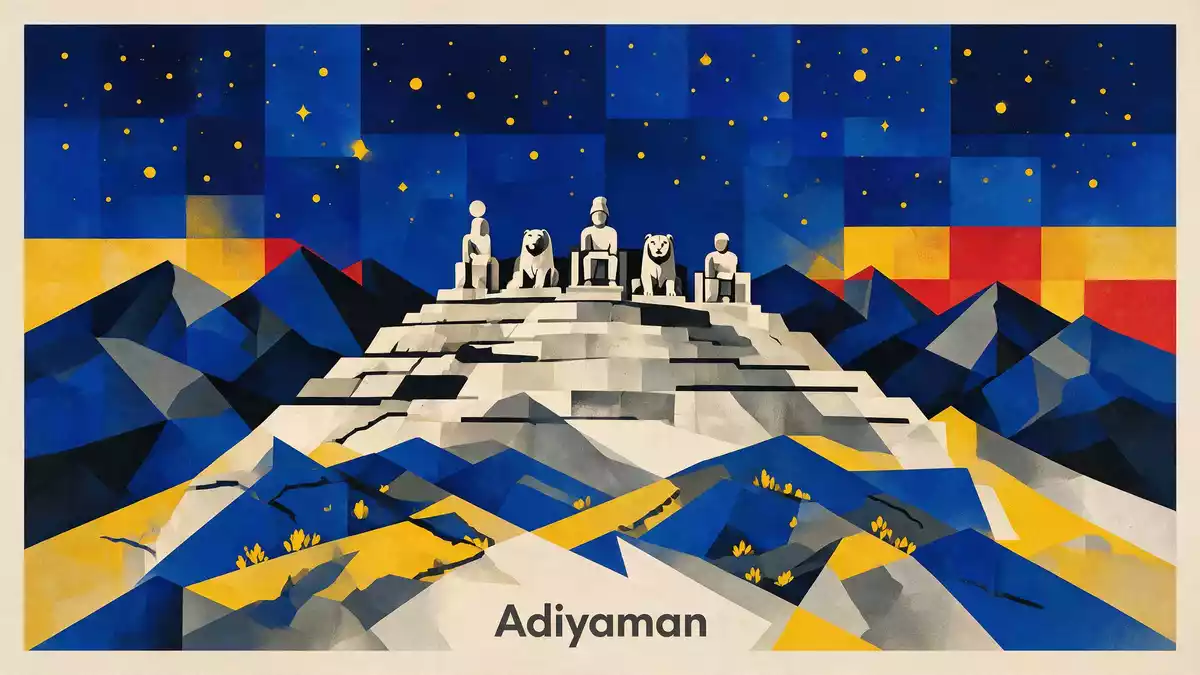
Nemrut Dagi in Adiyaman is a high summit of the Eastern Taurus range where a Hellenistic mountain sanctuary, a stone tumulus and colossal statues share the same wind?exposed ridge. Rising to around 2,150 m (7,054 ft) in south?east Turkey, the mountain carries the Hierotheseion of King Antiochos I of Commagene from the first century BC and a UNESCO World Heritage inscription dating from 1987.
A mountain throne above the Euphrates
Nemrut Dagi stands in the Anti?Taurus mountains of Adiyaman Province in south?east Turkey, north of the upper Euphrates and within the district of Kahta.Anti?Taurus mountains of Adiyaman The summit forms one of the higher peaks of the range, with the sanctuary area lying above 2,000 m (6,562 ft) and exposed to wide skies and long views towards the surrounding plateaux.2,134?m high peak
The archaeological zone occupies the very top of the mountain, where a broad summit is reshaped into a stepped platform and a conical mound of crushed stone. This artificial tumulus, built from small angular rock fragments, rises above terraces cut into the slope, so that built forms and natural peak interlock without a clear boundary between them.tumulus of crushed rock Around this summit complex the bare mountain flanks fall away in long, dry ridges with sparse vegetation and views towards the Euphrates valley and the hills of ancient Commagene.
Antiochos I and the kingdom of Commagene
The sanctuary on Nemrut Dagi belongs to the late Hellenistic kingdom of Commagene, a small state that linked Anatolia and northern Mesopotamia in the first century BC.kingdom of Commagene King Antiochos I Theos, who reigned from about 69 to 34 BC, ordered the construction of a Hierotheseion here as his monumental mountain tomb and cult site, combining Persian, Anatolian and Greek elements in its iconography.Antiochos I Theos of Commagene
The site achieved international recognition when it was inscribed on the UNESCO World Heritage List in 1987 as “Nemrut Da?”, under cultural criteria that highlight its colossal sculptural ensemble, its fusion of traditions and its role as an outstanding tomb sanctuary of the Hellenistic age.inscribed on the UNESCO World Heritage List in 1987 The inscription covers the mountain peak, the tumulus and the terraces, and emphasises the way this high place became a stage for royal self?representation framed by the Taurus mountains.
Terraces, colossal statues and fallen heads
The main sanctuary on Nemrut Dagi consists of a great tumulus framed by ceremonial terraces to the east and west, with a smaller terrace to the north.framed by ceremonial terraces On the eastern and western terraces, rows of colossal seated figures once formed a rigid formal assembly aligned beside stone thrones and long relief walls.
The best?known feature of Nemrut Dagi is these statues: representations of Antiochos I himself between syncretic deities that join Greek and Persian names and attributes.representations of Antiochos I himself The gods include Zeus?Oromasdes, Apollo?Mithras?Helios?Hermes and Artagnes?Heracles?Ares, together with figures of the goddess Commagene, a lion and an eagle.figures of the goddess Commagene Each seated statue originally reached around 8 to 9 m (26 to 30 ft) in height, carved from stone blocks and set on high plinths behind offering tables and processional spaces.
Earthquakes and the long exposure of the summit have brought most of the heads down to the terrace floors, so that visitors now encounter a scatter of colossal, detached faces aligned along the retaining walls. Despite their damage, the carved eyes, beards, headdresses and elaborate curls remain recognisable, and the scale of each head is close to that of an adult standing beside it.heads of the statues from both terraces Behind this sculptural foreground, the tumulus looms as a steep cone of broken stone whose interior structure has not been opened, preserving the mystery of the royal tomb it is believed to contain.
Nemrut Dagi in the Eastern Taurus landscape
Nemrut Dagi forms part of the Eastern Taurus chain, and its high position between Anatolia and northern Mesopotamia gives the summit an expansive horizon line.one of the highest peaks of the Eastern Taurus mountain range The slopes are largely bare or covered with low steppe vegetation, with occasional patches of scrub and rock outcrops that mark the underlying geology of the Anti?Taurus.
Below the summit zone, the wider Nemrut Dagi area forms part of a national park whose borders bring together mountain ridges, valleys and traces of the ancient Commagene kingdom such as bridges and smaller sanctuaries.Nemrut Dagi National Park The mountain lies within reach of the modern towns of Kahta and Adiyaman, so a visit to the summit can be combined with journeys through the plateau landscapes and the river valleys that once connected Commagene with neighbouring regions.
Visiting Nemrut Dagi: what travellers from Western Europe should know
- Nemrut Dagi rises in Adiyaman Province in south?east Turkey, within Kahta district, and is approached on mountain roads from the direction of Kahta and Adiyaman.
- The sanctuary lies high on the summit area above 2,000 m (6,562 ft), reached by paths and flights of steps that climb from a vehicle drop?off point to the terraces.
- The terrain on the upper slopes consists of bare rock and loose stone underfoot, and the summit area is exposed to wind and rapid weather changes at altitude.
- The official language is Turkish and the currency is the Turkish lira. Entry requirements depend on your nationality; UK travellers can check the FCDO travel advice at gov.uk/foreign-travel-advice, Irish travellers the Department of Foreign Affairs at ireland.ie.
Searching for Nemrut Dagi on social platforms
These links open searches for Nemrut Dagi on each platform.
Frequently asked questions about Nemrut Dagi
Where is Nemrut Dagi?
Nemrut Dagi is a high mountain in the Eastern Taurus range in Adiyaman Province in south?east Turkey, within the district of Kahta near the upper Euphrates.
What can visitors expect at the summit?
The summit area combines a large stone tumulus with terraces lined by colossal statues and fallen stone heads, set above bare ridges and broad plateau views.
What makes Nemrut Dagi distinctive?
Nemrut Dagi is distinctive as the mountain?top Hierotheseion of Antiochos I of Commagene, built in the first century BC with colossal syncretic deities and a royal tumulus.


