
National Mall as Washington’s long green axis of memory
Published on 09/09/2026 at 10:00 | Editorial responsibility: Rafael Müller, Editor-in-Chief AD HOC NEWS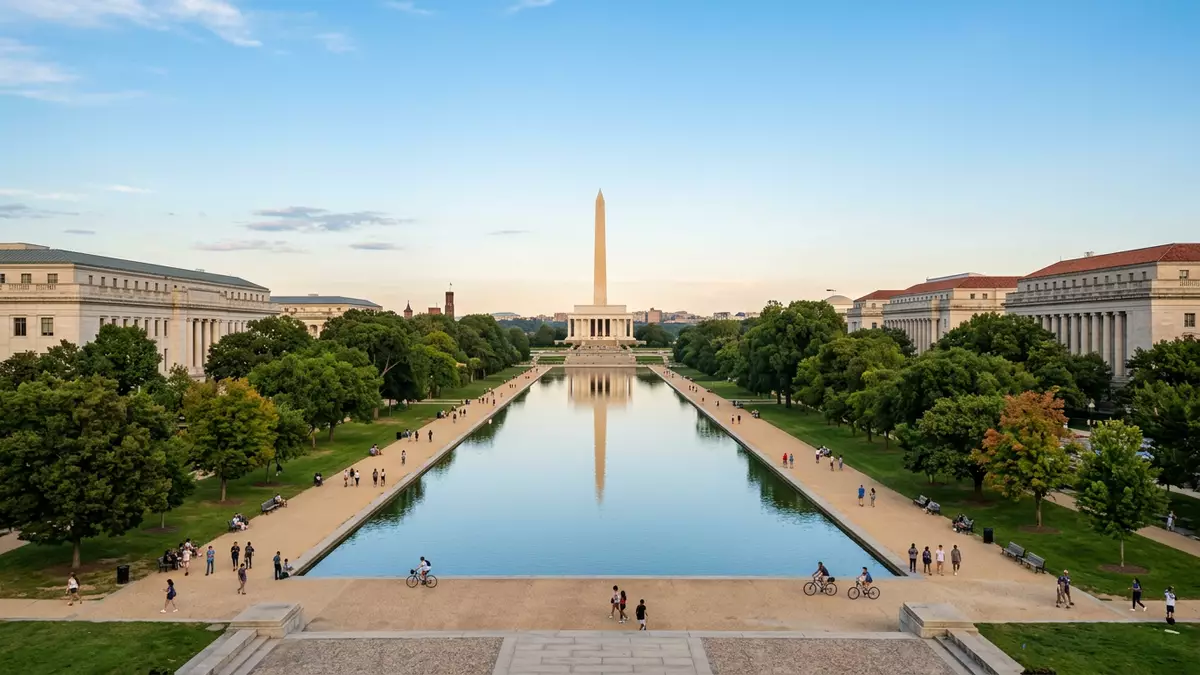
National Mall in Washington, D.C. forms a long, level park axis that links the United States Capitol, the Washington Monument and the Lincoln Memorial in a single open sweep of grass, trees and stone. Its conception in the 1791 L’Enfant Plan and refinement in the early twentieth-century McMillan Plan give this landscape a defined shape and role at the centre of the federal city.
A grand east–west axis between Capitol and memorials
The core of National Mall runs from the steps of the United States Capitol westward towards the Washington Monument and on to the Lincoln Memorial, creating a continuous ceremonial corridor more than 3 km (about 2 miles) long.expanse of open space This axis is flanked by broad avenues, with Constitution Avenue to the north and Independence Avenue to the south, fixing the Mall within the street grid of central Washington.bounded by Constitution and Independence Within this frame, the Mall presents a wide greensward divided into long panels of lawn separated by cross streets and paths.
The open parkland between the Capitol and the Lincoln Memorial covers hundreds of acres, with a standard width in the central portion that reaches well over 400 m (1,300 ft) across between the bordering roads.dimensions of the Mall Long sight-lines run uninterrupted along the axis, allowing direct views between the dome of the Capitol, the obelisk of the Washington Monument and the classical colonnade of the Lincoln Memorial. On plan, this east–west corridor intersects with the north–south axis that connects the White House to the Jefferson Memorial, giving the Mall a defined position within the wider geometry of the capital.L’Enfant’s Grand Avenue
From L’Enfant’s Grand Avenue to a landscaped greensward
The idea of a linear open space at the heart of Washington traces back to Pierre Charles L’Enfant, the French-born architect appointed by George Washington to lay out the new capital in the late eighteenth century.architect Pierre L’Enfant In the 1791 plan L’Enfant sketched a broad “Grand Avenue”, about 400 ft wide, extending west from the Capitol towards what was then the Potomac riverfront.Grand Avenue 400-foot wide Nineteenth-century alterations softened the plan, and for much of that century the area carried gardens, rail lines and mixed uses rather than a single continuous park.
The present form of National Mall owes a great deal to the McMillan Plan of 1901–1902, which revisited L’Enfant’s ideas and proposed a formal landscape with a central lawn, flanking drives and evenly spaced trees.McMillan Plan American elms were planted along both sides, and four boulevards were laid out parallel to the lawn, two to the north and two to the south. The result is a long greensward divided into a sequence of rectangular panels, edged by gravel paths and framed by lines of trees that emphasise the linear character of the space.panels of grass lawn Within this setting, roads and paths cross the Mall at right angles, but the main visual impression is of an extended park corridor aligned on major civic buildings.
Museums, memorials and the long green landscape of memory
Along the northern and southern edges of National Mall stand a series of Smithsonian Institution museums and other cultural buildings, creating a dense belt of places of science, history and art facing the central lawn.Smithsonian museums along the Mall The Smithsonian Castle, the National Museum of American History, the National Museum of Natural History and several other institutions address the Mall with formal façades and entrances, reinforcing its role as a civic promenade. Federal office buildings line further stretches, but the lawn and tree rows maintain an unbroken green surface between the Capitol grounds and the Washington Monument.
West of the Washington Monument, the landscape continues into West Potomac Park, where a series of memorials mark major episodes and figures in United States history. The Lincoln Memorial anchors the western end, while nearby stand the Korean War Veterans Memorial, the Vietnam Veterans Memorial and the National World War II Memorial, together with the Franklin Delano Roosevelt and Jefferson memorials further around the Tidal Basin.West Potomac Park memorials Within the long axis itself, statues such as the Ulysses S. Grant Memorial and the Naval Peace Monument punctuate the lawns. Taken together, the Mall and its adjoining parks form a continuous landscape where grass panels, tree groves, water features and stone monuments map the political and military history of the United States in space.
Visiting National Mall: what travellers from Western Europe should know
- National Mall lies in central Washington, D.C., extending between the United States Capitol, the Washington Monument and the Lincoln Memorial, and is reached on foot or by city streets and public transport.
- The terrain is level and open, with long stretches of grass panels, gravel paths and paved crossings; visiting specific memorials can involve extended walks across the park landscape.
- Large bodies of water, including the Reflecting Pool near the Lincoln Memorial and the Tidal Basin south of the Washington Monument, sit within walking distance of the main lawns and add further viewpoints.
- The official language is English and the currency is the United States dollar.
- Entry requirements depend on your nationality; UK travellers can check the FCDO travel advice at gov.uk/foreign-travel-advice, Irish travellers the Department of Foreign Affairs at ireland.ie.
Searching for National Mall on social platforms
These links open searches for National Mall on each platform.Frequently asked questions about National Mall
Where is National Mall located in Washington, D.C.?
National Mall occupies a central strip of Washington, D.C., lying between Constitution Avenue and Independence Avenue and stretching between the United States Capitol, the Washington Monument and the Lincoln Memorial.
What should visitors expect when walking along National Mall?
Visitors encounter long lawns divided into panels, tree-lined edges, major museums along both sides and a progression of statues and memorials towards the Washington Monument and Lincoln Memorial.
What makes National Mall distinctive among urban parks?
Its length, formal layout from the L’Enfant and McMillan plans and concentration of national museums and memorials turn National Mall into a single green axis where the architecture and landscape of the United States capital converge.


