
Naritasan Shinshoji and its forested temple city in Narita
Published on 09/18/2026 at 17:27 | Editorial responsibility: Rafael Müller, Editor-in-Chief AD HOC NEWS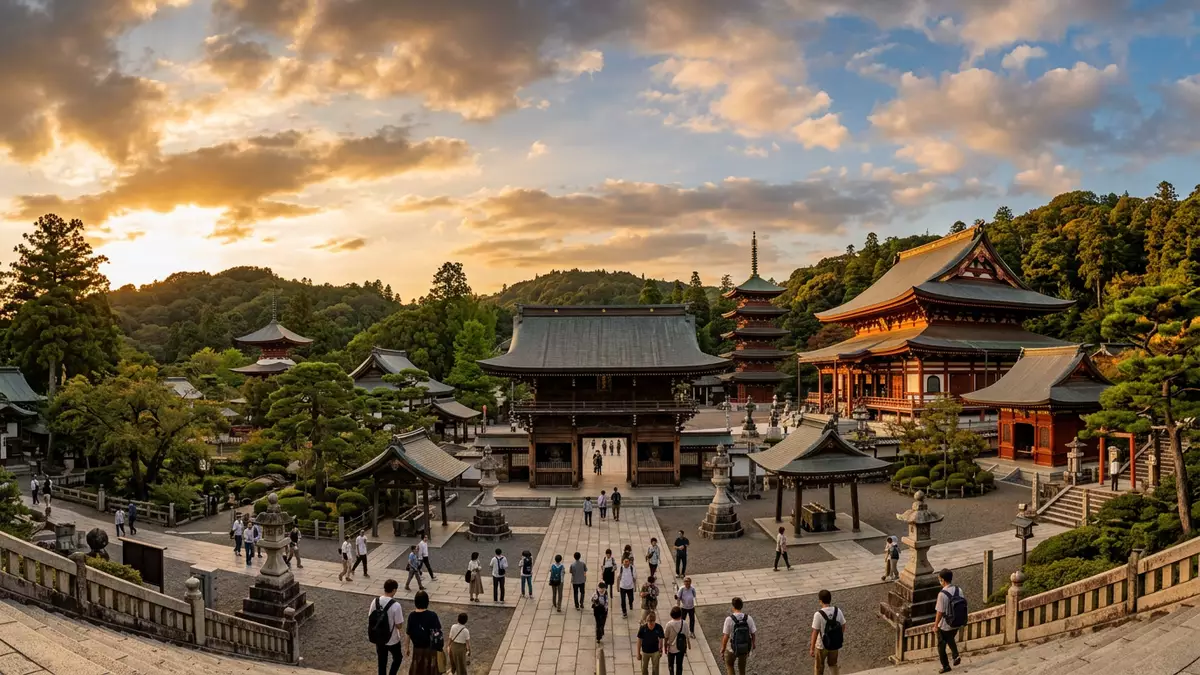
Naritasan Shinshoji in Narita, east of Tokyo, is a historic Shingon Buddhist temple complex that has grown over more than a millennium into a dense ensemble of halls, pagodas and wooded parkland. Founded in 940 during the Heian period and dedicated to the deity Fudo Myo-o, it forms a kind of self-contained temple city on the slope above Narita’s old approach street.Shingon Buddhist temple The complex is the head temple of the Chisan branch of Shingon Buddhism and remains one of the major religious centres in Chiba Prefecture.head temple of the Chisan school
Temple city: halls, pagodas and parkland on the hillside
The core of Naritasan Shinshoji is its main hall, dedicated to Fudo Myo-o, the fierce guardian deity whose image is central to the temple’s identity.Fudo Myo-o statue tradition Around it stand multiple worship halls, smaller shrines and gates, stepping up the slope in terraces linked by stairways and paths. Traditional wooden architecture with tiled roofs dominates these buildings, and many structures show details typical of Heian and later Japanese temple design, such as deep eaves and richly worked bracket complexes.
Beyond the cluster of main halls, Naritasan Shinshoji is marked by its pagodas. A three-storey pagoda built in 1712 stands among the older structures and is noted for its richly painted surfaces and tall finial rising above the roofline.three-storied pagoda from 1712 Further up the grounds, the Great Peace Pagoda, completed in 1984, introduces a more modern concrete structure with five levels, rising about 58 m (190 ft) and housing halls for sutra copying, Buddhist images and an upper observation space with views across the temple roofscape.Great Peace Pagoda completed in 1984 Behind and around these buildings spreads Naritasan Park, a landscaped area with ponds, bridges and walking paths that extend the temple city into a quieter wooded zone.
Heian origins and the Fudo Myo-o tradition
Naritasan Shinshoji is closely tied to the history of the Heian period and the spread of esoteric Buddhism in Japan. The temple is traditionally dated to the year 940, when the monk Kanch? Dais?j?, a disciple within the Shingon tradition, is recorded as founding the site and enshrining an image of Fudo Myo-o.founded in 940 by Kancho Daisojo This date places Naritasan Shinshoji among the older organised Buddhist centres in eastern Japan, reflecting political and religious developments of the tenth century.
The temple’s association with Fudo Myo-o, a wrathful protector figure in Shingon Buddhism, shapes its ritual life. Fire rituals known as goma, in which wooden sticks are burned as offerings, form a central practice at Naritasan Shinshoji and are held inside dedicated halls as part of prayers for protection and fulfilment of vows.goma fire ritual Over centuries, the temple complex has expanded with new buildings, pagodas and landscaped areas, turning what began as a single foundation into an extensive religious precinct layered with structures from different eras.
Naritasan Shinshoji in its urban and regional setting
Naritasan Shinshoji occupies a slope just above Narita’s historic Omotesando approach street, where traditional shops and restaurants line the route from the railway stations towards the temple gate.Narita Omotesando shopping street The complex lies in Narita City in Chiba Prefecture, a short rail journey from Narita International Airport, which has made the temple one of the first substantial historic sites accessible to travellers landing at the airport.Narita city location near the airport
Within the grounds, the terrain combines paved approaches, staircases and garden paths. The main halls stand on raised platforms reached by flights of steps, while the park area incorporates ponds, bridges and wooded slopes that give a sense of moving from dense built space into a more open landscape. Together, the architecture and planting create a sequence from urban street to gate, from gate to cluster of worship buildings, and finally from those buildings into the broader parkland that wraps around the Great Peace Pagoda.
Visiting Naritasan Shinshoji: what travellers from Western Europe should know
- Naritasan Shinshoji stands in Narita City in Chiba Prefecture, east of Tokyo, and is reached on foot from JR Narita Station or Keisei Narita Station on the rail lines serving Narita Airport.
- The temple complex occupies a hillside above the old approach street, with multiple staircases, terraces and paths; visits involve walking on uneven ground and climbing steps between the main halls and pagodas.
- Naritasan Park stretches behind the temple buildings with ponds, bridges and tree-lined paths, so exploring the grounds can mean spending extended time outdoors across both built and landscaped areas.
- The official language is Japanese and the currency is the Japanese yen.
- Entry requirements depend on your nationality; UK travellers can check the FCDO travel advice at gov.uk/foreign-travel-advice, Irish travellers the Department of Foreign Affairs at ireland.ie.
Searching for Naritasan Shinshoji on social platforms
These links open searches for Naritasan Shinshoji on each platform.
Frequently asked questions about Naritasan Shinshoji
Where is Naritasan Shinshoji located?
Naritasan Shinshoji is in Narita City in Chiba Prefecture, east of Tokyo, within walking distance of JR Narita Station and Keisei Narita Station on lines from Narita Airport.
What should visitors expect when exploring Naritasan Shinshoji?
Visitors encounter a large temple complex with multiple halls, traditional wooden architecture, pagodas and Naritasan Park, all spread across a hillside linked by staircases and paths.
What makes Naritasan Shinshoji distinctive among Japanese temples?
Its Heian-period foundation, role as head temple of the Chisan branch of Shingon Buddhism, prominent Fudo Myo-o worship and combination of historic halls, tall pagodas and extensive parkland give Naritasan Shinshoji a distinctive temple-city character.


