
Naritasan Shinshoji, a temple city on Narita’s hillside
Published on 08/16/2026 at 14:08 | Editorial responsibility: Rafael Müller, Editor-in-Chief AD HOC NEWS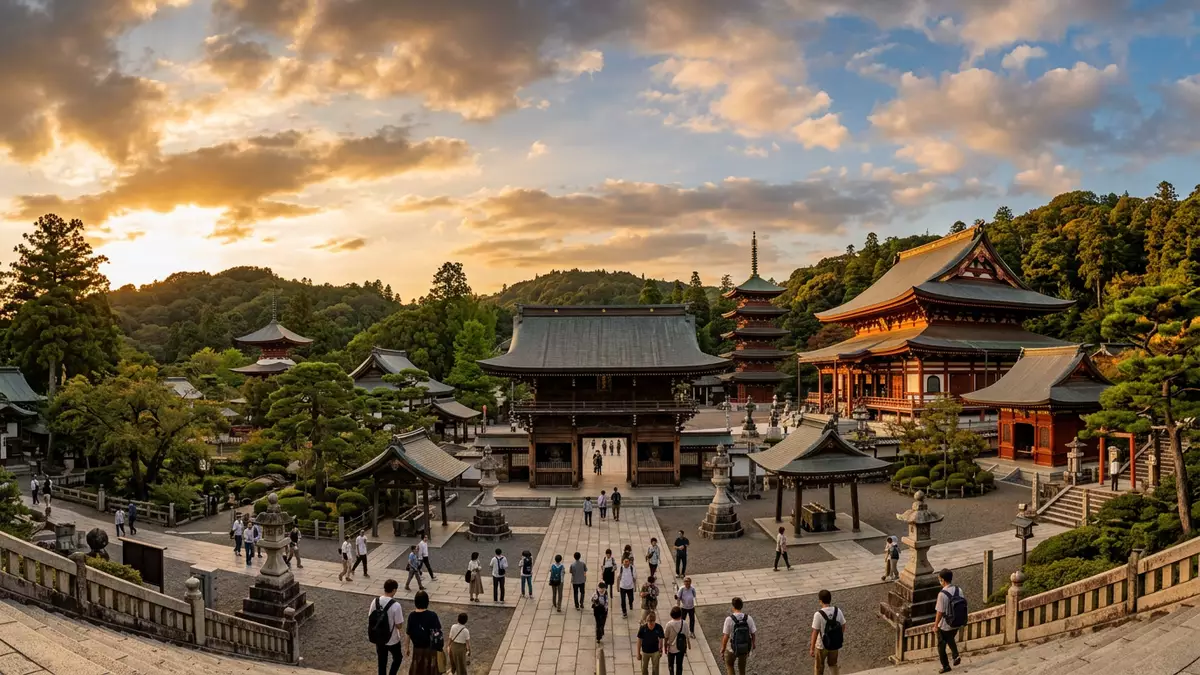
Naritasan Shinshoji is a vast Shingon Buddhist temple complex on a wooded slope in Narita, east of Tokyo, where historic halls and pagodas rise above a landscaped park. Founded in 940 AD during the Heian period, it has grown into the head temple of the Chisan branch of Shingon Buddhism and a major religious centre in Chiba Prefecture.Founded in 940 AD
A millennium-old temple complex dedicated to Fud? My?-?
The core identity of Naritasan Shinshoji is tied to the worship of Fud? My?-?, a fierce guardian deity central to Shingon Buddhism.Fud? My?-? is worshipped The temple was founded by the monk Kancho in 940 AD, and its history reaches back to the religious and political landscape of the Heian period.Founded by the monk Kancho Over the centuries Naritasan Shinshoji became the head temple of the Chisan school of Shingon Buddhism, a position that underlines its status within Japanese esoteric Buddhism.Head temple of the Chisan branch
The complex spreads across a hillside south of central Narita, with multiple halls, gates and pagodas arranged on terraces linked by stone staircases and paths. The main hall stands at the heart of the compound and houses the principal image of Fud? My?-?, while nearby structures include a three?storey pagoda dating from 1712 and other buildings designated as Cultural Properties of Japan.Three-storey pagoda from 1712 Together, these historic structures give the site a layered architectural character, combining Edo-period timber construction with later additions.
The Great Peace Pagoda and Narita-san Park
One of the most striking features of Naritasan Shinshoji is the Great Peace Pagoda, a large vermillion pagoda rising above the temple’s parkland. Completed in 1984 and standing about 58 m (190 ft) tall, it was built as a symbol of Shingon esoteric Buddhism and dominates the upper part of the complex.Great Peace Pagoda completed in 1984 Inside the pagoda are statues of Fud? My?-? and other guardians, along with Buddhist mandalas and collections of sutras that present Shingon teachings in visual form.Statues and mandalas in the pagoda
Below the halls and pagodas lies Narita-san Park, a landscaped garden that extends behind the main temple buildings. Paths wind around ponds, cascades and wooded slopes, offering views back towards the Great Peace Pagoda and the surrounding roofs.Narita-san Park behind the temple The park’s design combines water, planted banks and seasonal trees, creating a quieter counterpart to the stepped terraces of the religious precincts. From certain points, visitors can look up to see the pagoda rising above the treetops, emphasising the way the religious structures and garden form a single extended landscape.
Narita’s temple town and access from the airport
Naritasan Shinshoji is closely linked to Narita’s role as a temple town, with the approach street known as Narita Omotesando running from the railway stations towards the main gate.Omotesando approach from the stations Traditional shops, small eateries and wooden facades line this route, forming a corridor that connects the everyday fabric of Narita with the temple’s entrance. The main gate marks the transition from this commercial street to the stone-paved precincts of the temple complex, where religious structures and ritual spaces take over.
The temple stands in Narita City in Chiba Prefecture, not far from Narita International Airport, and is reached by the JR Narita Line and the Keisei Main Line.Located in Narita City, Chiba Prefecture From JR Narita Station or Keisei Narita Station, the route to the temple follows the Omotesando street and climbs gently towards the precincts, passing under signboards and over small inclines as the hillside setting becomes apparent.Short walk from Narita Station
Visiting Naritasan Shinshoji: what travellers from Western Europe should know
- Naritasan Shinshoji stands in Narita City in Chiba Prefecture, east of central Tokyo, and is reached on foot from JR Narita Station and Keisei Narita Station.
- The temple complex occupies a slope with multiple flights of stone steps and terraces, so movement between the main halls, pagodas and Narita-san Park involves repeated climbs and descents.
- Narita International Airport lies to the east of the city; rail connections on the JR Narita Line and the Keisei Main Line link the airport with Narita Station for onward travel to the temple on foot.
- The official language is Japanese and the currency is the yen.
Searching for Naritasan Shinshoji on social platforms
These links open searches for Naritasan Shinshoji on each platform.
Frequently asked questions about Naritasan Shinshoji
Where is Naritasan Shinshoji located?
Naritasan Shinshoji stands in Narita City in Chiba Prefecture, east of Tokyo, within reach of Narita International Airport by JR and Keisei railway lines.
What should visitors expect on a visit?
Visitors encounter a large temple complex with historic halls, pagodas, stone staircases and Narita-san Park, all connected by paths that climb the wooded hillside.
What makes Naritasan Shinshoji distinctive?
Its combination of a Heian-period foundation, dedication to Fud? My?-? and the prominent Great Peace Pagoda above a landscaped park gives Naritasan Shinshoji a distinctive temple-city character.


