
Naqsh-e Jahan: Safavid grandeur at the heart of Isfahan
Published on 09/04/2026 at 10:59 | Editorial responsibility: Rafael Müller, Editor-in-Chief AD HOC NEWS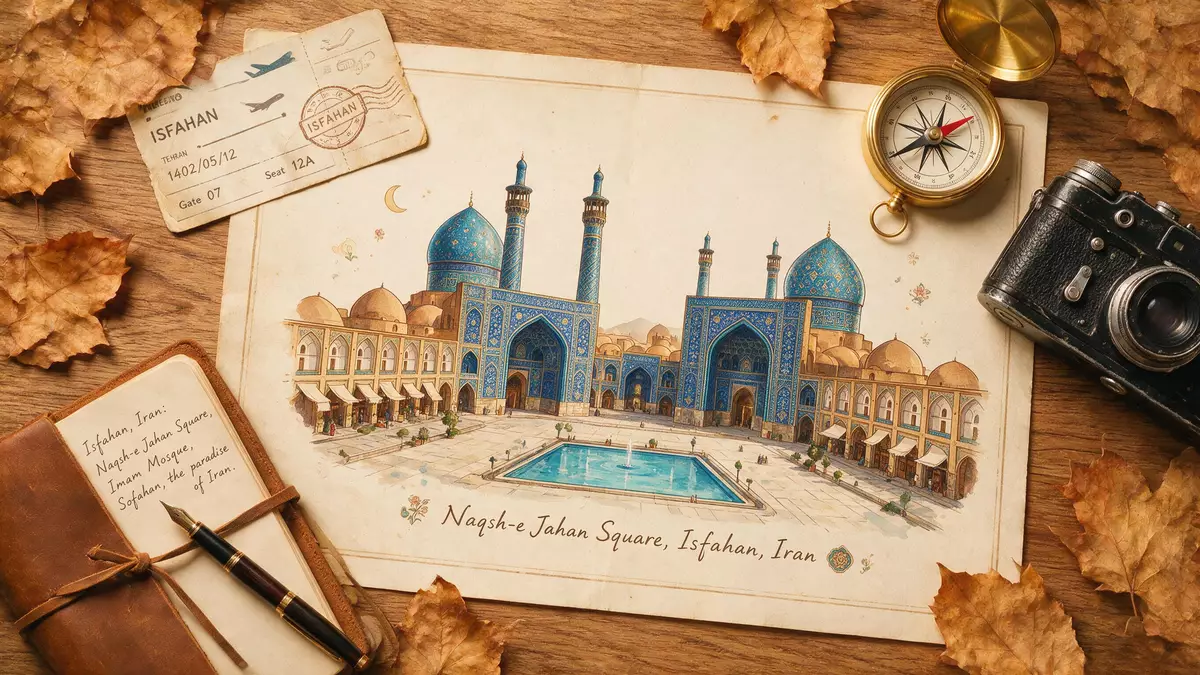
Naqsh-e Jahan in Isfahan is a vast Safavid-era square where imperial architecture, religion and commerce meet around one monumental urban space. Laid out under Shah Abbas I in the early seventeenth century, it forms the ceremonial core of the old Safavid capital and remains one of Iran’s most recognisable historic ensembles.
A Safavid square on an imperial scale
Naqsh-e Jahan Square occupies the centre of Isfahan, in the plateau of central Iran, on the traditional crossroads of north–south and east–west routes. The square is rectangular and immense, measuring about 560 m (1,837 ft) in length and 160 m (525 ft) in width, covering nearly nine hectares of open space framed by buildings.560 m by 160 m Its scale makes it one of the largest historic city squares in the world and a striking contrast to the denser traditional fabric of Iranian cities.immense public urban square
The square took shape during the reign of Shah Abbas I, the fifth ruler of the Safavid dynasty, as part of a wider programme of urban development in Isfahan. Construction is dated to the period between 1598 and 1629, when the court and administration were concentrated around this new ceremonial centre.constructed between 1598 and 1629 The ensemble is inscribed on the UNESCO World Heritage List under the name Meidan Emam, Esfahan, recognising its value as a masterpiece of Iranian and Islamic urban design.World Heritage inscription
Mosques, palace and bazaar around the perimeter
The defining experience of Naqsh-e Jahan is the way four major monuments anchor each side of the rectangle, turning the empty space into a carefully composed stage. On the southern side stands the Shah Mosque, also known as the Imam Mosque, a large congregational mosque with an entrance aligned to the square and a prayer hall behind. On the eastern side, the smaller Sheikh Lotfollah Mosque presents a more intimate, courtly place of worship, distinguished by its domed profile and rich tilework.Shah Mosque and Sheikh Lotfollah Mosque
Opposite the Shah Mosque on the western side rises the Ali Qapu Palace, a multi-storey pavilion that served as the royal residence and viewing platform over the square. Its elevated terrace allowed the Safavid court to look out across ceremonies and entertainments set in the open space below. To the north, the Qeysarieh Gate marks the entrance into Isfahan’s Grand Bazaar, linking the square directly to a dense network of commercial lanes and caravanserais.Ali Qapu Palace and Qeysarieh Portal Surrounding the square itself, two-storey arcades run continuously along the edges, housing rows of shops behind repetitive arches and niches in the Safavid style.two-storey row of shops
Names, decoration and life of the square
Naqsh-e Jahan means “image of the world” in Persian, an evocative title for a square that gathers religious, royal and commercial functions in one space.meaning of Naqsh-e Jahan Over its history it has carried several official names. Under the Safavids it was widely known as Shah Square or the Royal Square, while after the Iranian Revolution of 1979 its designation changed to Imam Square, the form used in the UNESCO listing of Meidan Emam.former and current names The different labels all refer to the same physical place in the centre of Isfahan.
The square itself is more than an expanse of paving. Historical descriptions and surviving features show a central garden with a large pool, set within the open area, reflecting the facades and domes around it.yard with a large pool The elevations of the surrounding buildings are richly decorated with glazed tiles, carved stone and painted surfaces, displaying patterns and calligraphy characteristic of Safavid art. The continuous arcades create a rhythmic backdrop of arches, while the mosques and palace rise above them to form a layered skyline of domes and minarets. The combination of open ground, water, greenery and built edges gives the square a balanced composition that can be appreciated from many points within the enclosure.
Visiting Naqsh-e Jahan: what travellers from Western Europe should know
- Naqsh-e Jahan lies in central Isfahan, which is connected to other Iranian cities by road and rail; the square can be reached on foot from the historic centre.
- The interior of the square is level, but access to monuments such as Ali Qapu Palace and the mosques involves staircases and steps typical of historic buildings.
- The surrounding bazaar arcades contain numerous craft and souvenir workshops, so walking the perimeter involves passing through covered passages lined with small shops.
- The official language is Persian and the currency is the Iranian rial.
- Entry requirements depend on your nationality; UK travellers can check the FCDO travel advice at gov.uk/foreign-travel-advice, Irish travellers the Department of Foreign Affairs at ireland.ie.
Searching for Naqsh-e Jahan on social platforms
These links open searches for Naqsh-e Jahan on each platform.
Frequently asked questions about Naqsh-e Jahan
Where is Naqsh-e Jahan located?
Naqsh-e Jahan is a large historic square in the centre of Isfahan, a major city in central Iran standing at the meeting point of important inland routes.
What can visitors expect when they enter the square?
Visitors encounter an expansive rectangular space with a central garden and pool, framed by continuous arcades and dominated by the Shah Mosque, Sheikh Lotfollah Mosque, Ali Qapu Palace and the bazaar gate.
What makes Naqsh-e Jahan distinctive among city squares?
Its vast dimensions, Safavid-period setting and the way royal, religious and commercial buildings encircle a single open square give Naqsh-e Jahan a character that is closely tied to the history of Isfahan as a capital.


