
Naqsh-e Jahan and the Safavid square in Isfahan
Published on 09/14/2026 at 11:01 | Editorial responsibility: Rafael Müller, Editor-in-Chief AD HOC NEWS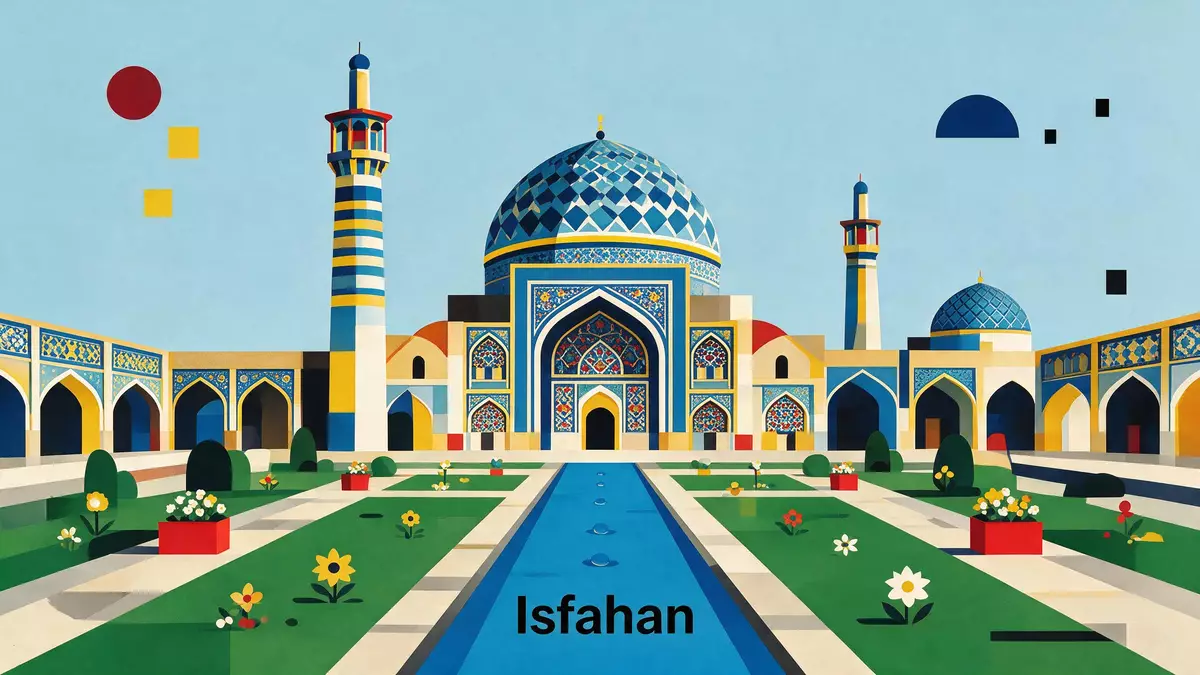
Naqsh-e Jahan in Isfahan is a large Safavid city square, framed by arcades, mosques, a palace and bazaar fronts. Its formal UNESCO name, Meidan Emam, Esfahan, links it to the World Heritage List and to the reign of Shah Abbas I.
The Safavid square at the centre of Isfahan
The square belongs to the early seventeenth-century expansion of Isfahan under the Safavids, when the city became a political and ceremonial capital. Its broad rectangular form is one of its most striking features, and the open centre is enclosed by a continuous urban edge.
The whole ensemble is closely associated with Shah Abbas I, and its layout brings together court, worship and commerce in a single civic setting. The place was inscribed in 1979 under the official designation Meidan Emam, Esfahan, and the listing presents it as a major example of Safavid urban design.Safavid city square
Monuments around the open centre
Four major monuments define the edges of Naqsh-e Jahan: Ali Qapu Palace on the west, Sheikh Lotfollah Mosque on the east, the Shah Mosque on the south and the Qaysariyyah Bazaar gate on the north. Two-storey arcades run around the square, linking the monuments and the shops beneath them.four major monuments
That arrangement makes the square feel like a composed urban frame rather than a detached monument. The bazaar edge, the royal palace and the mosques remain legible as separate parts, yet they read together as one ensemble.one ensemble
A Safavid public setting in stone and tile
Naqsh-e Jahan is closely identified with Safavid patronage, tilework and formal urban planning. The square’s name, “Image of the World”, has long travelled with it, and the buildings around it preserve a strong imperial and ceremonial character.
The ensemble combines palace architecture, mosque architecture and the commercial edge of the bazaar. That mixture gives the place its lasting interest: it is a city square, but also a clear record of how power, worship and trade were arranged in Isfahan under Shah Abbas I.Safavid patronage
Visiting Naqsh-e Jahan: what travellers from Western Europe should know
- Naqsh-e Jahan lies in central Isfahan, and the square is reached through the city streets that lead to its arcades and surrounding monuments.
- The open centre is level and broad, while the surrounding buildings rise in layers of façade, domes and gateways.
- The official language is Persian and the currency is the Iranian rial.
- Entry requirements depend on your nationality; UK travellers can check the FCDO travel advice at gov.uk/foreign-travel-advice, Irish travellers the Department of Foreign Affairs at ireland.ie.
Searching for Naqsh-e Jahan on social platforms
These links open searches for Naqsh-e Jahan on each platform.
Frequently asked questions about Naqsh-e Jahan
Where is Naqsh-e Jahan?
It stands in Isfahan, in central Iran, as the city’s best-known Safavid square. The ensemble is identified by the UNESCO name Meidan Emam, Esfahan.
What does a visit show?
It shows a large open square ringed by arcades, religious buildings, a palace and the bazaar gate. The parts remain distinct, but they are arranged as a single urban composition.
What makes it distinctive?
The combination of royal, religious and commercial buildings around one open centre is the defining feature. Shah Abbas I, Safavid patronage and the 1979 UNESCO inscription belong to its historical identity.


