
Naqsh-e Jahan and the monumental square of Isfahan
Published on 09/23/2026 at 10:04 | Editorial responsibility: Rafael Müller, Editor-in-Chief AD HOC NEWS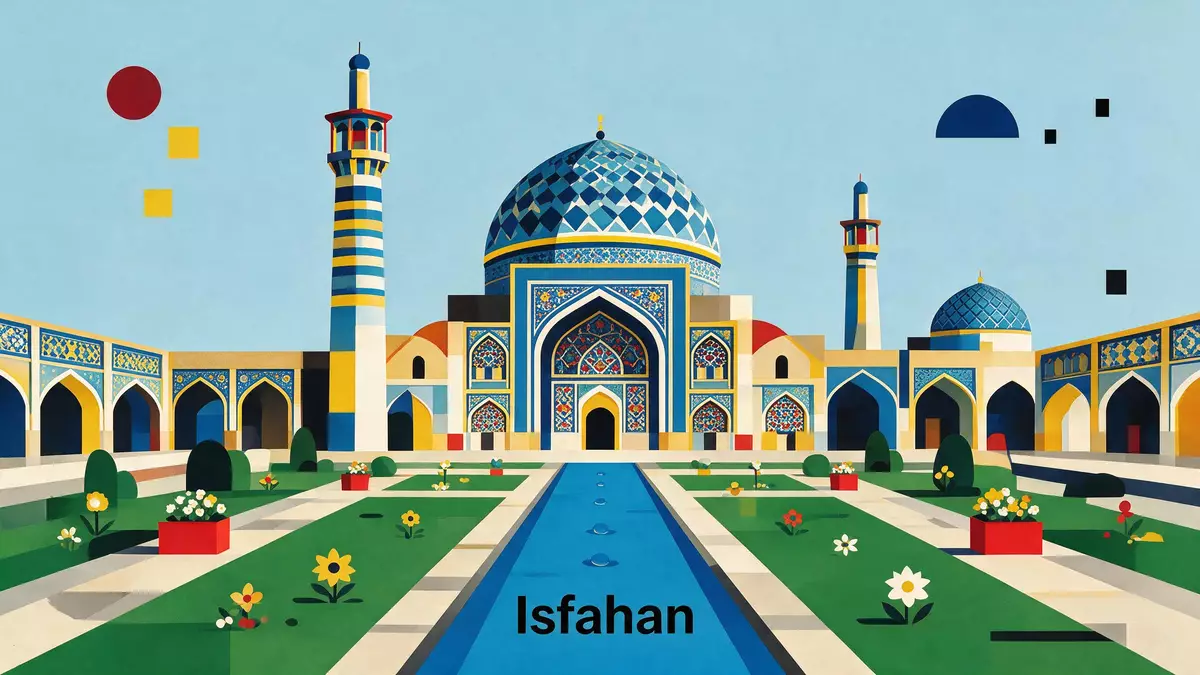
Naqsh-e Jahan is a vast rectangular square at the centre of Isfahan, framed by arcades and four major Safavid monuments. Its open expanse measures 560 m (1,837 ft) from north to south and 160 m (525 ft) across, giving the city an architectural centre on an urban scale.
Laid out under Shah Abbas I between 1598 and 1629, the square brings a mosque, palace, bazaar gateway and second mosque into one composition. The UNESCO World Heritage property is formally known as Meidan Emam, Esfahan.
Naqsh-e Jahan: a rectangle framed by Safavid architecture
The proportions are the first fact to register. Naqsh-e Jahan extends much farther along its length than across its width, while two-storey arcades create a continuous built edge around the central space. Shops occupy the arcade fronts, joining commerce to the monumental setting.
The square belongs to the Safavid period, when Isfahan served as the dynasty’s capital. UNESCO’s Meidan Emam listing identifies Shah Abbas I as its builder and records the ensemble’s early seventeenth-century character.
Four sides, four architectural landmarks
The southern side is occupied by the Imam Mosque, also known as the Shah Mosque. Its entrance portal faces the square, while the mosque extends beyond the portal into a complex of courtyards, domes and tiled prayer spaces.
Sheikh Lotfollah Mosque stands on the eastern side. Across the square, Ali Qapu Palace rises above the western arcade with its elevated terrace. At the northern end, Qeysarieh Gate opens towards Isfahan’s covered bazaar. The four buildings give each side a distinct architectural identity.
Blue, turquoise and other coloured tiles cover important surfaces across the ensemble. Calligraphic bands, geometric patterns and vegetal designs appear on portals, domes and walls. The materials and ornament belong to the visual language of Safavid Iranian and Islamic architecture.
From royal square to historic urban ensemble
Naqsh-e Jahan served as a public urban space within the Safavid capital. Its broad surface accommodated markets, ceremonial activity and polo, while the surrounding buildings connected royal, religious and commercial functions.
The name Naqsh-e Jahan means “Image of the World”. Earlier names included Shah Square and Imam Square, while Meidan Emam, Esfahan is the designation used for the World Heritage property. Safavid Isfahan’s urban history places the square within a wider programme of palaces, promenades, markets and religious buildings.
The square entered the UNESCO World Heritage List in 1979. Its significance lies in the relationship between the immense open rectangle, the arcades and the buildings placed at its four sides. Isfahan’s Safavid monuments include Naqsh-e Jahan among the city’s principal architectural achievements.
Visiting Naqsh-e Jahan: what travellers from Western Europe should know
- Naqsh-e Jahan lies in central Isfahan, with the Imam Mosque to the south and Qeysarieh Gate leading towards the Grand Bazaar on the north side.
- The square is a large paved urban space. Its long rectangular plan involves substantial walking between the four principal monuments and along the surrounding arcades.
- Isfahan’s official language is Persian and its national currency is the Iranian rial.
- Nearby landmarks include the Grand Bazaar, Ali Qapu Palace and Sheikh Lotfollah Mosque, all forming part of the square’s historic setting.
Searching for Naqsh-e Jahan on social platforms
These links open searches for Naqsh-e Jahan on each platform.
Frequently asked questions about Naqsh-e Jahan
Where is Naqsh-e Jahan?
Naqsh-e Jahan is in central Isfahan, Iran. The square forms the principal historic urban ensemble around the Imam Mosque, Ali Qapu Palace, Sheikh Lotfollah Mosque and Qeysarieh Gate.
What can visitors expect at the square?
Visitors find a broad rectangular space, two-storey arcades, tiled monuments, shops and access towards the Grand Bazaar. The four principal buildings stand on the square’s southern, western, eastern and northern sides.
What makes Naqsh-e Jahan distinctive?
Its distinctive feature is the combination of immense scale and concentrated architecture. A 560 m by 160 m Safavid square joins royal, religious and commercial landmarks within one continuous urban composition.


