
Naos tou Olympiou Dios in Athen: marble columns against the Attic sky
Published on 08/21/2026 at 12:17 | Editorial responsibility: Rafael Müller, Editor-in-Chief AD HOC NEWS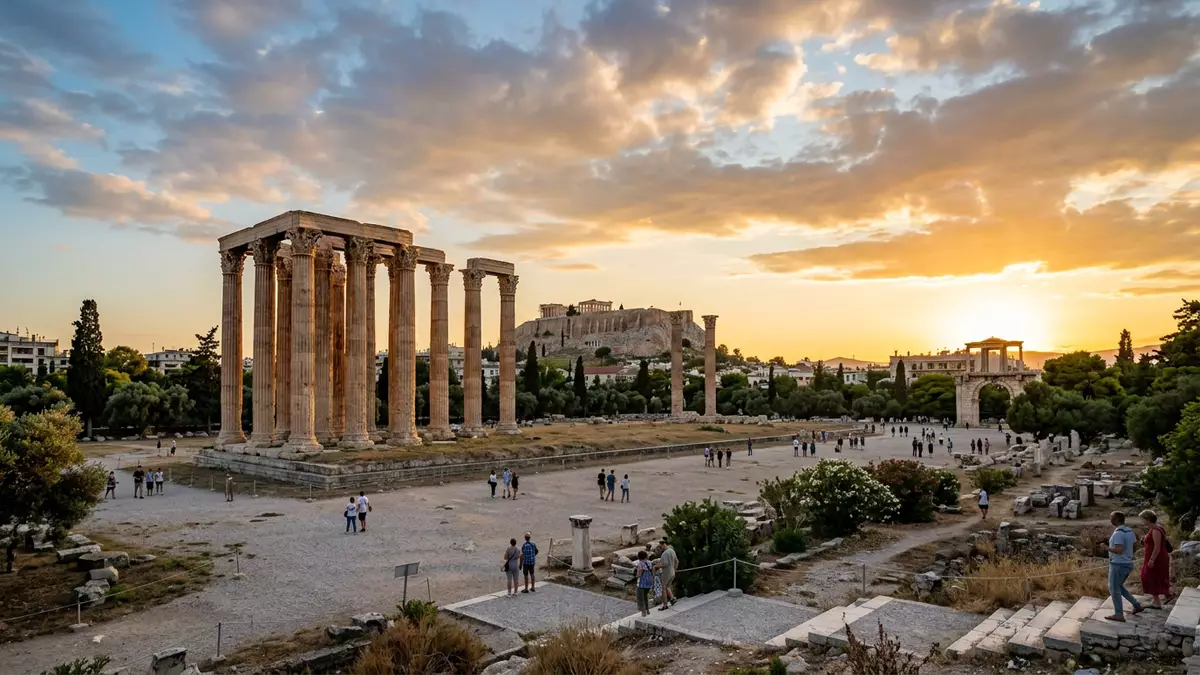
Naos tou Olympiou Dios, known in English as the Temple of Olympian Zeus, is a vast open sanctuary in Athen where marble columns stand in a broad rectangle against the Attic sky. Rising between the Acropolis rock and the course of the Ilissos river, the ruin preserves a fragment of one of the grandest Corinthian temples of the ancient Mediterranean.
A colossal Corinthian temple in central Athen
The temple of Naos tou Olympiou Dios occupies a large walled enclosure in central Athen, south-east of the Acropolis and roughly south of Syntagma Square, on ground that slopes gently towards the Ilissos river.Temple of Olympian Zeus, Athens Within this enclosure the surviving columns mark the footprint of a peripteral temple, ringed by an outer colonnade and raised on a platform above the surrounding level.
Construction of the Temple of Olympian Zeus extended over many centuries: building began in the sixth century BC under the Peisistratid tyrants and was only completed in the early second century AD under the Roman emperor Hadrian.built over several centuries The completed temple rose in the Corinthian order, with tall fluted columns and capitals carved with acanthus leaves, creating a regular forest of stone within sight of the Acropolis.Corinthian plan
Marble columns and the scale of the Olympieion
Naos tou Olympiou Dios became one of the largest temples in the Greek world of its period, with a full colonnade of over a hundred columns ringing its cella.largest temple in ancient Greece during the Roman period These columns stood in evenly spaced rows along the long sides and narrower fronts, framing the inner sanctuary on all four sides and extending over a platform more than 100 m (328 ft) in length.colossal platform dimensions
The material of the later phases was Pentelic marble, the same pale stone used for the Parthenon, cut into monolithic shafts that rise to around 17 m (55 ft).height of columns Of the original colonnade more than fifteen columns remain standing, with another lying fallen in a row, its drums exposed like a stone staircase along the ground.columns that still stand The gaps between them reveal the surrounding city and the distant hills, giving visitors a sense of both the original enclosure and the scale of what has been lost.
Sanctuary setting between Acropolis and Ilissos
The Olympieion precinct lies in a broad flat area between the southern flank of the Acropolis and the Ilissos river, in a part of Athen that once formed a religious landscape of shrines and processional ways.sanctuary of Olympian Zeus From many points inside the enclosure the view back towards the Acropolis frames the temple columns against the limestone rock and the outline of the Parthenon, visually linking the sanctuary of Zeus with the civic and cult centre of classical Athen.location relative to Acropolis
The broad space around Naos tou Olympiou Dios makes its scale legible in a way that is different from more crowded urban ruins. The outer wall defines a rectangle of ground where the marble bases, fragments of columns and scattered architectural blocks lie exposed on low grass and earth. Beyond the enclosure, major streets and the parkland around the Zappeion run nearby, but inside the precinct the dominant elements remain stone, sky and the long perspectives between the surviving columns.
Visiting Naos tou Olympiou Dios: what travellers from Western Europe should know
- Naos tou Olympiou Dios stands in central Athen south-east of the Acropolis and roughly south of Syntagma Square, close to major streets and within walking distance of the Acropolis Museum.
- The sanctuary occupies an open, largely level enclosure where the ground is a mix of earth and short grass, with low remains and column bases that require attention when walking.
- The site lies between the Acropolis and the course of the Ilissos river, with nearby parkland around the Zappeion offering further walking routes through trees and open spaces.
- The official language is Greek and the currency is the euro.
Searching for Naos tou Olympiou Dios on social platforms
These links open searches for Naos tou Olympiou Dios on each platform.
Frequently asked questions about Naos tou Olympiou Dios
Where is Naos tou Olympiou Dios located in Athen?
Naos tou Olympiou Dios stands in central Athen south-east of the Acropolis and roughly south of Syntagma Square, near the former course of the Ilissos river.
What can visitors expect when entering the sanctuary?
Visitors enter a broad open precinct with surviving marble columns, scattered architectural fragments and long views towards the Acropolis and surrounding city streets.
What makes Naos tou Olympiou Dios distinctive among ancient sites?
The temple’s Corinthian marble columns, its multi-century construction ending under Hadrian and its setting between the Acropolis and Ilissos river give the Olympieion a distinctive character in Athen.


