
Naos tou Olympiou Dios and the marble columns of Athen
Published on 09/12/2026 at 20:52 | Editorial responsibility: Rafael Müller, Editor-in-Chief AD HOC NEWS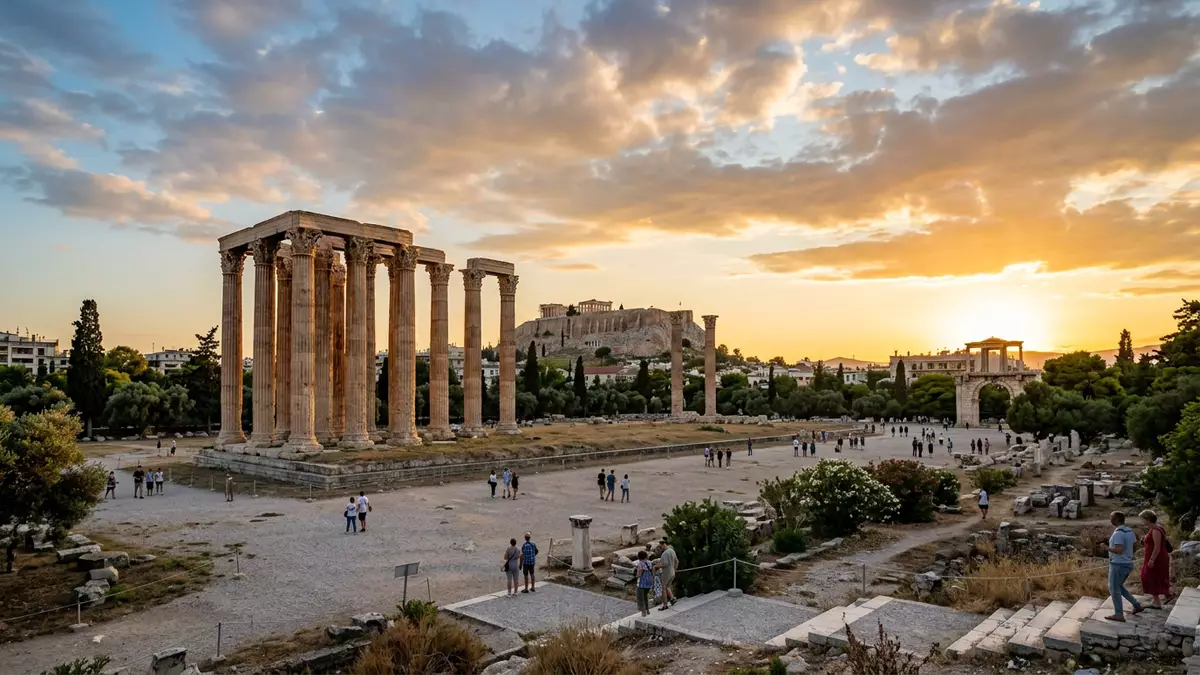
Naos tou Olympiou Dios in Athen is a ruined temple of Olympian Zeus with marble columns standing in an open precinct. Its name, form and setting make it one of the clearest surviving fragments of imperial Athens.
Hadrian's temple in central Athen
The monument is better known in English as the Temple of Olympian Zeus, and it lies south-east of the Acropolis in central Athen. Construction began in the sixth century BC and was completed under Hadrian in AD 131 or 132Temple of Olympian Zeus.
The temple belongs to the Corinthian order in its final form, and the precinct preserves the scale of a large sanctuary rather than a compact shrine. Classical Athens, Hellenistic intervention and Roman completion are all visible in its history, even though the building itself survives only in partfinal form.
The surviving colonnade and open precinct
The main impression is made by the standing columns, set apart in a broad enclosure of open ground. Their height and spacing give the ruin a measured rhythm, while the fallen stone nearby shows how much of the structure has gone.
The site reads as architecture in the plural: columns, platform, enclosure and fragments rather than a single intact hall. The remaining fabric belongs to a sanctuary that once held a colossal cult statue of Zeus, with Hadrian honoured beside the godcult statue of Zeus.
From ancient sanctuary to Roman monument
The temple was linked to a long religious landscape, and the later Roman phase left the strongest physical impression. Hadrian's completion brought a new monumental order to a site that had already been a place of worship for centuriesplace of worship.
That layered history matters because the temple is not a single-period creation. It is a ruin with an identifiable imperial finish, an earlier Greek foundation and a long life as part of the civic landscape of Athenimperial finish.
Visiting Naos tou Olympiou Dios: what travellers from Western Europe should know
- The site lies south-east of the Acropolis and south of Syntagma Square, in the centre of Athen. Akropoli station on the metro serves the area.
- The terrain is open and exposed, with broad paths between the columns and the surrounding enclosure. The ruin is read at ground level, with no enclosed interior to cross.
- The nearest major reference points are the Acropolis and the course of the Ilissos river. The temple stands within a dense archaeological district of central Athen.
- The country is Greece and the official language is Greek and the currency is the euro.
Searching for Naos tou Olympiou Dios on social platforms
These links open searches for Naos tou Olympiou Dios on each platform.
Frequently asked questions about Naos tou Olympiou Dios
Where is Naos tou Olympiou Dios?
It stands in central Athen, south-east of the Acropolis and near the route of the Ilissos river. The site is easy to place within the city's archaeological core.
What does a visit involve?
The visit is mainly an encounter with ruins in the open air. The columns, enclosure and surviving masonry are the essential features.
What makes it distinctive?
The combination of Greek beginnings, Roman completion and the surviving Corinthian columns gives the temple its character. Hadrian's role is part of the monument's identity.


